Facts
The petitioners were successful bidders for several water supply contracts under the "Jal Jeevan Mission".
Source reference: p. 19, para. 4Following the issuance of work orders, the respondent authorities alleged that technical experience certificates submitted by the petitioners (purportedly issued by Municipal Council, Karad) were fake.
Source reference: p. 19, para. 4; p. 25, para. 10In an earlier round of litigation (WPC No. 1263/2025), the High Court quashed initial show-cause notices due to pre-determination but granted the State liberty to take a fresh decision.
Source reference: p. 20, para. 5; p. 26, para. 10Consequently, the Apex Committee of the State Water and Sanitation Mission held a meeting on 02.12.2025, after providing a personal hearing to the petitioners.
Source reference: p. 21-22, para. 7The Committee decided to maintain the cancellation of the contracts and blacklisted the petitioners for three years.
Source reference: p. 21-22, para. 7The petitioners challenged this decision, claiming they relied in good faith on certificates provided by their joint-venture partner (Respondent No. 6) and that substantial work (~70%) was already completed.
Source reference: p. 22-23, para. 7-8Issues
Whether the respondent authorities violated the principles of natural justice while reaching the impugned decision dated 02.12.2025.
Source reference: p. 37-38, para. 20-21Whether the termination of the contract and the subsequent NIT for balance work were legally sustainable given the dispute over the genuineness of the experience certificates.
Source reference: p. 38, para. 22Whether the imposition of a three-year blacklisting was proportionate and valid in the absence of a conclusive finding of deliberate fraud by the petitioners.
Source reference: p. 39-41, para. 23-28Law Applied
The court applied Article 226 of the Constitution of India regarding the scope of judicial review in contractual matters.
Source reference: p. 42, para. 29It relied on the principle that submission of forged documents in public procurement strikes at the root of the bidding process and vitiates the contract.
Source reference: p. 38, para. 22For blacklisting, the court applied the "Proportionality Test" and "Reasoned Decision-Making" doctrine.
Source reference: p. 39-40, para. 23-25It heavily cited *Gorkha Security Services v. Government (NCT of Delhi)* (2014) 9 SCC 105, which characterizes blacklisting as "civil death".
Source reference: p. 41, para. 26It heavily cited *UMC Technologies Pvt. Ltd. v. Food Corporation of India* (2021) 2 SCC 551, which mandates that blacklisting must be preceded by an unambiguous show-cause notice and must not be arbitrary.
Source reference: p. 41-42, para. 27Reasoning
The Court found that procedural fairness was maintained as the petitioners were granted a personal hearing on 28.11.2025.
Source reference: p. 38, para. 21Regarding the contract termination, the Court held that since the petitioners gained technical qualification based on a certificate that the alleged issuing authority (Municipal Council, Karad) denied issuing, the employer was justified in cancelling the agreement to protect the sanctity of the tender process.
Source reference: p. 38-39, para. 22However, the Court distinguished between a bidder’s intentional forgery and a situation where a bidder relies on a document from a third party (Respondent No. 6) that is later found defective.
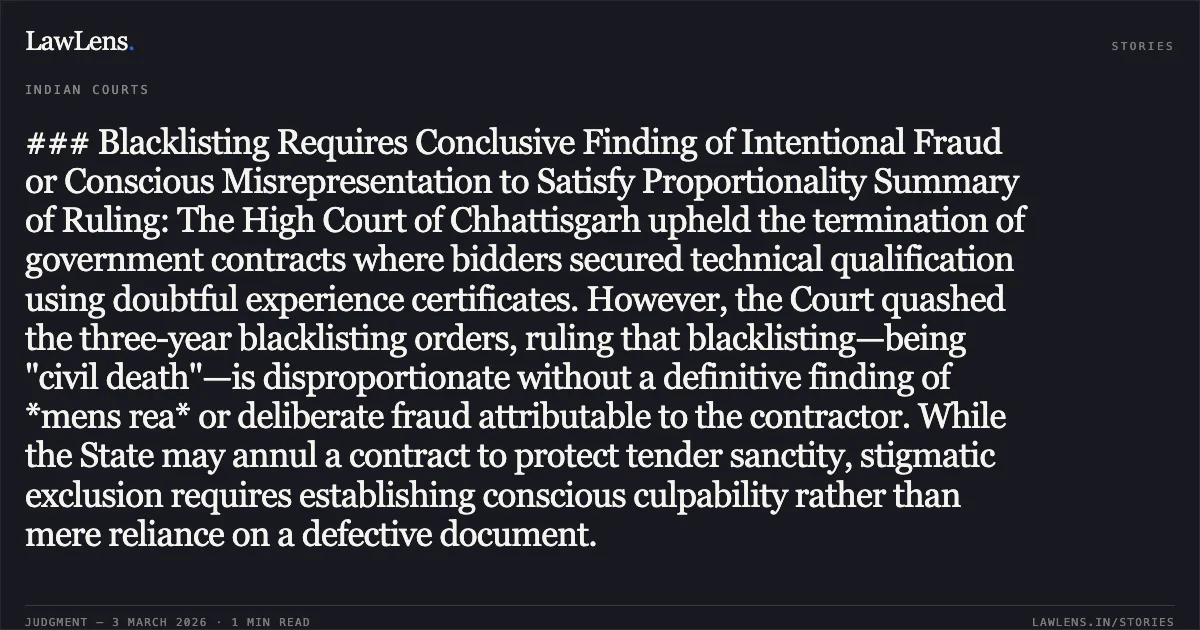
Source reference: p. 40, para. 24The Court noted that the Apex Committee failed to record a definitive finding of mens rea (deliberate intent to defraud) on the part of the petitioners.
Source reference: p. 40, para. 25Consequently, while the contract cancellation was an adequate measure to neutralize the advantage of a doubtful certificate, the additional penalty of a three-year debarment was deemed disproportionate and lacked the necessary foundation of established culpability.
Source reference: p. 41, para. 25Holding
The Court partly allowed the writ petitions.
It upheld the respondents' decision to annul the contracts and proceed with re-tendering.
Source reference: p. 42, para. 28However, it set aside the order blacklisting the petitioners for three years, holding it to be disproportionate in the absence of a conclusive finding of deliberate fraud.
Source reference: p. 42, para. 28Regarding disputes over payment for work done and measurement, the Court directed the petitioners to invoke the specific dispute-resolution/arbitration mechanism or approach a Civil Court, as these involved factual determinations beyond the scope of Article 226.
Source reference: p. 42-43, para. 29Acts & Sections Cited
4 provisions across 1 statute referred to in this judgment. Each provision opens on LawLens.
Indian Penal Code, 18604
Original Court PDF
M/s A.K. Construction & Ors. v. State of Chhattisgarh & Ors. 2026:CGHC:10481-DB
Click to open original judgment
Original judgment, available to read, download and summarize on LawLens.in