Facts
The appellant/complainant filed a complaint under Sections 138/141 of the Negotiable Instruments Act (NI Act) alleging that the respondents (a partnership firm and its partners) issued a cheque for ₹1,89,363.54 to discharge liabilities for medical supplies
Source reference: p. 2The cheque was returned for "insufficiency of funds" on April 25, 1995, and the respondents failed to pay despite receiving a demand notice
Source reference: p. 2The trial court initially acquitted the accused, but the High Court remanded the matter for fresh trial in 2006
Source reference: p. 3Upon remand, the Metropolitan Magistrate again acquitted the respondents, holding that the complainant failed to prove a final settlement of accounts and that a blank "security" cheque was unilaterally filled by the complainant
Source reference: p. 9The appellant challenged this second acquittal
Source reference: p. 3Issues
1. Whether the trial court’s judgment of acquittal was perverse for failing to apply the statutory presumption under Section 139 of the NI Act regarding blank signed cheques
Source reference: p. 8 / para. 102. Whether the complaint was maintainable given the challenges to the authority of the complainant’s representative and the non-impleadment of the firm at specific stages
Source reference: p. 13 / para. 143. Whether the 30-year delay in litigation is a valid ground for upholding an acquittal despite evidence of the offense
Source reference: p. 14 / para. 15Law Applied
The Court applied Section 138 (dishonour of cheque) and Section 139 (presumption in favour of holder) of the Negotiable Instruments Act, 1881
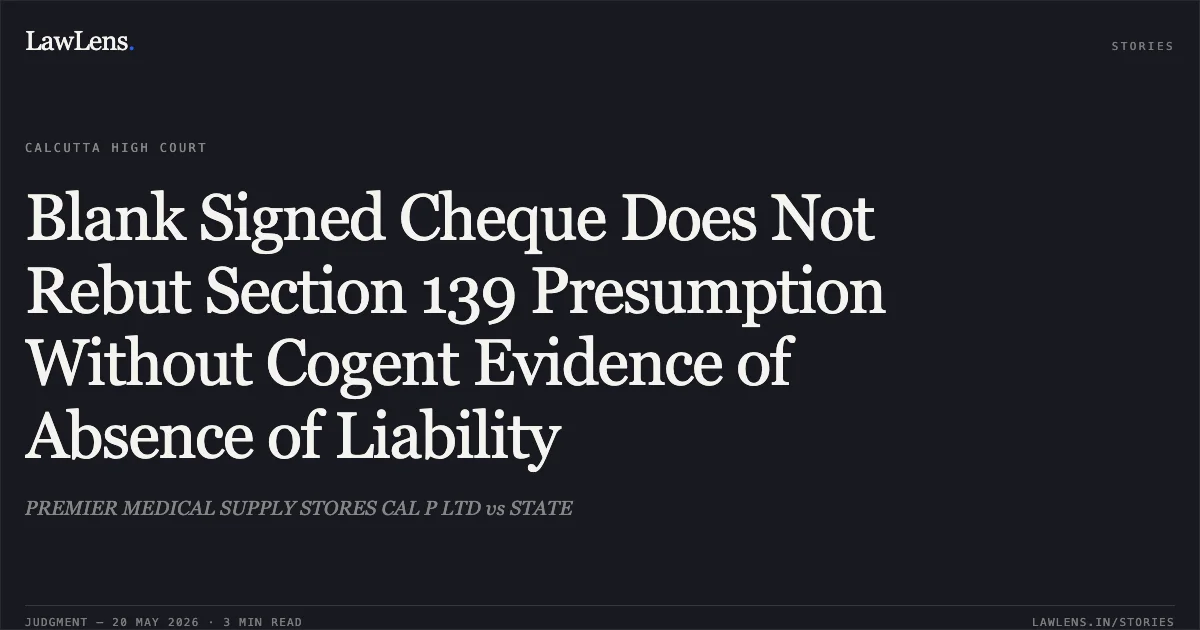
Source reference: p. 9It relied on Bir Singh v. Mukesh Kumar, establishing that a signed blank cheque voluntarily handed over attracts the presumption of a legally enforceable debt regardless of who filled in the details
Source reference: p. 10It applied the principle from Aneeta Hada v. Godfather Travels and Tours Pvt Ltd regarding the vicarious liability of directors/partners
Source reference: p. 4It applied the principle from Dhanasingh Prabhu v. Chandrasekar, which clarifies that partners can be prosecuted even if the firm is not separately impleaded
Source reference: p. 13Regarding appellate interference, it cited Dhanpal v. State, emphasizing that an acquittal can be overturned if the trial court's view is "perverse"
Source reference: p. 6Reasoning
The High Court found the trial court’s reasoning—that the absence of a "final settlement" negated the debt—to be perverse
Source reference: p. 10The Court observed that the respondents admitted to issuing the cheque and signing it, which automatically triggered the Section 139 presumption
Source reference: p. 12Under the Bir Singh precedent, the onus shifted to the accused to provide cogent evidence that no debt existed; mere claims that the cheque was for "security" or was "blank" were insufficient as a matter of law
Source reference: p. 11-12Regarding authorization, the Court noted that a previous High Court order in the same litigation had already established the complainant's competency to file the case, making the trial court's hesitation on this point erroneous
Source reference: p. 13-14Finally, the Court rejected the respondent's argument that the 30-year delay necessitated acquittal, ruling that while speedy trial is vital, delay cannot allow an admitted liability to be ignored when the trial court's findings are legally unsustainable
Source reference: p. 18Holding
The Court answered the issues in the affirmative, finding the acquittal perverse
The High Court allowed the appeal, set aside the order of acquittal, and convicted the respondents under Section 138 of the NI Act, sentencing the respondents to pay a fine of ₹3,00,000 as compensation with a default sentence of 3 months' simple imprisonment
Source reference: p. 18Acts & Sections Cited
7 provisions across 2 statutes referred to in this judgment. Each provision opens on LawLens.
Code of Criminal Procedure, 19732
Negotiable Instruments Act, 18815
Original Court PDF
PREMIER MEDICAL SUPPLY STORES CAL P LTDvsSTATE
Click to open original judgment
Original judgment, available to read, download and summarize on LawLens.in