Facts
The petitioners sought quashing under Section 528 of the Bharatiya Nagarik Suraksha Sanhita, 2023, of FIR No. 82/2025, registered under Sections 109(1)/3(5) of the Bharatiya Nyaya Sanhita, 2023 and Section 27 of the Arms Act, 1959, and the proceedings arising from it.
Source reference: para. 1The FIR alleged that, during a quarrel between former neighbours, petitioner no. 1 attacked respondent no. 2 with a stick and petitioner no. 2 shot him in the thigh.
Source reference: paras. 7.1–7.5A chargesheet was filed on 26 April 2025.
Source reference: para. 2During the proceedings, the parties settled the dispute; respondent no. 2 stated that the settlement was voluntary and that he did not wish to pursue the case.
Source reference: paras. 9–11, 17Issues
1. Whether the High Court could quash proceedings involving non-compoundable offences under Section 528 BNSS on the basis of a voluntary settlement between the parties.
Source reference: paras. 14–172. Whether, in the circumstances, continuing the prosecution would amount to an abuse of the process of law.
Source reference: paras. 12–13, 17Law Applied
Section 528 BNSS, corresponding to Section 482 CrPC, preserves the High Court’s inherent power to quash criminal proceedings to secure the ends of justice or prevent abuse of process.
Source reference: paras. 1, 14–15That power may be exercised in appropriate cases involving non-compoundable offences where the parties have genuinely settled, the settlement is voluntary, and quashing would not adversely affect an overriding public interest; the likelihood of conviction and the nature of the dispute are relevant considerations.
Source reference: paras. 14–15, 17The Court relied on Gian Singh v. State of Punjab, (2012) 10 SCC 303, concerning quashing after settlement where the prospect of conviction is remote, and Jitender Raghuvanshi v. Babita Raghuvanshi, (2013) 4 SCC 58, on the High Court’s inherent power to quash appropriate proceedings notwithstanding non-compoundability.
Source reference: paras. 15–16Reasoning
The Court accepted that the dispute arose from a quarrel between neighbours and found that the parties had resolved their differences voluntarily.
Source reference: paras. 12–13, 17Respondent no. 2 confirmed the settlement on affidavit and in person, and the prosecution was unlikely to progress because he was not cooperating and had not come forward for examination.
Source reference: paras. 12–13, 17In those circumstances, the Court considered the likelihood of conviction remote and continuation of the trial futile.
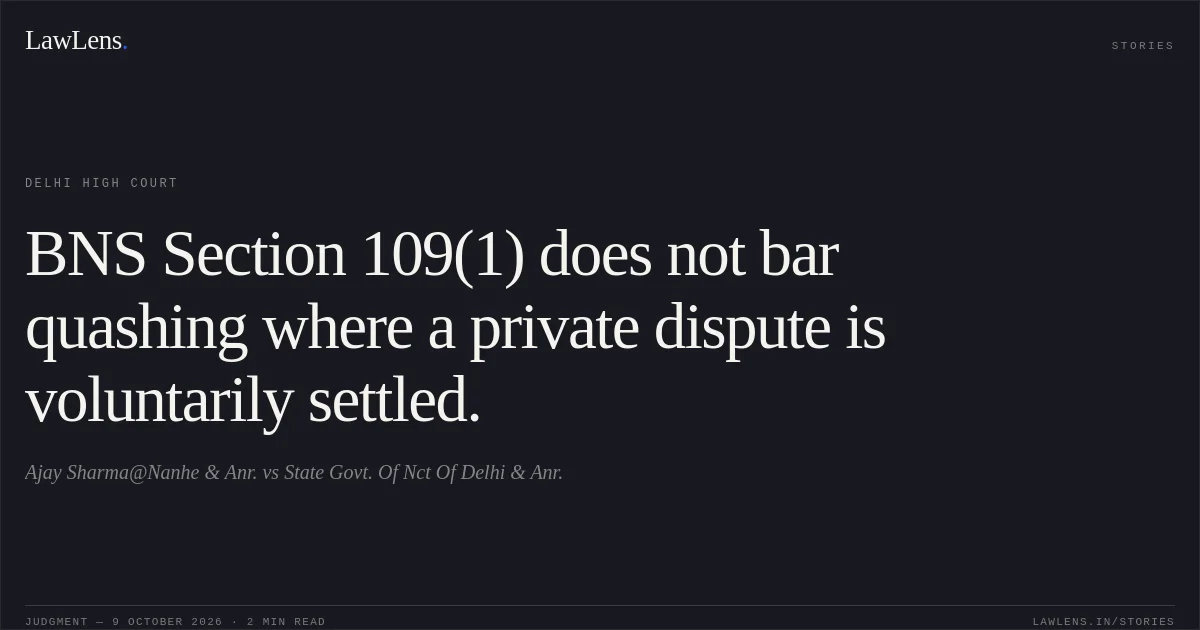
Source reference: para. 17It held that the invocation of Section 109(1) BNS did not, by itself, remove the Court’s power to quash, and concluded that the settlement and circumstances justified exercise of that power.
Source reference: para. 17Holding
The Court quashed FIR No. 82/2025 and all proceedings emanating from it under Sections 109(1)/3(5) BNS and Section 27 of the Arms Act.
Quashing was made subject to payment of ₹50,000 to the Delhi High Court Bar Clerk’s Association within two weeks, with proof to be filed before the Court and a copy provided to the IO/SHO within one week thereafter.
Source reference: paras. 19–21The petition and pending application were disposed of.
Source reference: para. 22Acts & Sections Cited
6 provisions across 4 statutes referred to in this judgment. Each provision opens on LawLens.
Bharatiya Nagarik Suraksha Sanhita, 20231
Code of Criminal Procedure, 19732
Bharatiya Nyaya Sanhita, 20232
Arms Act, 19591
Original Court PDF
Ajay Sharma@Nanhe & Anr.vsState Govt. Of Nct Of Delhi & Anr.
Click to open original judgment
Original judgment, available to read, download and summarize on LawLens.in