Facts
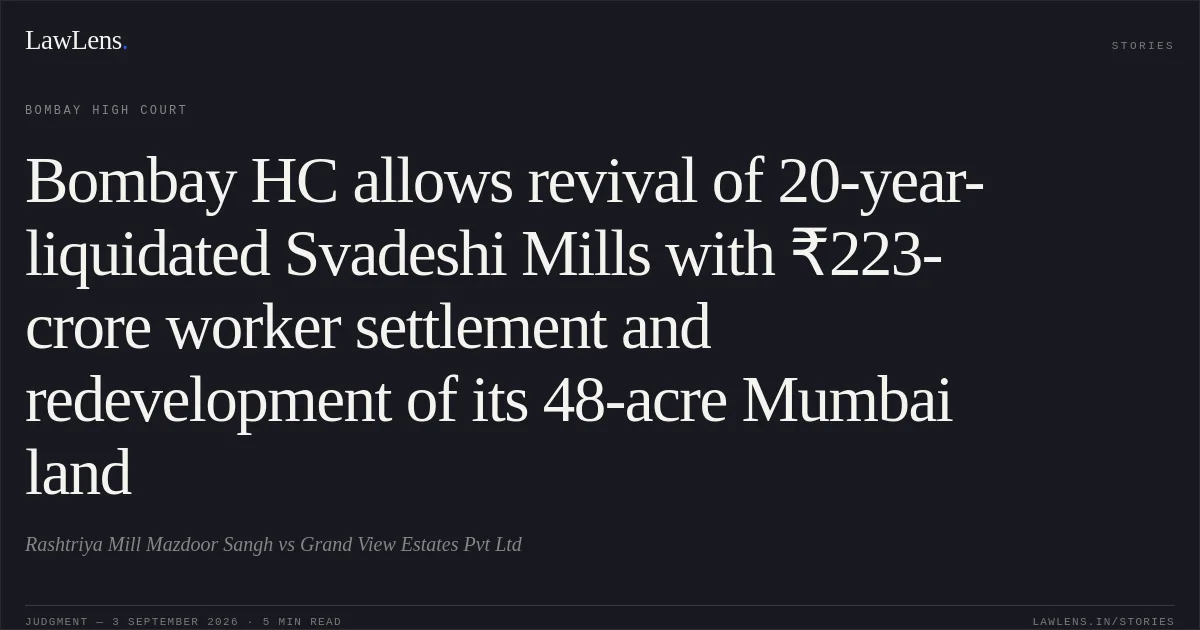
The Svadeshi Mills Company Ltd. (“Company”) was ordered to be wound up by the Bombay High Court on 5 September 2005.
Source reference: paras. 1–6; pp. 5–8Grand View Estates Pvt. Ltd. and Forbes & Co. Ltd. jointly held 53.25% of the Company’s shareholding, and Grand View also claimed to be a secured creditor pursuant to an assigned Recovery Certificate.
Source reference: paras. 1–6; pp. 5–8The Company’s principal remaining asset was approximately 48 acres of land at Sion, Mumbai.
Source reference: paras. 1–6; pp. 5–8Grand View sought a permanent stay of the winding-up order under Section 466 of the Companies Act, 1956, proposing revival through redevelopment of the land, payment of all creditors and workmen, housing-related benefits, and establishment of an educational or textile institution.
Source reference: paras. 1–6; pp. 5–8Grand View deposited ₹240 crores with the Official Liquidator, from which approximately ₹169 crores had already been disbursed to workmen.
Source reference: paras. 4, 15; pp. 6, 15–17The workers’ union, Rashtriya Mill Mazdoor Sangh, supported the proposal pursuant to a settlement negotiated before a Court-appointed committee, under which approximately 2,834 ex-workers, including certain badli workers and other categories allegedly not fully entitled in liquidation, would receive enhanced benefits.
Source reference: paras. 15–16; pp. 15–17Two minority shareholders opposed revival, contending that the proposal was a device to exploit the Company’s land, that the majority shareholders’ dues were inflated, and that the original textile business was not being resumed.
Source reference: paras. 7–12The learned Single Judge dismissed the revival application, leading to the present appeals.
Source reference: para. 1; p. 5Issues
1. Whether the Company’s winding-up order ought to be permanently stayed and the Company revived under Section 466 of the Companies Act, 1956, on the basis of Grand View’s proposal.
Source reference: paras. 1–2, 39–40; pp. 5, 35–362. Whether the revival proposal satisfied the requirements of public interest, commercial morality, and bona fides governing an application under Section 466.
Source reference: para. 5; p. 73. Whether revival could be permitted where the proposal involved redevelopment of the Company’s land and a change in the object clause from textile manufacturing to real-estate development, rather than resumption of the original textile business.
Source reference: paras. 26–28; pp. 21–294. Whether the objections concerning the alleged inflation or deferral of Grand View’s and Forbes’ dues, receipt of dividends, and the source of the ₹240-crore deposit were matters relevant to the determination of revival at this stage.
Source reference: para. 28; pp. 23–265. Whether the interests and consent of the workmen, together with the settlement providing enhanced payments and housing benefits, constituted a material consideration in favour of revival.
Source reference: paras. 30–31, 37–39; pp. 31–35Law Applied
The Court applied Section 466 of the Companies Act, 1956, which empowers the Court to stay or permanently stay winding-up proceedings where revival is justified.
Source reference: para. 5; p. 7Relying principally on Meghal Homes Pvt. Ltd. v. Shree Niwas Girni K.K. Samiti, (2007) 7 SCC 753, the Court treated public interest, commercial morality, and bona fides as the governing considerations for revival.
Source reference: para. 5; p. 7The Court held that there is no absolute rule requiring revival to involve resumption of the company’s former business or prohibiting a lawful alteration of its objects, particularly where the original business has become commercially unviable.
Source reference: para. 28(5); pp. 26–28It relied on Swaraj Infrastructure (P) Ltd. v. Kotak Mahindra Bank Ltd., (2019) 3 SCC 620, for the principle that acceptance of part of an undisputed entitlement does not necessarily bar a claim to a larger entitlement, and held that receipt of a dividend did not by itself establish relinquishment of security.
Source reference: para. 28(2); pp. 23–24The Court also referred to Mrs. Bacha F. Guzdar v. Commissioner of Income Tax, 1954 (2) SCC 563, recognising a shareholder’s right to dividends and to the surplus assets remaining after satisfaction of the Company’s liabilities in winding up.
Source reference: para. 35; p. 33Questions concerning the precise adjudication of creditor claims, interest, and the status of securities were held to arise at the stage of claim adjudication and not to be determinative of the revival application.
Source reference: para. 28; pp. 23–26Reasoning
The Court found that the circumstances had materially changed from the earlier failed revival proposals.
Source reference: paras. 28(10), 31, 37–39; pp. 29–35The present proposal secured payment of creditors and workmen, included benefits for badli and other categories of workers, had the support of the representative union, and was backed by a ₹240-crore deposit.
Source reference: paras. 28(10), 31, 37–39; pp. 29–35Applying Meghal Homes, the Court concluded that redevelopment by the Company itself was distinguishable from a proposal merely to sell the Company’s land to an outside developer; redevelopment did not amount to transfer or divestment of the asset.
Source reference: paras. 26, 28(9), 32, 38; pp. 21–22, 28–32, 35The Court considered the resumption of textile operations commercially unrealistic because the plant and machinery had been disposed of, textile mills in Mumbai had generally closed, and prior viability assessments had found revival of the weaving and processing operations unviable.
Source reference: para. 28(5); pp. 26–28The objections regarding alleged inflated dues, dividend receipt, conversion of liabilities into long-term loans, and the source of the deposit were not treated as sufficient grounds to reject revival; those matters could be examined when claims were adjudicated.
Source reference: para. 28(1)–(4); pp. 23–26Balancing the speculative prospect of recovery through a future public auction against the concrete and enhanced benefits secured for 2,834 workmen, the Court held that revival was conducive to public interest, commercially proper, and bona fide.
Source reference: paras. 31, 37–39; pp. 31–35Holding
The Division Bench allowed Appeal (L) No. 10776 of 2026, set aside the learned Single Judge’s judgment dated 23 February 2026 and order dated 27 February 2026, and allowed Interim Application No. 6953 of 2025 in terms of prayer clause (a), thereby granting the proposed permanent stay of winding up and permitting revival of the Company.
The connected appeals filed by Rashtriya Mill Mazdoor Sangh and Forbes & Co. Ltd. were disposed of in terms of the judgment, and the interim applications in the appeals were consequently disposed of.
Source reference: paras. 41–42; p. 36The Court refused to stay the effect or implementation of its judgment for three weeks to enable the minority shareholders to approach the Supreme Court.
Source reference: paras. 43–44; p. 36Acts & Sections Cited
2 provisions across 1 statute referred to in this judgment. Linked provisions open on LawLens.
Companies Act, 19562
Original Court PDF
Rashtriya Mill Mazdoor SanghvsGrand View Estates Pvt Ltd
Click to open original judgment
Original judgment, available to read, download and summarize on LawLens.in