Facts
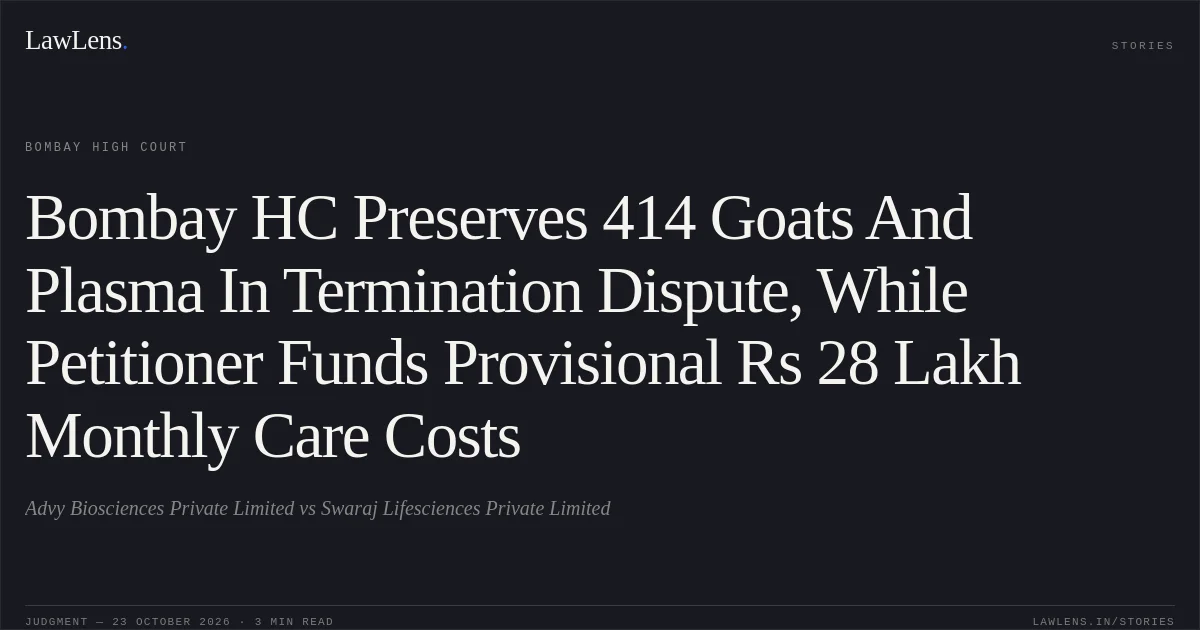
The parties’ Supply Agreement dated 1 April 2025 concerned the Respondent’s maintenance of goats for producing Anti-Human IgG (Fc) Serum (Goat).
Source reference: para. 1–3The Petitioner claimed that its immunogens, protocols and technical information were used in the process, and that interruption of veterinary and immunisation procedures or disclosure of confidential information could harm the herd and its commercial interests.
Source reference: para. 1–3The Respondent disputed the Petitioner’s proprietary claims, asserted ownership of the goats, alleged delayed payments and failure to meet minimum-order requirements, and stated that maintaining the herd cost approximately Rs. 28,07,567 per month.
Source reference: para. 4–5After the Respondent issued a termination notice dated 24 August 2026, the Petitioner applied under Section 9 of the Arbitration and Conciliation Act, 1996, seeking interim protection pending arbitration.
Source reference: para. 1The parties disputed, among other matters, compliance with the contractual notice-and-cure procedure, the payment terms, and the effect of termination.
Source reference: para. 9–13Issues
1. Whether the Petitioner had made out a prima facie case for interim measures preserving the goats, plasma, records and confidential information pending arbitration.
Source reference: para. 6, 21–232. Whether the balance of convenience and risk of irreparable harm justified protective relief, having regard to the Respondent’s claimed ownership and maintenance costs.
Source reference: para. 24–263. Whether the Court should grant relief that effectively continued the parties’ commercial relationship or determined the validity of the termination notice at the interim stage.
Source reference: para. 20, 23, 27(k)–(l)Law Applied
Section 9 of the Arbitration and Conciliation Act, 1996 empowers the Court to grant interim protection, including before constitution of the arbitral tribunal; under Section 9(2), arbitral proceedings must be commenced within the prescribed period after interim relief is granted.
Source reference: para. 7Applying Adhunik Steels Ltd. v. Orissa Manganese and Minerals (P) Ltd., (2007) 7 SCC 125, and Essar House Private Limited v. ArcelorMittal Nippon Steel India Limited, (2022) 20 SCC 178, the Court applied the ordinary interim-injunction considerations: prima facie case, balance of convenience and irreparable injury, weighing the likely consequences for both parties and preserving, rather than prejudging, rights to be decided in arbitration.
Source reference: para. 8Section 17 permits the arbitral tribunal to continue, modify or discharge interim measures after its constitution.
Source reference: para. 27(n)The Respondent’s reliance on Sections 14 and 41(h) of the Specific Relief Act, 1963, and Sections 15 and 24 of the Micro, Small and Medium Enterprises Development Act, 2006, was not finally determined; the related claims and defences were left open.
Source reference: para. 4, 20, 27(l)Reasoning
The Court found serious, unresolved disputes concerning the alleged payment default, compliance with the contractual termination procedure, ownership and use of the goats and plasma, and the parties’ confidentiality obligations; it therefore made no final determination on those matters.
Source reference: para. 9–20, 23Nevertheless, a material risk existed that changes to the herd’s veterinary or immunisation care, or use or disclosure of the plasma and confidential information, could cause harm not adequately compensable by damages.
Source reference: para. 21–23The Respondent’s substantial maintenance costs weighed against requiring it to bear the burden without financial provision.
Source reference: para. 24–25The Petitioner’s offers to deposit sums towards invoices and the proposed goat purchase price, and to pay reasonable maintenance expenses, supported limited preservation measures subject to financial conditions.
Source reference: para. 24–25A Court Commissioner, rather than a Receiver, was considered sufficient to inspect and report without taking over farm management.
Source reference: para. 26Holding
The Petition was partly allowed.
The Court restrained dealings with the relevant goats, plasma and Products that could defeat the protective order; required continued appropriate veterinary care, access for one Livestock Supervisor, preservation of relevant records and plasma, and inspection by a Court Commissioner.
Source reference: para. 27(a)–(g)The Petitioner was directed to deposit Rs. 57,34,529.78 towards pending invoices and Rs. 20,25,592 as security relating to the proposed purchase price of the goats, and to bear reasonable maintenance expenses, provisionally stated as Rs. 28,07,567 per month, subject to verification.
Source reference: para. 27(h)–(j)The termination notice was restrained only insofar as acting on it would defeat these protective directions; its validity and the parties’ substantive rights were left open.
Source reference: para. 27(k)–(l)The Petitioner was directed to commence arbitration within 90 days, and either party may seek appropriate relief from the tribunal under Section 17 once constituted.
Source reference: para. 27(m)–(n)There was no order as to costs.
Source reference: para. 28Acts & Sections Cited
6 provisions across 3 statutes referred to in this judgment. Each provision opens on LawLens.
Arbitration and Conciliation Act, 19962
Specific Relief Act, 19632
Micro, Small and Medium Enterprises Development Act, 20062
Original Court PDF
Advy Biosciences Private LimitedvsSwaraj Lifesciences Private Limited
Click to open original judgment
Original judgment, available to read, download and summarize on LawLens.in