01Facts
The plaintiffs in two suits claimed that Pandharinath Namdev Pavshe had agreed in 1990 and 1991 to sell them separate properties, received the full consideration and delivered possession, as evidenced by agreements and possession receipts.
¶ 3.2–3.15They sought specific performance and injunction in suits filed in 2018.
¶ 3.2–3.15The trial Court rejected their applications for temporary injunction; the District Court reversed those orders and restrained the defendants from disturbing the plaintiffs’ possession.
¶ 3.2–3.15The defendants, Pavshe’s legal heirs, challenged the appellate orders under Article 227 of the Constitution.
¶ 3.2–3.1502Issues
i.1. Whether the District Court was justified in interfering with the trial Court’s discretionary refusal of temporary injunction
¶ 16–21ii.2. Whether the material relied on by the District Court—including the unregistered agreements, revenue entries and 2014 measurement report—provided a proper basis to find a prima facie case of possession
¶ 22–2503Law Applied
Under Wander Ltd. v. Antox India P. Ltd., an appellate court should not substitute its discretion for that of the trial court unless the latter acted arbitrarily, capriciously or perversely, or ignored settled principles; mere possibility of a different view is insufficient.
¶ 17Seema Arshad Zaheer v. Municipal Corporation of Greater Mumbai explains that intervention is warranted where discretion rests on no relevant material or ignores relevant material.
¶ 18Skyline Education Institute (India) Pvt. Ltd. v. S.L. Vaswani and Ramakant Ambalal Choksi v. Harish Ambalal Choksi reinforce the restraint owed to a reasoned discretionary order.
¶ 19–20Under Explanation I to Article 25 of Schedule I of the Maharashtra Stamp Act, an agreement to sell that provides for transfer of possession may be treated as a conveyance for stamp-duty purposes.
¶ 30–32Section 34 of that Act bars an insufficiently stamped instrument from being admitted in evidence for any purpose until duly stamped; the proviso to Section 49 of the Registration Act does not displace that bar.
¶ 33–35The Court also noted the pre-amendment requirement under Section 34 of the Maharashtra Stamp Act that the stamp paper be purchased in the name of an executor.
¶ 36Provisions in the judgment · 3 · Linked ones open on LawLens
Maharashtra Stamp Act Section 34Section 4
Registration Act, 1908 Section 49
04Reasoning
The District Court relied on revenue entries that had been set aside, and which were not based on registered instruments; those entries therefore could not support its finding of possession.
¶ 26–27The agreements appeared prima facie insufficiently stamped because they provided for possession and full payment, and so could not be relied on even for a collateral purpose unless duly stamped.
¶ 28–37The stamp papers also appeared not to have been purchased by a party to the instruments.
¶ 28–37The 2014 survey report’s assertion that Pandharinath was present was unreliable because he had died in 2012.
¶ 38The substantial delay in seeking specific performance and the plaintiff’s inconsistent assertions—including an adverse-possession claim and a later development-related arrangement with the defendants—further undermined the asserted possession and equitable case.
¶ 39–41In these circumstances, the trial Court’s refusal of injunction was not perverse, and the District Court exceeded the limits of appellate interference.
¶ 4205Holding
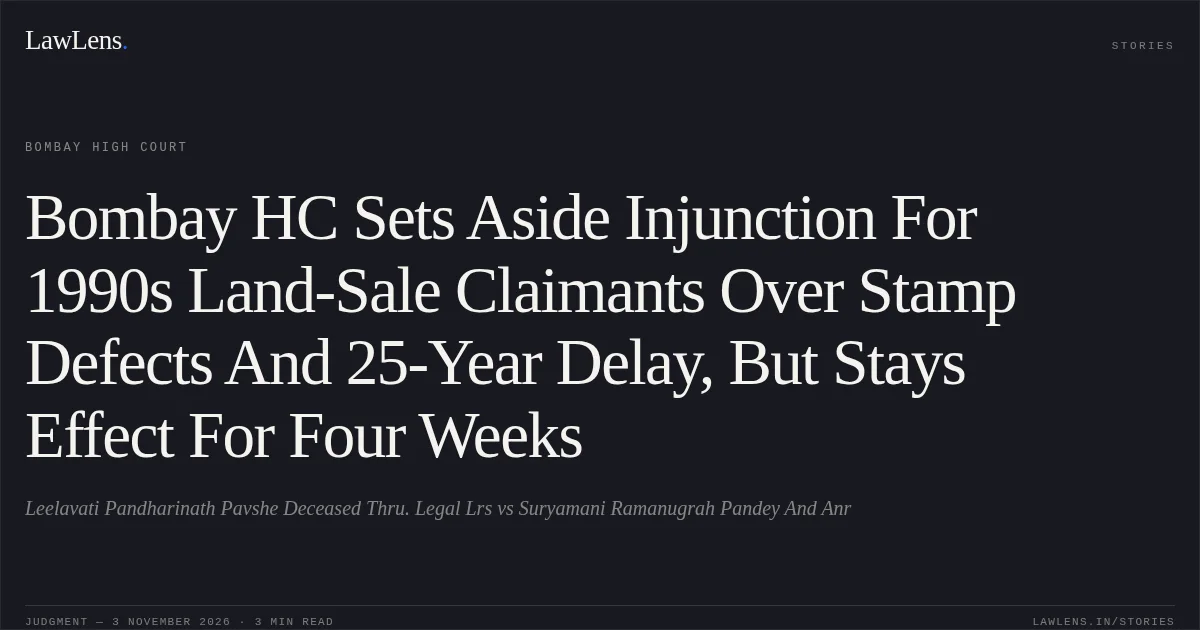
The High Court allowed both petitions, quashed the District Court’s orders granting injunctions, and restored the trial Court’s orders rejecting the temporary-injunction applications.
¶ 43It made the Rule absolute with no order as to costs.
¶ 43The effect, execution and operation of the judgment were stayed for four weeks.
¶ 43Original Court PDF
Leelavati Pandharinath Pavshe Deceased Thru. Legal LrsvsSuryamani Ramanugrah Pandey And Anr
Click to open original judgment
Original judgment, available to read, download and summarize on LawLens.in