01Facts
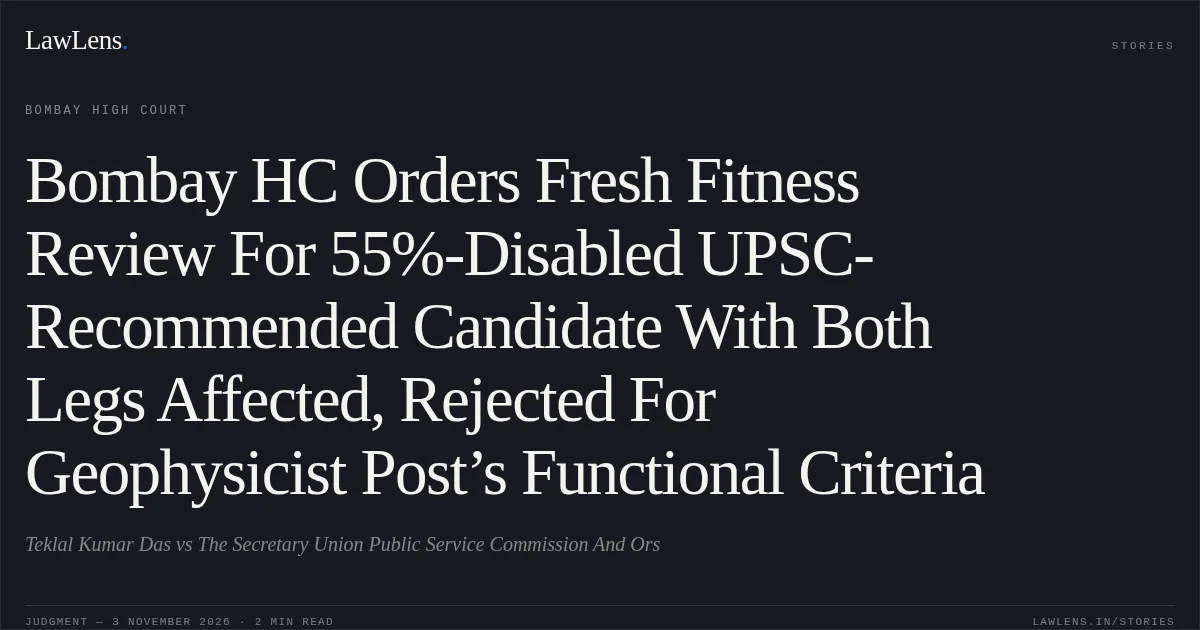
The petitioner, who has a 55% disability affecting both legs, applied under the disability-reserved vacancies for Geophysicist, Group A, through the Combined Geo-Scientist Examination, 2022.
¶ 5–11After clearing all examination stages, UPSC recommended him for appointment.
¶ 5–11The Central Standing Medical Board (CSMB) recorded him as fit under the physically handicapped category, with bilateral leg disability; however, the Ministry of Mines rejected his candidature because the notified functional classification for the post included hearing impairment, one arm affected, or one leg affected, but not both legs affected.
¶ 5–11, 34–40The Central Administrative Tribunal dismissed his challenge.
¶ 15, 41–4402Issues
i.1. Whether the Tribunal’s dismissal of the petitioner’s challenge was sustainable despite the absence of a specific medical finding on his ability to perform the functional requirements of the Geophysicist post.
¶ 41–44ii.2. Whether the petitioner’s fitness should be assessed through a de novo functional evaluation that takes account of his disability and the principle of reasonable accommodation.
¶ 45–4903Law Applied
Section 2(y) of the Rights of Persons with Disabilities Act, 2016 (RPwD Act), defines “reasonable accommodation” as necessary and appropriate modifications or adjustments, without disproportionate or undue burden, to enable persons with disabilities to exercise their rights equally with others.
¶ 45–47The Court, relying on Omkar Ramchandra Gond v. Union of India, applied the principle that reasonable accommodation must be interpreted broadly to advance full and effective participation, including flexibility to address individual needs.
¶ 45–47The applicable examination rules specified the functional classifications and physical requirements for the Geophysicist post.
¶ 40The Court further held that an expert medical assessment—not the Court’s own view—was required to determine whether the petitioner could meet the post’s functional demands.
¶ 41–44Provisions in the judgment · 1 · Linked ones open on LawLens
Rights of Persons with Disabilities Act, 2016. Section 2
04Reasoning
The CSMB had recorded the petitioner as “fit” under the disability category, but its report did not specifically determine whether he could perform the Geophysicist post’s functions.
¶ 39–42The Ministry relied on the distinction between the notified classifications and the petitioner’s bilateral leg disability, while the Tribunal dismissed the challenge without addressing the missing functional assessment.
¶ 39–42Because fitness for the post required an expert, post-specific evaluation, and because the reasonable-accommodation principle required consideration of the petitioner’s individual circumstances, the High Court concluded that a de novo assessment by the CSMB was necessary.
¶ 43–49The Court expressly declined to substitute its own impression of the petitioner’s physical fitness for a medical or scientific report.
¶ 43–4905Holding
The High Court partly allowed the petition, set aside the Tribunal’s order, and remanded the matter to the CSMB for a de novo functional assessment of whether the petitioner could discharge the duties of a Geophysicist.
¶ 51–54The Board was directed to issue a detailed report within four weeks of examining him.
¶ 51–54If the report favours the petitioner, the concerned respondents must consider it favourably and act in accordance with law; the petitioner may challenge an adverse decision.
¶ 51–54The interim direction reserving one post was continued until the Board’s report or decision and for three weeks thereafter.
¶ 51–54Original Court PDF
Teklal Kumar DasvsThe Secretary Union Public Service Commission And Ors
Click to open original judgment
Original judgment, available to read, download and summarize on LawLens.in