01Facts
The Management initiated disciplinary proceedings against Respondent No. 1, a teacher, following allegations of misconduct involving a minor girl student. After the first enquiry, penalties were imposed; the Education authority later set aside the Enquiry Committee’s report. The Management subsequently obtained what it claimed was permission to conduct a fresh enquiry, which resulted in Respondent No. 1’s termination on 21 September 2016.
¶ 2, 10–12Respondent No. 1 appealed, and the School Tribunal set aside the termination, ordered reinstatement and awarded 75% back wages. The Management challenged that order in this writ petition.
¶ 3, 41–4202Issues
i.Whether the Management could conduct a second disciplinary enquiry on substantially the same charges after the first enquiry had concluded.
¶ 9ii.Whether the authority’s alleged permission under Section 4-A of the Maharashtra Employees of Private Schools (Conditions of Service) Regulation Act, 1977, authorised the second enquiry.
¶ 9, 17–23iii.Whether the Tribunal’s directions on reinstatement and back wages warranted interference.
¶ 41–4503Law Applied
Section 4-A of the Maharashtra Employees of Private Schools (Conditions of Service) Regulation Act, 1977, empowers the Director, in cases involving serious misconduct or moral turpitude, to examine an enquiry in which an employee was allegedly unreasonably exonerated and to take specified action, including directing the recording of additional evidence; the affected employee and Management must receive an opportunity to be heard.
¶ 17–19The provision does not confer on the Management an independent, unrestricted power to reopen a completed enquiry.
¶ 19, 23Under Union of India v. K.D. Pandey, repeated enquiries cannot be ordered merely to obtain a finding acceptable to the disciplinary authority.
¶ 24–25K.R. Deb v. Collector of Central Excise, as discussed in Vijay Shankar Pandey v. Union of India, recognises that further evidence may be taken where a proper enquiry was impaired by a serious defect or other legitimate reason, but dissatisfaction with the enquiry report alone is insufficient to set it aside and order another enquiry.
¶ 30–32A second disciplinary action on the same cause of action, without legal authority, may amount to impermissible double jeopardy in the service-law sense.
¶ 27–28Provisions in the judgment · 3 · Linked ones open on LawLens
Indian Penal Code, 1860 Section 354Section 506
Maharashtra Employees of Private Schools (Conditions of Service) Regulation Act, 1977. Section 4
04Reasoning
The Tribunal found that the second enquiry substantially repeated the first enquiry’s charges, including the principal allegations concerning the same student, and the Management did not displace that finding.
¶ 20Although the victim’s mental trauma and the possibility of additional evidence were relevant, they did not dispense with the statutory procedure required by Section 4-A.
¶ 21, 26The record did not establish that the Director had validly exercised the statutory power, considered the requirements of Section 4-A, and afforded Respondent No. 1 a proper hearing before the later enquiry.
¶ 22–23, 29, 33The seriousness of the allegations could not cure that procedural and legal defect; accordingly, the termination based on the second enquiry could not stand.
¶ 38–40The Tribunal’s award of 75% back wages was also upheld, the Management having shown no sufficient reason to interfere with it.
¶ 4105Holding
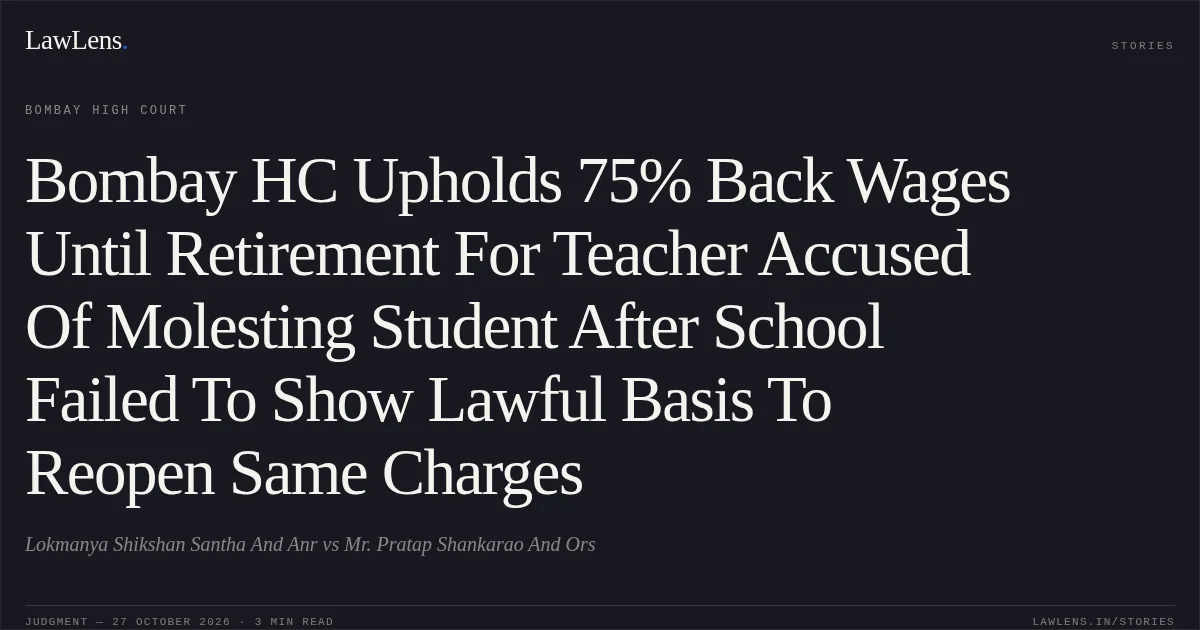
The High Court dismissed the writ petition and upheld the Tribunal’s order, finding that the second enquiry had not been shown to be a lawful exercise of power under Section 4-A.
¶ 39, 42Because Respondent No. 1 had reached superannuation during the proceedings, reinstatement was replaced by entitlement to admissible consequential service and retiral benefits. He was awarded 75% back wages from termination until the date he would have attained superannuation; liability was assigned to the State if the relevant grant-in-aid had not been released, and otherwise to the Management.
¶ 43–45The benefits and back wages were to be calculated and paid within twelve weeks of production of an authenticated copy of the judgment; the rule was discharged with no order as to costs.
¶ 45–46Original Court PDF
Lokmanya Shikshan Santha And AnrvsMr. Pratap Shankarao And Ors
Click to open original judgment
Original judgment, available to read, download and summarize on LawLens.in