Facts
The dispute arose from a development agreement dated 12 January 2011, which required the developer to pay liquidated damages of ₹10 lakh per week for a qualifying delay exceeding 60 days.
Source reference: para. 22Following disputes over redevelopment, the Society claimed damages under Clause 26.
Source reference: para. 1, 24–26The sole arbitrator found delay and breach by the developer and awarded damages calculated for 62 weeks, after adjustments, together with interest and costs.
Source reference: paras. 1, 24–26The developer challenged the award under Section 34 of the Arbitration and Conciliation Act, 1996, arguing that the Society had neither proved loss or legal injury nor established that the stipulated sum was a genuine pre-estimate of damages.
Source reference: paras. 4–14Issues
Whether the award of liquidated damages under Clause 26 could stand without proof of actual loss or legal injury, where the arbitrator found that loss was difficult to prove and treated the stipulated amount as a genuine pre-estimate.
Source reference: paras. 22–29Whether the arbitrator’s findings on breach and liquidated damages disclosed patent illegality warranting interference under Section 34 of the Arbitration and Conciliation Act, 1996.
Source reference: paras. 21, 33–37Law Applied
Section 74 of the Indian Contract Act, 1872 permits reasonable compensation for breach, not exceeding the amount named in the contract or the stipulated penalty; the named amount is not automatically recoverable merely because breach is established.
Source reference: no citationAs stated in Kailash Nath Associates v. Delhi Development Authority, damage or loss is a condition for applying Section 74, but proof of its precise amount may be dispensed with where loss is difficult or impossible to prove and the stipulated sum is a genuine pre-estimate.
Source reference: para. 28ONGC Ltd. v. Saw Pipes Ltd. recognises that, in such circumstances, a genuine pre-estimate may be awarded without proof of actual loss, subject to the amount not being unreasonable or penal.
Source reference: paras. 29, 39Under Section 34, including Section 34(2A), a domestic award may be set aside for patent illegality going to the root of the matter, but the court cannot reappreciate evidence or replace a plausible arbitral view with its own; an erroneous application of law alone is insufficient.
Source reference: paras. 21, 33, 37; Ssangyong Engineering & Construction Co. Ltd. v. NHAI, para. 39Reasoning
The Court treated Clause 26—which described the weekly sum as liquidated damages “and not as penalty”—as reflecting the parties’ agreed pre-estimate, and accepted the arbitrator’s findings that the developer’s delay and breach were established and that the Society’s loss from delayed redevelopment was difficult to quantify.
Source reference: paras. 23–26, 29It distinguished Fateh Chand and Kailash Nath on the basis that loss may not need to be quantified where it is difficult to prove and a genuine pre-estimate exists.
Source reference: paras. 27–29Given the arbitrator’s reasons and the Court’s view that the award represented a plausible assessment of the evidence, it held that the challenge would require impermissible reappreciation of evidence and did not establish patent illegality.
Source reference: paras. 33–37Holding
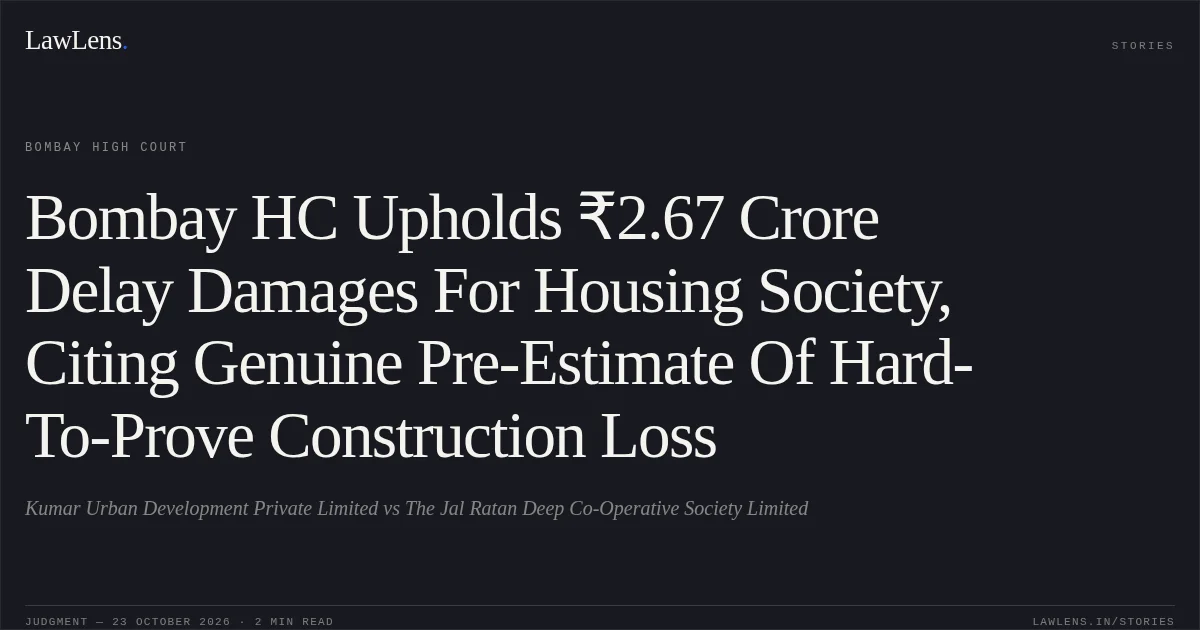
The Court rejected the challenge, holding that the arbitrator’s award of liquidated damages under Clause 26 did not warrant interference under Section 34.
The petition was dismissed; any amount deposited in Court was directed to be released within one month of the judgment’s upload, and there was no order as to costs.
Source reference: para. 40Acts & Sections Cited
9 provisions across 2 statutes referred to in this judgment. Each provision opens on LawLens.
Arbitration and Conciliation Act, 19967
Indian Contract Act, 18722
Original Court PDF
Kumar Urban Development Private LimitedvsThe Jal Ratan Deep Co-Operative Society Limited
Click to open original judgment
Original judgment, available to read, download and summarize on LawLens.in