Facts
ONGC and Afcons Infrastructure Limited entered into a contract for the construction, installation and commissioning of an offshore project, with completion stipulated by 30 April 2011.
Source reference: paras. 2–5; pp. 2–4The project was completed with a delay exceeding 220 days.
Source reference: paras. 2–5; pp. 2–4ONGC extended the completion date while reserving its right to recover liquidated damages under Clause 6.3.2 of the General Conditions of Contract.
Source reference: paras. 2–5; pp. 2–4At Afcons’s request, Clause 6.3.4 was subsequently inserted, requiring Afcons to furnish unconditional and irrevocable bank guarantees for 110% of ONGC’s maximum liquidated-damages claim, to remain valid until the dispute concerning ONGC’s entitlement was finally settled.
Source reference: paras. 2–5; pp. 2–4The arbitral tribunal found that the delay was attributable to Afcons, that Afcons was not entitled to an unconditional extension of time, and that Clause 6.3.2 was applicable.
Source reference: paras. 6, 54, 57; pp. 4, 28–29Nevertheless, it rejected ONGC’s counterclaim for liquidated damages on the ground that ONGC had neither pleaded nor proved actual loss, and directed the return of the bank guarantees.
Source reference: paras. 6, 54, 57; pp. 4, 28–29ONGC challenged the award under Section 34 of the Arbitration and Conciliation Act, 1996, and filed the present petition under Section 9 seeking renewal and continuation of the bank guarantees pending disposal of the Section 34 proceedings.
Source reference: para. 7; p. 5The bank guarantees were due to expire on 15 July 2026.
Source reference: paras. 4, 29, 31; pp. 3, 17–18Issues
Whether an unsuccessful party in arbitration could invoke Section 9 after the arbitral award to seek interim protection pending a Section 34 challenge.
Source reference: paras. 51–53; pp. 26–28Whether ONGC had established the higher threshold of a prima facie case, balance of convenience, irreparable injury, and rare and compelling circumstances required for post-award continuation of bank guarantees.
Source reference: paras. 52–53, 75; pp. 26–28, 38Whether the challenge to the award raised substantial legal questions concerning Section 74 of the Contract Act, 1872, the proof of loss in liquidated-damages claims, and the application of the authorities in Saw Pipes, Construction & Design Services and Kailash Nath Associates.
Source reference: paras. 59–73; pp. 30–37Whether continuation of the bank guarantees would preserve the parties’ existing contractual security without improperly enlarging ONGC’s rights or prejudicing Afcons.
Source reference: paras. 77–83; pp. 39–46Law Applied
Section 9 of the Arbitration and Conciliation Act, 1996 permits “a party” to seek interim measures until enforcement of the arbitral award under Section 36; under Home Care Retail Marts Pvt. Ltd. v. Haresh N. Sanghavi, an unsuccessful party is not barred from invoking Section 9, but must satisfy the ordinary requirements of interim relief and, after an adverse award, demonstrate rare and compelling circumstances.
Source reference: para. 52; p. 27ONGC v. Swiber Offshore Construction Pte. Ltd. establishes that post-award continuation of a bank guarantee requires an exceptionally strong challenge and compelling surrounding circumstances, and that the award cannot simply be disregarded.
Source reference: paras. 53, 74; pp. 27–28, 37–38Under Sections 73 and 74 of the Indian Contract Act, 1872, compensation must relate to loss or legal injury caused by breach; strict proof of actual loss may be dispensed with where loss is difficult or impossible to quantify, provided the stipulated amount is a genuine pre-estimate of loss.
Source reference: paras. 63–67; pp. 32–35Fateh Chand v. Balkishan Dass and Kailash Nath Associates v. DDA emphasise that the existence of loss or legal injury remains necessary, whereas ONGC v. Saw Pipes Ltd. and Construction & Design Services v. DDA recognise that reasonable compensation may be awarded without precise proof of loss in appropriate cases, including public-utility projects where loss is difficult to quantify.
Source reference: paras. 63–67; pp. 32–35The court also considered Saisudhir Energy Solutions Ltd. v. NTPC Ltd., GAIL (India) Ltd. v. Punj Lloyd Ltd., and BPL Ltd. v. Morgan Securities & Credits Pvt. Ltd. on contractual intention, liquidated damages, public-interest projects and the obligation to give effect to agreed contractual terms.
Source reference: paras. 9, 22–24, 60; pp. 6–8, 13–15, 31Reasoning
The Court held that ONGC’s challenge was not merely speculative.
Source reference: paras. 56–58, 76; pp. 29–30, 39The tribunal had accepted the material factual foundations of ONGC’s claim—namely, that Afcons caused the delay, was not entitled to an unconditional extension, and was otherwise subject to Clause 6.3.2—but rejected the counterclaim on the legal ground that loss was not pleaded or proved.
Source reference: paras. 56–58, 76; pp. 29–30, 39This raised substantial questions regarding whether the tribunal had correctly reconciled Kailash Nath Associates with Construction & Design Services, particularly in a public-utility project involving crude oil and natural-gas production, where losses such as blocked capital, delayed production and related public consequences may be difficult to quantify.
Source reference: paras. 64–69; pp. 32–35The Court did not finally determine the correctness of the award, but found that the Section 34 challenge involved a significant legal issue and was not an imaginary or weak challenge.
Source reference: paras. 56, 73–74; pp. 29, 37–38The balance of convenience favoured preservation of the existing security.
Source reference: paras. 77–78; pp. 39–40The bank guarantees had been furnished in substitution for ONGC’s right to deduct liquidated damages and had remained in force for nearly fifteen years.
Source reference: paras. 62, 77–78; pp. 31–33, 39–40Clause 6.3.4 prima facie contemplated their continuation until final settlement of the liquidated-damages dispute.
Source reference: paras. 62, 77–78; pp. 31–33, 39–40ONGC sought neither immediate encashment nor enforcement of the award, but only continuation of the security pending the Section 34 proceedings.
Source reference: paras. 77–78; pp. 39–40The Court further found potential irreparable prejudice because expiry of the guarantees could make restoration of that security impossible, particularly given the involvement of an Indonesian joint-venture constituent and the uncertainty regarding future recovery.
Source reference: paras. 80–81; pp. 41–42A corporate guarantee offered by Afcons was not considered commercially equivalent to unconditional bank guarantees issued under the contract.
Source reference: para. 81; p. 42Taken cumulatively, these factors satisfied the heightened requirement of rare and compelling circumstances under Home Care Retail Marts.
Source reference: paras. 83–85; pp. 42–47Holding
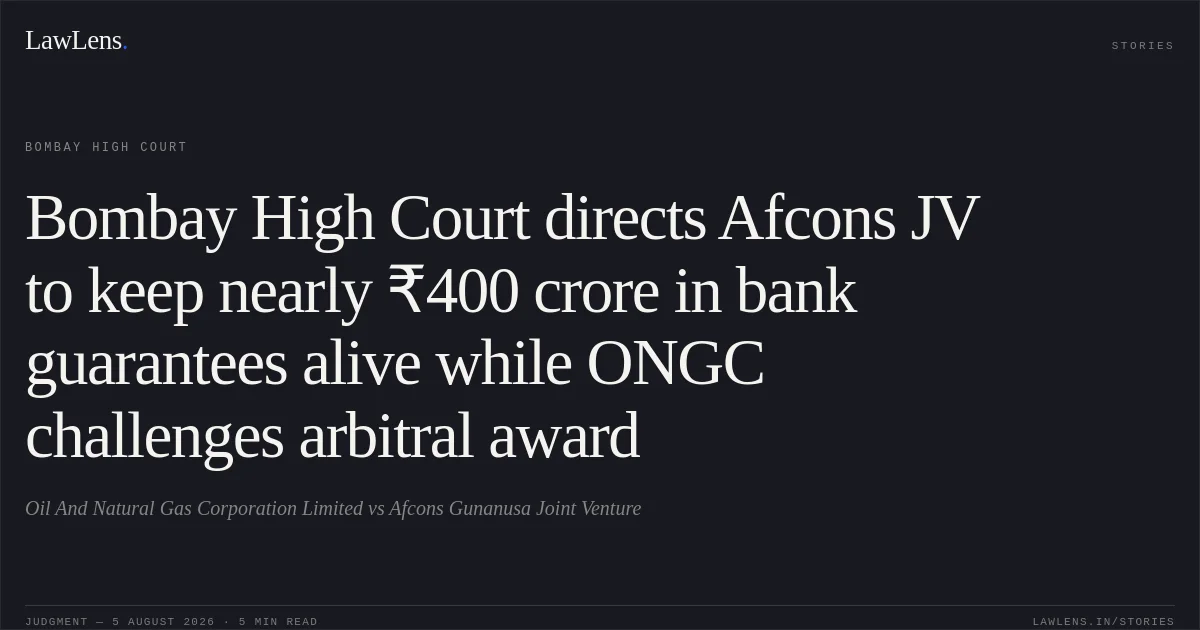
The Bombay High Court allowed ONGC’s Section 9 petition and directed Afcons to renew, extend and keep alive all bank guarantees furnished under Clause 6.3.4, on the same terms, conditions and amounts, until final disposal of ONGC’s Section 34 petition.
Afcons was directed to initiate renewal at least fifteen days before expiry and provide copies of the renewed guarantees to ONGC.
Source reference: para. 86(c); p. 48Afcons was restrained from cancelling, discharging or releasing the guarantees during the pendency of the Section 34 proceedings.
Source reference: para. 86(d); p. 48ONGC was expressly prohibited from invoking the guarantees solely on the basis of this order; invocation remained subject to the contract, the terms of the guarantees and further orders of the competent court.
Source reference: para. 86(e); p. 48All observations were declared prima facie and non-binding on the court hearing the Section 34 petition, and there was no order as to costs.
Source reference: para. 86(f)–(i); p. 48Original Court PDF
Oil And Natural Gas Corporation LimitedvsAfcons Gunanusa Joint Venture
Click to open original judgment
Original judgment, available to read, download and summarize on LawLens.in