Facts
Aaj Ka Anand Papers Ltd. underwent CIRP after the NCLT admitted State Bank of India’s Section 7 application on 31 March 2022.
Source reference: paras. 2–3Upon failure of CIRP, the corporate debtor was ordered into liquidation on 12 April 2023, and Jitender Kumar Jain was appointed liquidator.
Source reference: paras. 2–3A Stakeholders’ Consultation Committee (SCC) was constituted, comprising SBI, Bank of Baroda and Edelweiss Asset Reconstruction Company Ltd.
Source reference: paras. 2–3A promoter/ex-director lodged a complaint against Jain on 3 July 2023, followed by further written grievances on 10 August 2023.
Source reference: paras. 5–6The investigation report dated 10 May 2024 found no actionable material against Jain.
Source reference: paras. 7–9, 27–29Nevertheless, the IBBI issued a show-cause notice dated 9 July 2024 concerning five unrelated matters, including the constitution of the SCC, presentation of liquidation costs, and delay in issuing auction notices.
Source reference: paras. 7–9, 27–29After considering Jain’s reply and written submissions, the Disciplinary Committee suspended his authorisation for assignment for three months by order dated 18 December 2024.
Source reference: paras. 9–10Jain challenged the show-cause notice and disciplinary order; Edelweiss, a secured financial creditor and SCC member, separately challenged the order in support of Jain.
Source reference: paras. 9–10, 17Issues
Whether the IBBI could issue a show-cause notice under Section 219 of the IBC, as it stood before the 6 April 2026 amendment, on the basis of material extraneous to the investigation report and unrelated to the complaints that triggered the investigation.
Source reference: paras. 23–32Whether the disciplinary proceedings and order were vitiated by violation of natural justice because relevant material and explanations furnished by Jain were not properly considered.
Source reference: paras. 34–36, 45–49Whether the Disciplinary Committee’s findings regarding the SCC’s constitution, presentation of liquidation costs and delay in auction notices were sustainable where Jain had adopted reasonably possible interpretations of the applicable Regulations and had relied on obstruction by the promoters and condonation by the NCLT.
Source reference: paras. 37–45Whether Edelweiss, as an SCC member and secured financial creditor, was a person aggrieved entitled to challenge the disciplinary order against Jain.
Source reference: paras. 17, 52Law Applied
The Court applied Sections 217–220 of the Insolvency and Bankruptcy Code, 2016, and the Insolvency and Bankruptcy Board of India (Inspection and Investigation) Regulations, 2017.
Source reference: paras. 23–25Under Section 219, as it stood at the relevant time, a show-cause notice could be issued upon completion of an inspection or investigation under Section 218; Regulation 11 required the Board to consider the investigation report and form a prima facie opinion that sufficient cause existed for action under Section 220.
Source reference: paras. 23–25The Court held that “consider” requires the authority to genuinely examine and think over the report, rather than merely refer to it.
Source reference: para. 48Judicial review in writ jurisdiction is limited and does not permit appellate reappreciation of evidence, but interference is justified for procedural irregularity, disregard of relevant material or violation of natural justice.
Source reference: paras. 22, 46, 49The Court also considered Regulations 5 and 31A of the Liquidation Regulations, 2016, and noted that a reasonably possible interpretation of regulatory provisions should not, without more, attract disciplinary action.
Source reference: paras. 37–42Clause 23A of the Model Bye-Laws was relevant because initiation of disciplinary proceedings automatically suspends an insolvency professional’s authorisation for assignment.
Source reference: para. 50The Court relied on Chairman, LIC of India v. A. Masilamani, (2013) 6 SCC 530.
Source reference: para. 48The Court referred to Union of India v. P. Gunasekaran, (2015) 2 SCC 610, and Chief Commercial Manager, South Central Railway v. G. Ratnam, (2007) 8 SCC 212.
Source reference: paras. 22, 46, 49Reasoning
The Court found that the investigation initiated on the promoter’s complaints concluded that there was no actionable material against Jain.
Source reference: paras. 27–32The subsequent show-cause notice, although referring to and annexing the investigation report, relied on five different issues unrelated to the complaints and was therefore based on extraneous material.
Source reference: paras. 27–32The Board’s general regulatory powers did not cure this defect, particularly when the material forming the basis of the prima facie opinion was not disclosed to Jain.
Source reference: paras. 27–32The disciplinary order further failed to properly evaluate Jain’s detailed explanation concerning the promoters’ obstruction, the participation of all financial creditors in SCC meetings, the timing of the introduction of Regulation 31A(6B), the technical nature of the alleged violations, and the NCLT’s condonation of auction-related delays.
Source reference: paras. 34–45The Court held that the interpretation treating SBI as representative of the secured financial-creditor class was reasonably possible and that no creditor had objected.
Source reference: paras. 38–42It also found that the Committee wrongly considered SCC meetings beyond those identified in the show-cause notice and adopted an unduly stringent approach to technical regulatory issues.
Source reference: paras. 38–42These defects constituted serious procedural infirmities and violations of natural justice, warranting writ interference notwithstanding the limited scope of judicial review.
Source reference: paras. 46–49Although Edelweiss lacked a conventional grievance against an order penalising Jain, the Court treated its challenge as deserving consideration in view of its interest as an SCC member in the efficient completion of liquidation and its support for the liquidator.
Source reference: para. 52Holding
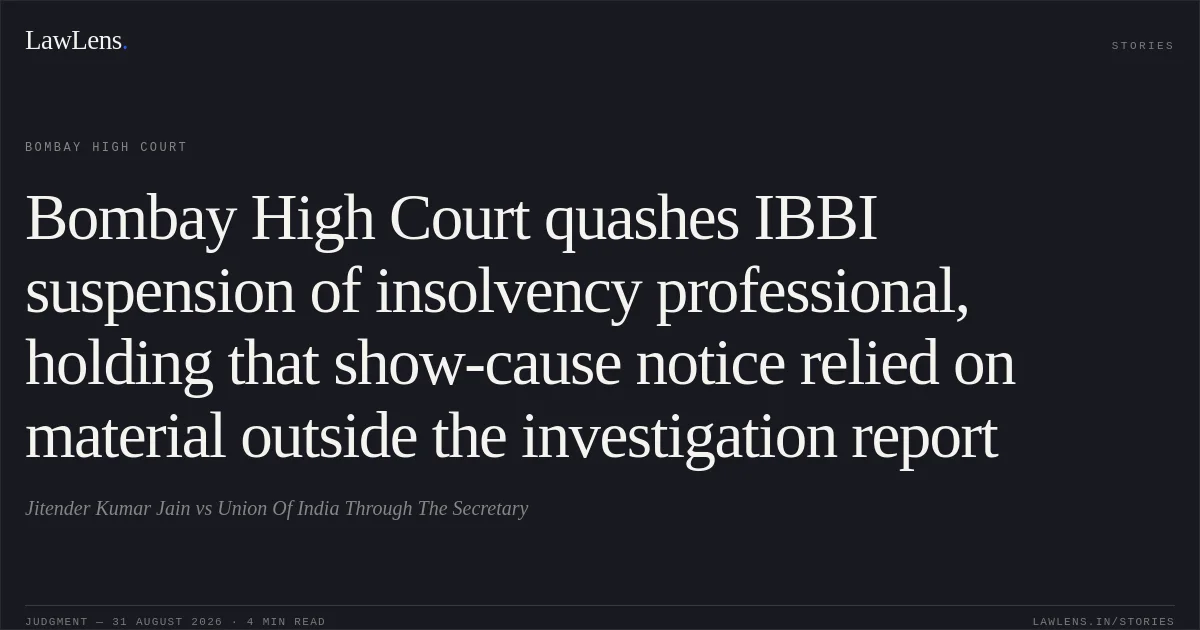
The Court allowed both writ petitions and quashed and set aside the Disciplinary Committee’s order dated 18 December 2024 imposing a three-month suspension on Jain.
The proceedings were held procedurally invalid because the show-cause notice was founded on material extraneous to the investigation report and because the Disciplinary Committee failed to consider relevant defences and material placed by Jain.
Source reference: paras. 32, 46, 49Jain’s request for a direction to constitute an appellate body was not granted, since the subsequent amendment introducing Section 220(7) of the IBC provided a statutory appeal to the NCLAT.
Source reference: para. 53The constitutional challenge to Regulation 13(3)(ba) of the Investigation Regulations, 2017, was left open as it was not seriously argued.
Source reference: para. 54Pending applications were also disposed of.
Source reference: para. 55Acts & Sections Cited
5 provisions across 1 statute referred to in this judgment. Each provision opens on LawLens.
Insolvency and Bankruptcy Code, 2016.5
Original Court PDF
Jitender Kumar JainvsUnion Of India Through The Secretary
Click to open original judgment
Original judgment, available to read, download and summarize on LawLens.in