Facts
The appellant, M/s Coda Payments India Pvt. Ltd., provides technology-enabled services for the monetisation and sale of digital content through platforms including “Codashop” and “Codapay”, using payment aggregators and gateways.
Source reference: paras. 2–5; pp. 2–3The Enforcement Directorate (“ED”) registered ECIR/HYZO/35/2021 on the basis of ten FIRs alleging cheating and unauthorised deductions from users of online games, including “Garena Free Fire”.
Source reference: paras. 2–5; pp. 2–3On 23 September 2022, the ED searched premises connected with the appellant and issued orders under Section 17(1A) of the Prevention of Money Laundering Act, 2002 (“PMLA”), freezing five bank accounts and various merchant IDs and payment-aggregator accounts.
Source reference: paras. 6–7; p. 3Seized records and digital devices were retained under Sections 20(1) and 21(1), and the ED filed Original Application No. 750 of 2022 under Section 17(4) seeking continuation of the freezing and retention.
Source reference: paras. 8–9; pp. 3–4The Adjudicating Authority allowed the application on 15 March 2023, and the Appellate Tribunal dismissed the appellant’s appeal on 6 March 2025.
Source reference: paras. 10–11; p. 4Issues
Whether the Adjudicating Authority, constituted solely by its Chairperson, had jurisdiction in the absence of a finding that its composition complied with Sections 6(2) and 6(5) PMLA.
Source reference: paras. 16–19; pp. 8–10Whether the Adjudicating Authority complied with Section 8(2) PMLA by recording a finding, after considering the appellant’s reply and the material on record, that the specified properties were involved in money-laundering.
Source reference: paras. 21–25; pp. 10–12Whether the Appellate Tribunal could cure the Adjudicating Authority’s failure by supplying, for the first time on appeal, the statutory finding required under Section 8(2) PMLA.
Source reference: paras. 26–34; pp. 12–15Whether the appellant’s gross turnover, foreign remittances, and entire banking and payment infrastructure could be treated as “proceeds of crime” without identifying the specific property and establishing its nexus with criminal activity relating to a scheduled offence.
Source reference: paras. 35–41; pp. 15–18Whether the freezing, retention, and attachment proceedings were vitiated by the ED’s failure to disclose and substantiate the requisite “reasons to believe” under the PMLA.
Source reference: paras. 47–52; pp. 19–21Law Applied
The Court applied Sections 6(2), 6(5), and 6(7) PMLA, which govern the composition and constitution of Benches of the Adjudicating Authority; Section 8(2), which requires the Authority, after considering the reply, hearing the parties, and examining the relevant material, to record a finding whether the properties specified in the notice are involved in money-laundering; and Sections 17, 20, and 21, which regulate seizure/freezing and retention of property and records.
Source reference: no citationUnder Section 2(1)(u) PMLA, “proceeds of crime” means property derived or obtained, directly or indirectly, as a result of criminal activity relating to a scheduled offence.
Source reference: no citationRelying on Vijay Madanlal Choudhary v. Union of India, (2023) 12 SCC 1, the Court held that the existence of a scheduled offence does not make every asset of the accused “proceeds of crime”; the property must have a demonstrable nexus with the criminal activity.
Source reference: para. 36; pp. 15–16The Court further applied the principles in Mohinder Singh Gill v. Chief Election Commissioner, (1978) 1 SCC 405, and 63 Moons Technologies Ltd. v. Union of India, (2019) 18 SCC 401, that an order must stand or fall on the reasons recorded in it and cannot subsequently be supplemented by new reasons.
Source reference: paras. 31–33; pp. 14–15It also relied on M/s Prakash Industries Ltd. v. Union of India, 2023 SCC OnLine Del 336, and J. Sekar v. Union of India, 2018 SCC OnLine Del 6523, concerning the necessity of furnishing and communicating the requisite “reasons to believe” under the PMLA.
Source reference: para. 52; p. 21Reasoning
The Court held that the Appellate Tribunal had completely disregarded the appellant’s jurisdictional objection concerning the Adjudicating Authority’s constitution.
Source reference: paras. 16–19; pp. 8–10Since the Authority’s composition was not shown to comply with Section 6 PMLA, the Adjudicating Authority’s order was rendered a nullity or coram non judice.
Source reference: paras. 16–19; pp. 8–10Independently, the Court found that the Adjudicating Authority merely stated that the material justified continuation of freezing and retention for adjudication; it did not identify the specific properties involved in money-laundering or explain their nexus with the alleged criminal activity, as required by Section 8(2).
Source reference: paras. 22–25; pp. 11–12The Tribunal itself recognised this omission but impermissibly attempted to cure it by recording its own prima facie conclusion.
Source reference: paras. 26–30; pp. 13–15An appellate body may affirm, reverse, or modify a finding already made, but cannot substitute the original authority’s mandatory statutory determination.
Source reference: paras. 26–30; pp. 13–15The Court further held that the appellant’s gross revenue of approximately Rs. 2,850 crores and remittances of approximately Rs. 2,320 crores to a foreign group entity did not, without more, establish that the entire turnover or all bank balances were proceeds of crime.
Source reference: paras. 35–39; pp. 15–17The subsequent closure or withdrawal of nine FIRs, leaving one FIR involving approximately Rs. 85,650, also rendered the freezing of assets worth approximately Rs. 100 crores prima facie excessive and disproportionate, particularly when the ED had not produced evidence establishing the alleged unauthorised auto-debit mechanism or cheating through the appellant’s payment gateways.
Source reference: paras. 40–51; pp. 17–20The failure to substantiate and communicate the requisite reasons to believe further vitiated the freezing and retention proceedings.
Source reference: para. 52; p. 21Holding
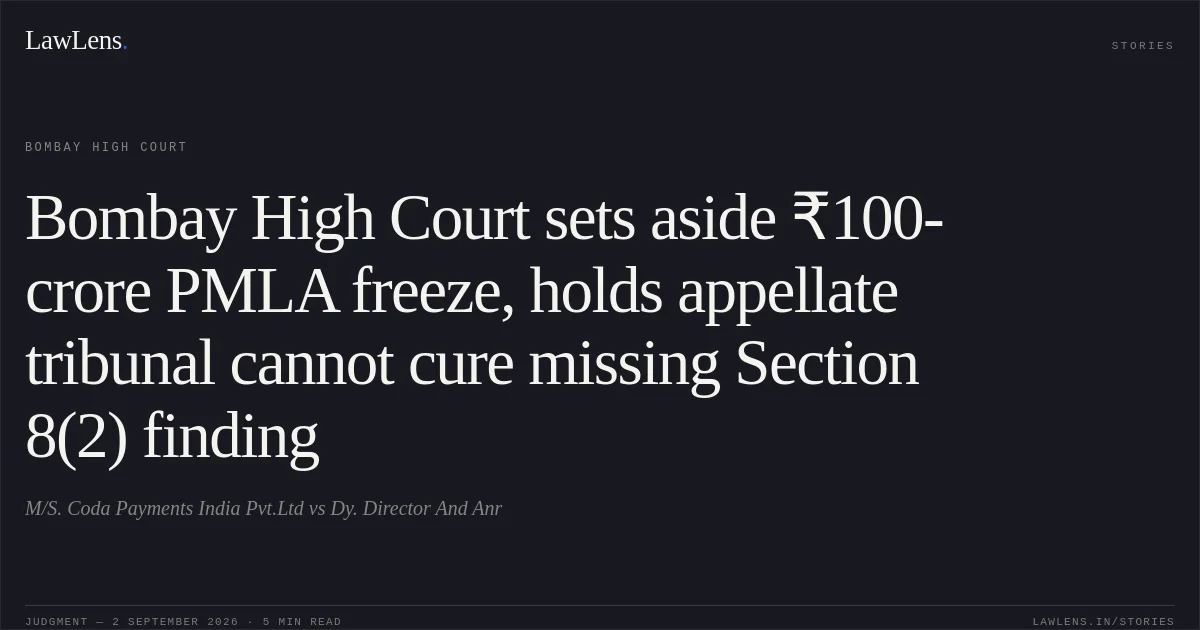
The Bombay High Court allowed the appeal and quashed and set aside the Appellate Tribunal’s order dated 6 March 2025, holding that the Adjudicating Authority had failed to comply with the mandatory requirements of Section 8(2) PMLA and that the Tribunal could not cure that defect on appeal.
The Court also held that the appellant’s entire business assets, bank accounts, and payment infrastructure could not be treated as proceeds of crime merely on the basis of turnover or foreign remittances, without identification of the specific property and its nexus with a scheduled offence.
Source reference: paras. 37–39, 49–50; pp. 16–20Interim Application No. 3418 of 2025 was consequently disposed of as infructuous.
Source reference: para. 55; p. 22The Court clarified that its findings concerned only the legality of the impugned PMLA orders and did not finally determine whether the appellant had committed any scheduled offence or money-laundering offence.
Source reference: para. 53; p. 22Acts & Sections Cited
12 provisions across 2 statutes referred to in this judgment. Each provision opens on LawLens.
Prevention of Money-Laundering Act, 2002
Indian Penal Code, 18601
Original Court PDF
M/S. Coda Payments India Pvt.LtdvsDy. Director And Anr
Click to open original judgment
Original judgment, available to read, download and summarize on LawLens.in