Facts
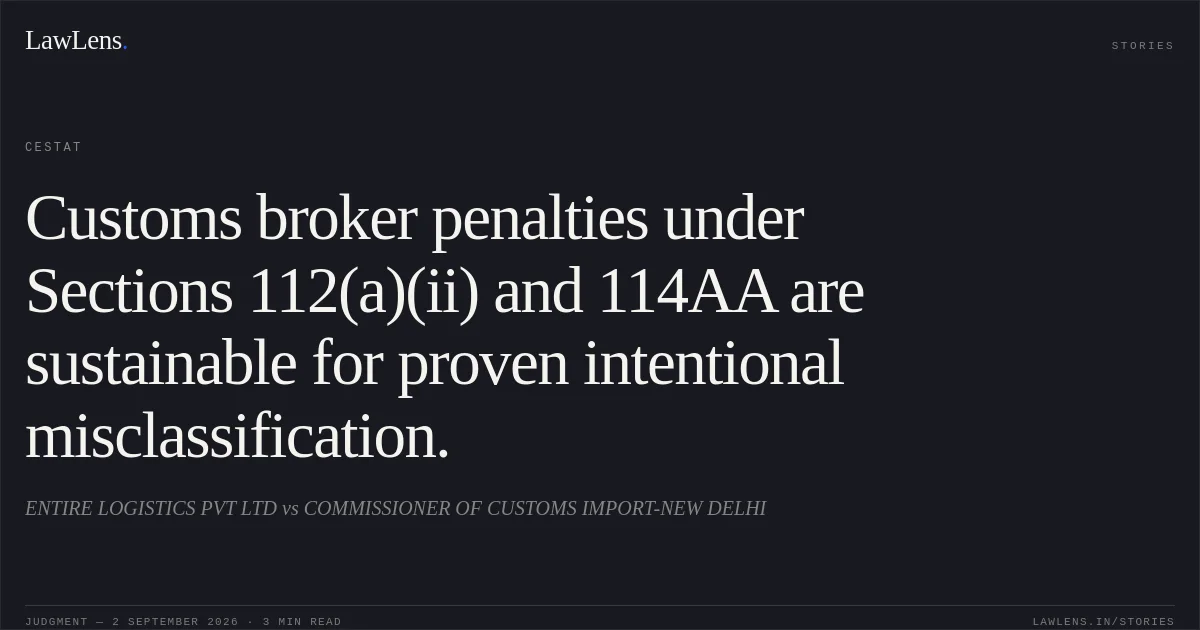
The three appeals arose from a common investigation concerning imports of areca nuts by M/s SYM Company, M/s Gorgeous Apparels and M/s Vikash Trading. The goods were declared as “Beetle Nut/Supari” and classified under CTH 21069030 to claim exemption under Notification No. 50/2017-Cus., whereas the Department alleged that they were areca nuts classifiable under CTH 08028090 and imported in violation of the applicable Minimum Import Price and DGFT restrictions.
Source reference: pp. 2–4The appellant, a common Customs House Agent/customs broker for the three importers, and its director, Shri Ashish Gupta, were alleged to have knowingly advised the importers to adopt the incorrect classification and valuation. Statements were recorded under Section 108 of the Customs Act, 1962. The adjudicating authorities imposed penalties under Sections 112 and 114AA of the Customs Act for abetting the improper importation and using false or incorrect declarations. The penalties were upheld in appeal, resulting in the present proceedings before the Tribunal.
Source reference: pp. 4–7Issues
Whether the appellant customs broker and its director knowingly abetted the misclassification, undervaluation and attempted importation of prohibited areca nuts so as to attract penalties under Sections 112(a)(ii) and 114AA of the Customs Act, 1962?
Source reference: pp. 4–7, 12Whether the statements recorded under Section 108 of the Customs Act could be relied upon as substantive evidence in the absence of retraction, and whether the alleged non-compliance with Section 138B of the Customs Act vitiated the penalties?
Source reference: pp. 5–6, 7–10Whether the appellant’s conduct constituted violations of Regulations 10(d), 10(e) and 10(f) of the Customs Broker Licensing Regulations, 2018?
Source reference: pp. 4, 10–12Law Applied
The Tribunal applied Sections 111(d) and 111(m) of the Customs Act, 1962, under which goods imported contrary to prohibitions or restrictions, or goods not corresponding with the declaration regarding their description or value, are liable to confiscation. Sections 112(a)(ii) and 114AA provide for penalties where a person knowingly participates in or abets improper importation, or knowingly uses or causes to be used false or incorrect material in customs transactions.
Source reference: pp. 3–4, 7, 12The Tribunal held that a voluntary statement recorded under Section 108 of the Customs Act is admissible as substantive evidence because a customs officer is not a police officer, relying on Ramesh Chandra Mehta v. State of West Bengal, Illias v. Collector of Customs, K.I. Pavunny v. Assistant Collector (HQ), Central Excise Collectorate, Cochin, and Amad Noormamad Bakali v. State of Gujarat.
Source reference: pp. 7–9Regulations 10(d), 10(e) and 10(f) of the Customs Broker Licensing Regulations, 2018 impose duties on a customs broker to advise clients regarding compliance, exercise due diligence and not use or cause the use of incorrect or false information.
Source reference: p. 4It also relied on Commissioner of Customs v. K.M. Ganatra & Co., which emphasised the fiduciary and regulatory responsibilities of customs brokers, and CC (General) v. World Wide Areca Manufacturer concerning liability for conduct facilitating illegal imports.
Source reference: pp. 10–11Reasoning
The Tribunal found that the appellant’s liability was not based merely on the mechanical filing of Bills of Entry. The un-retracted Section 108 statement of the director specifically indicated that the appellant had suggested classification under CTH 21069030 instead of CTH 08028090 to secure exemption and reduce duty, thereby helping the importers remain commercially competitive.
Source reference: p. 10The importers’ statements, the CRCL report and the expert report from the Areca Nut Research and Development Foundation corroborated the admission and established that the goods did not qualify for the declared classification.
Source reference: pp. 3, 10Since neither the director nor the importers retracted their statements or produced evidence of coercion, the Tribunal treated the statements as voluntary and admissible. It therefore rejected the argument that the absence of proceedings under Section 138B rendered the evidence unusable.
Source reference: pp. 7–10Applying the requirement of knowledge and intention under Sections 112(a)(ii) and 114AA, the Tribunal concluded that the appellant had knowingly recommended the false classification and facilitated the attempted importation of restricted goods.
Source reference: p. 12Holding
The Tribunal answered the issues against the appellant. It held that the appellant customs broker and its director had knowingly and intentionally facilitated misclassification and undervaluation of the areca nuts, thereby attracting penalties under Sections 112(a)(ii) and 114AA of the Customs Act, 1962.
The reliance on the voluntary and corroborated Section 108 statements was upheld, and the alleged procedural objection under Section 138B was rejected. The impugned appellate orders were upheld and Customs Appeals Nos. 50286, 50287 and 51865 of 2025 were dismissed.
Source reference: p. 12Acts & Sections Cited
4 provisions across 2 statutes referred to in this judgment. Each provision opens on LawLens.
Customs Act,19623
Central Excise Act, 19441
Original Court PDF
ENTIRE LOGISTICS PVT LTDvsCOMMISSIONER OF CUSTOMS IMPORT-NEW DELHI
Click to open original judgment
Original judgment, available to read, download and summarize on LawLens.in