Facts
The petitioners were admitted to Jamnalal Bajaj Institute of Management Studies’ two-year MMS course for 2024–2026 under the Children of Indian Workers in Gulf Countries (CIWGC) supernumerary quota, on the basis of academic credentials reflected in the final merit list.
Source reference: paras. 5(a)–(e)Yash Gaikwad, Vishal Gupta and Gautam Nair were ranked at Nos. 10, 6 and 8 respectively, with marks of 81.80%, 84.00% and 82.40%.
Source reference: paras. 5(a)–(e)In March 2026, an anonymous complaint alleged that the petitioners had submitted forged or fabricated academic documents.
Source reference: para. 5(f)A First Committee, constituted as a fact-finding body without hearing the petitioners, reported discrepancies between the submitted documents and the petitioners’ genuine university records and recommended cancellation of their admissions.
Source reference: paras. 5(f)–(n)A Second Committee thereafter notified the petitioners, heard their oral and written submissions, and independently reached substantially similar conclusions.
Source reference: paras. 5(o)–(v)The Institute cancelled and revoked their admissions by communications dated 27 March 2026.
Source reference: para. 5(w)The petitioners challenged the decision under Article 226 of the Constitution.
Source reference: paras. 3–4Issues
Whether the cancellation of the petitioners’ admissions was vitiated by breach of natural justice because the First Committee acted without hearing them and the subsequent hearing before the Second Committee was allegedly inadequate.
Source reference: paras. 41–45Whether the material established, on a preponderance of probabilities, not merely that the academic documents were false, but that the petitioners knowingly relied upon or participated in the submission of those documents.
Source reference: paras. 48–50, 64–65Whether the Institute’s failure to detect the discrepancies during the admission process, or alleged institutional bias in the constitution and functioning of the committees, invalidated the cancellation decision.
Source reference: paras. 46–47, 66–68Whether cancellation of the admissions at the fag end of the MMS course was arbitrary or disproportionate under Articles 14 and 21 of the Constitution.
Source reference: paras. 69–78Law Applied
The Court applied Article 226 principles governing judicial review of administrative and educational decisions, including natural justice, procedural fairness, institutional impartiality, and proportionality.
Source reference: paras. 42–45A person facing serious academic, civil or reputational consequences must ordinarily receive a real and meaningful opportunity to know and answer the substance of the case; however, natural justice is not an inflexible ritual and every procedural irregularity does not invalidate a decision where the material facts are substantially known and an effective opportunity to respond has been provided.
Source reference: paras. 42–45In an institutional enquiry, allegations need not be proved beyond reasonable doubt; the applicable standard is preponderance of probabilities, although suspicion cannot substitute for cogent material.
Source reference: paras. 49–50, 64The Court relied on Shiva Dhawan v. SVKM’s Narsee Monjee Institute of Management Studies , 2018 SCC OnLine Bom 1272, on meaningful hearing; Union of India v. M/s Chaturbhai M. Patel & Co. , (1974) 1 SCC 747, on the seriousness of allegations of fraud; Suresh Pathrella v. Oriental Bank of Commerce , (2006) 10 SCC 572, Samar Bahadur Singh v. State of Uttar Pradesh , (2011) 9 SCC 94, and Ram Preeti Yadav v. U.P. Board of High School and Intermediate Education , (2003) 8 SCC 311, on drawing inferences of knowledge or participation from cumulative circumstances.
Source reference: paras. 28–33, 64–78It further applied the principle that fraud vitiates an act and that an ineligible candidate cannot retain an admission obtained through materially false credentials, as reflected in Gurdeep Singh v. State of J&K , 1995 Supp (1) SCC 188, and P.N. Bhadra v. Registrar, University of Agricultural Sciences , 1995 SCC OnLine Kar 461.
Source reference: paras. 28–33, 64–78Reasoning
The Court held that the absence of a hearing before the First Committee did not by itself invalidate the decision because that committee was only fact-finding; the petitioners were subsequently informed of the allegations, appeared before the Second Committee, and submitted oral and written responses.
Source reference: paras. 41–45The Court rejected the claim that the hearing was merely a formality, while emphasising that allegations of fraud do not dispense with natural justice.
Source reference: paras. 41–45On the merits, the Court distinguished between proving that documents were false and proving the petitioners’ responsibility for knowingly relying upon them.
Source reference: paras. 48–50, 64–65For Gaikwad, the cumulative circumstances included systematic alteration of his marks, his own handwritten and signed application recording the inflated percentage, the direct merit advantage, and his failure to object to the merit list.
Source reference: paras. 52–56In Gupta’s case, the inflated CPI, corresponding application-form representation, materially improved ranking, and discrepancy with verified VJTI records justified the inference that he knowingly relied on the false credentials.
Source reference: paras. 57–60In Nair’s case, the document combined his name with Gaikwad’s academic particulars, reflected an enhanced CGPA despite Nair never having studied at VNIT, and corresponded with the inflated percentage in his application form; the absence of a satisfactory explanation supported the Committee’s conclusion.
Source reference: paras. 61–63The Institute’s own verification failures warranted separate investigation but did not validate admissions obtained through false credentials or exonerate the petitioners.
Source reference: paras. 66–68The alleged institutional bias was also not established because no committee member was shown to have a personal stake, involvement in preparing the documents, or disqualifying prejudice.
Source reference: paras. 46–47Finally, the Court held that the serious consequences and late discovery of the alleged fraud could not outweigh the integrity of the admission process, particularly because the inflated credentials were central to eligibility and merit ranking.
Source reference: paras. 69–78Holding
The Court answered the issues against the petitioners.
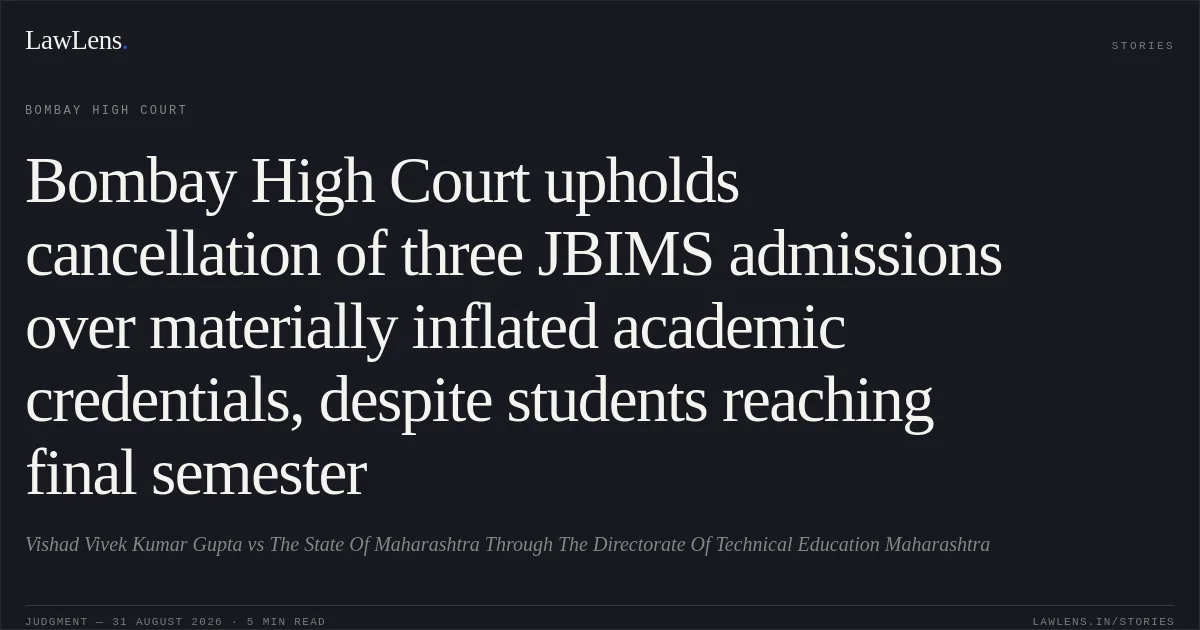
It held that the Second Committee afforded a sufficient opportunity of hearing; that the petitioners’ knowing reliance upon materially false academic credentials was established on a preponderance of probabilities; that institutional lapses did not preserve otherwise invalid admissions; and that cancellation at the end of the course was neither arbitrary nor disproportionate.
Source reference: paras. 64–78The Court declined to interfere with the Institute’s communications dated 27 March 2026 and dismissed both writ petitions with no order as to costs.
Source reference: para. 83It clarified that its findings were confined to the validity of the admission cancellations and did not determine criminal liability or identify the persons who physically fabricated or altered the documents.
Source reference: para. 79The Institute was expected to conduct a fair, independent and expeditious investigation into possible negligence, collusion, dereliction of duty or misconduct by its officers, employees, intermediaries or other persons involved in processing the supernumerary-quota admissions.
Source reference: paras. 80–82Original Court PDF
Vishad Vivek Kumar GuptavsThe State Of Maharashtra Through The Directorate Of Technical Education Maharashtra
Click to open original judgment
Original judgment, available to read, download and summarize on LawLens.in