Facts
The four petitioners were entities engaged in importing, trading and dealing in gold, jewellery and other precious metals.
Source reference: no citationThey placed orders with an Indonesian supplier and received invoices dated 4, 5, 6, 7 June and 3 July 2023. They made advance payments aggregating to approximately USD 34.05 million against invoices valued at approximately USD 34.96 million, representing more than 90% of the invoice value.
Source reference: pp. 8–10; para. 7On 12 July 2023, the Directorate General of Foreign Trade issued Notification No. 19/2023, changing the import policy for unstudded gold from “free” to “restricted”.
Source reference: pp. 6–8; paras. 4–6Clause 1.05(b) of the Foreign Trade Policy, 2023 preserved imports already made before the restriction and permitted post-restriction imports where the importer had an Irrevocable Commercial Letter of Credit (“ICLC”) established before the restriction.
Source reference: pp. 6–8; paras. 4–6The respondents declined to extend this transitional benefit to the petitioners because their transactions were supported by advance payments rather than ICLCs.
Source reference: pp. 10–12; paras. 7, 10The petitioners challenged the notification, Clause 1.05(b), and the Policy Relaxation Committee’s order dated 29 December 2023, but ultimately did not press their challenge to the validity of the notification or the policy clause.
Source reference: pp. 10–12; paras. 7, 10The Court directed the petitioners to establish that the transactions were bona fide and not structured to circumvent the policy change.
Source reference: pp. 24–26; paras. 24–26The petitioners produced incorporation documents and details of earlier transactions demonstrating that they were regular traders and importers of precious metals.
Source reference: pp. 24–26; paras. 24–26Issues
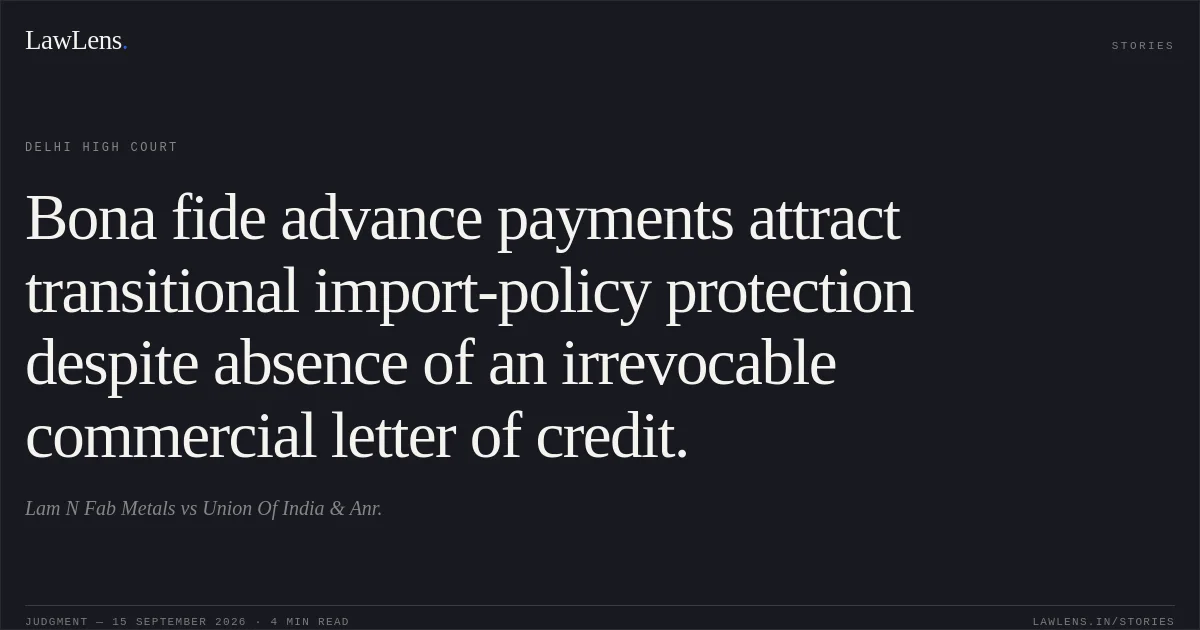
Whether the petitioners, whose contracts were supported by substantial advance payments made before 12 July 2023, were entitled to the transitional benefit under Clause 1.05(b) of the Foreign Trade Policy, despite not having established ICLCs.
Source reference: p. 18; para. 16Whether advance payments exceeding 90% of the transaction value could, in the peculiar facts of the case, be treated as providing protection equivalent to or greater than that afforded by an ICLC.
Source reference: pp. 18–19; paras. 17–22Whether the benefit of Clause 1.05(b) should be extended after verifying the bona fide nature of the petitioners and their transactions.
Source reference: pp. 25–26; paras. 26–28Law Applied
The Court applied Clause 1.05(b) of the Foreign Trade Policy, 2023, which protects imports made before a change from “free” to “restricted” policy and provides a transitional exception for commitments supported by pre-existing ICLCs.
Source reference: pp. 7–8It recognised that the Central Government possesses authority under the Foreign Trade (Development and Regulation) Act, 1992 to alter import policy in public interest, and that courts ordinarily exercise restraint in reviewing such policy decisions.
Source reference: pp. 12–14; paras. 11–12, 21However, delegated legislation and policy notifications ordinarily operate prospectively unless the enabling statute authorises retrospective operation, as held in Director General of Foreign Trade v. Kanak Exports, and the effective time of an electronically published notification is material under Union of India v. G.S. Chatha Rice Mills.
Source reference: pp. 19–24; para. 23The Court also relied on M/S Bright Metal Refiners v. Directorate General of Foreign Trade concerning the prospective operation of import-policy notifications, and on Nocil Ltd. v. Policy Relaxation Committee regarding the discretionary nature of policy relaxations.
Source reference: pp. 15–16, 19–25; paras. 13, 23The governing principle applied was that Clause 1.05(b) had to be interpreted purposively to protect bona fide pre-existing commercial commitments, rather than being applied mechanically only to formal ICLC transactions.
Source reference: pp. 18–19; paras. 20–22Reasoning
The Court accepted that the Government was justified in changing gold’s import status because of an unusual surge in imports, possible misuse of preferential trade arrangements, revenue implications and concerns relating to financial security; it therefore declined to interfere with the policy decision itself.
Source reference: pp. 12–14, 18–19; paras. 11–12, 21The Court nevertheless distinguished between the validity of the policy change and the scope of the transitional protection under Clause 1.05(b).
Source reference: pp. 18–19; paras. 17–22It held that the purpose of recognising ICLCs was to protect genuine commercial commitments entered into before the policy change.
Source reference: pp. 18–19; paras. 17–22In the present case, the petitioners had paid more than 90% of the invoice value before the notification, which, in the Court’s view, constituted a stronger and more tangible commercial commitment than an ICLC.
Source reference: pp. 18–19; paras. 17–22The petitioners’ incorporation documents and history of prior import transactions further established that they were bona fide precious-metal traders and that the disputed transactions were not isolated arrangements designed to defeat the notification.
Source reference: pp. 24–26; paras. 24–27Accordingly, a purposive interpretation of Clause 1.05(b) required the advance-payment transactions to receive equivalent transitional protection.
Source reference: pp. 18–19; paras. 20–22Holding
The Court held that the petitioners were entitled to the benefit of Clause 1.05(b) of the Foreign Trade Policy for the transactions supported by the pre-notification invoices and advance payments.
It directed the respondents to extend the transitional benefit to the transactions tabulated in paragraph 7 of the judgment.
Source reference: p. 26; para. 28The writ petitions were disposed of accordingly, and all pending applications were also disposed of.
Source reference: p. 26; para. 29The Court expressly directed that the order should not be treated as a precedent, as it was based on the peculiar facts of the case.
Source reference: p. 26; para. 30Acts & Sections Cited
4 provisions across 2 statutes referred to in this judgment. Each provision opens on LawLens.
General Clauses Act, 18972
Original Court PDF
Lam N Fab MetalsvsUnion Of India & Anr.
Click to open original judgment
Original judgment, available to read, download and summarize on LawLens.in