Facts
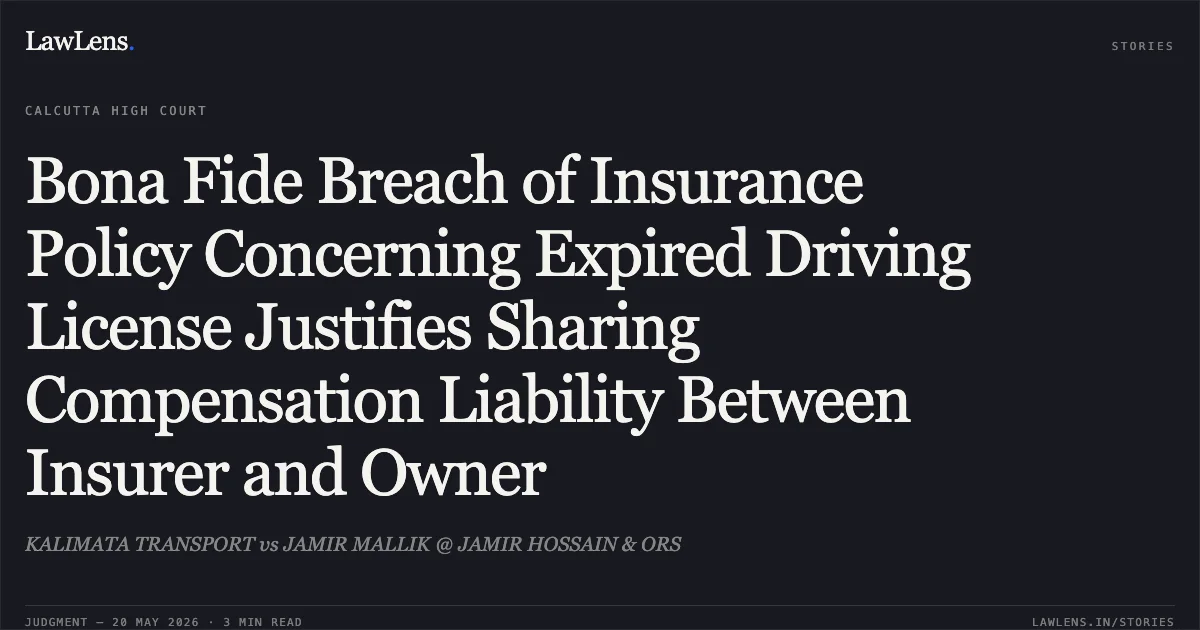
On February 3, 2011, a bicycle rider was killed after being hit by a lorry (WB-15A/7295) owned by the appellant, Kalimata Transport
Source reference: p. 2The claimants (parents of the deceased) filed a claim under Section 166 of the Motor Vehicles Act, 1988.
Source reference: p. 2The Tribunal awarded Rs. 2,92,500 with 8% interest, directing the vehicle owner (appellant) to pay the full amount because the driver’s license was found to be invalid on the date of the accident
Source reference: p. 2-3The owner appealed, contending that the driver had a license since 1988 which was renewed periodically, and that any lapse was unintentional rather than a willful breach of policy
Source reference: p. 4Evidence from the RTO showed the license was valid for transport vehicles until 2008 and renewed again only from April 21, 2011, leaving a gap during which the accident occurred
Source reference: p. 5Issues
1. Whether the Insurance Company is automatically absolved from liability if the driver's license had expired on the date of the accident but was renewed subsequently
Source reference: p. 52. Whether the breach of policy conditions regarding a valid driving license must be "willful" to entitle the insurer to a total exoneration or a right to recovery
Source reference: p. 6-7Law Applied
The court applied Section 166 of the Motor Vehicles Act, 1988, concerning compensation for motor accidents
Source reference: p. 1Skandia Insurance Co. Ltd. v. Kokilaben Chandravadan, which holds that "breach" implies a willful infringement and that an insurer is not absolved if the insured is not at fault/negligent in a willful manner
Source reference: p. 6The "Pay and Recover" doctrine as refined in National Insurance Co. Ltd. v. Liraza Bibi and Reliance General Insurance Co. Ltd. v. Niyati Kumar, emphasizing that insurers must conduct an inquiry to determine if a policy violation was bona fide or deliberate before seeking recovery from the owner
Source reference: p. 6-8Reasoning
The Court observed that while the driver lacked a valid license on the specific date of the accident, he was not a person who never held a license; his license had been renewed periodically before and after the incident
Source reference: p. 10Following the Skandia precedent, the Court reasoned that for an insurer to be absolved, the owner must have willfully placed the vehicle in the hands of an unlicensed driver
Source reference: p. 6However, the Court found "some negligence" on the part of the owner for failing to verify the renewal status at the exact time of the accident
Source reference: p. 11Rather than remanding the 12-year-old case for a fresh inquiry by the insurance company—which would cause further hardship—the Court exercised its discretion to balance the equities
Source reference: p. 11It determined that since the breach was not entirely deliberate but involved oversight, the liability should be shared
Source reference: p. 11-12Holding
The Court modified the Tribunal’s award, holding that the appellant (owner) and respondent no. 3 (Bajaj Allianz General Insurance Co. Ltd.) shall share the compensation of Rs. 2,92,500 plus interest equally (50% each)
Since the owner had already deposited the full amount in Court, the Insurance Company was directed to reimburse the owner Rs. 1,46,250 with 8% interest from the date of filing within eight weeks. The claimant (respondent no. 2) was permitted to withdraw the funds already deposited by the appellant
Source reference: p. 12Acts & Sections Cited
1 provisions across 1 statute referred to in this judgment. Each provision opens on LawLens.
Motor Vehicles Act, 19881
Original Court PDF
KALIMATA TRANSPORTvsJAMIR MALLIK @ JAMIR HOSSAIN & ORS
Click to open original judgment
Original judgment, available to read, download and summarize on LawLens.in