Facts
The petitioner, a Deputy General Manager in the respondent company, was served a show-cause notice on June 11, 2019, alleging negligence and lack of devotion to duty.
Source reference: para 2, 4The allegation was that the petitioner reviewed and forwarded the Annual Confidential Reports (ACRs) of a Junior Engineer, Shri Subodh Ingle, for a period between 2010 and 2014 when Ingle was not in service due to a prior removal (later set aside).
Source reference: para 4, 11The petitioner explained that he acted upon a specific memo from the General Manager dated August 3, 2018, requesting these ACRs, and that the ACRs were prepared by the Reporting Officer and merely reviewed by him.
Source reference: para 5, 12, 13On March 11, 2020, the Disciplinary Authority imposed a punishment of withholding two annual grade increments without cumulative effect, stating the petitioner’s reply was "not satisfactory".
Source reference: para 6The Appellate Authority dismissed his appeal via a non-speaking order on May 12, 2021.
Source reference: para 6, 19Issues
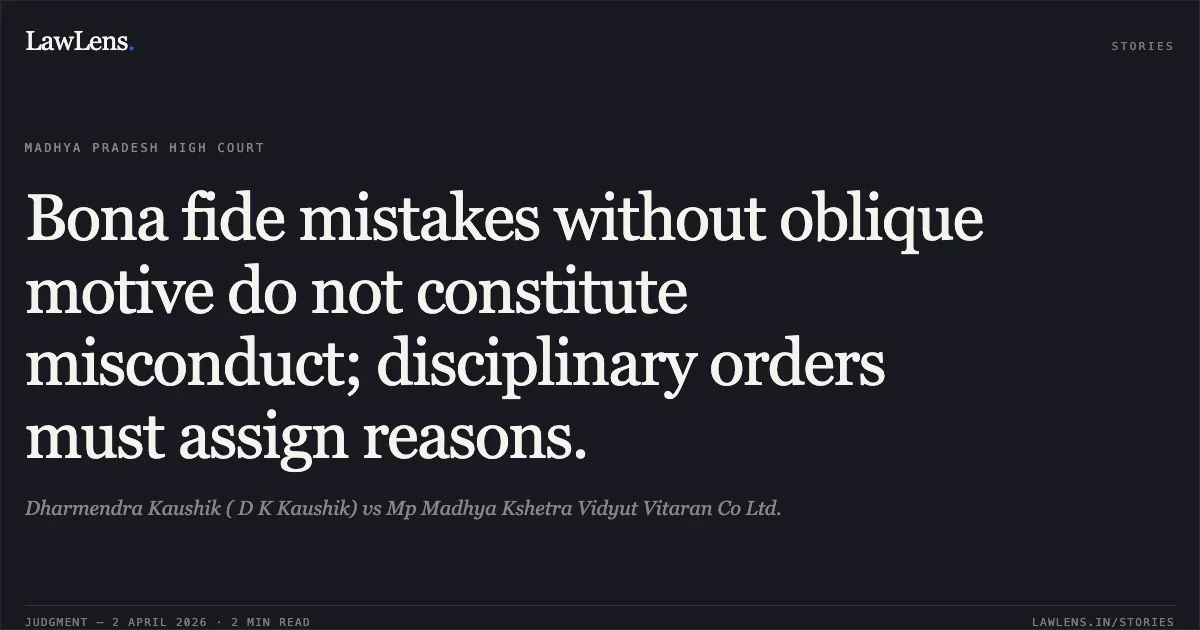
1. Whether the impugned punishment and appellate orders were unsustainable due to being "non-speaking" and lacking reasons.
Source reference: para 7, 192. Whether the act of writing/reviewing ACRs based on superior directions and in the absence of an oblique motive constitutes "misconduct."
Source reference: para 15, 17Law Applied
Administrative and quasi-judicial orders must be "speaking orders" containing clear reasons, as established in M/S Kranti Asso. Pvt. Ltd. & Anr v. Masood Ahmed Khan & Ors., which describes reasons as the "heartbeat" of such decisions.
Source reference: para 8, 20Regarding the definition of misconduct, the court relied on Union of India v. J. Ahmed [(1979) 2 SCC 286] and Inspector Prem Chand v. Govt. of NCT of Delhi [(2007) 4 SCC 566], which establish that a mere error of judgment, negligence simpliciter, or a bona fide mistake without an oblique motive or gross culpability does not amount to misconduct.
Source reference: para 15, 16, 17Reasoning
The court found that the Disciplinary Authority failed to consider a vital fact: the petitioner was duty-bound to provide the ACRs because he was specifically directed to do so by the General Manager's memo dated August 3, 2018.
Source reference: para 13, 14, 17Applying the ratio of J. Ahmed, the court reasoned that since there was no allegation of an "oblique motive" and the act did not cause "irreparable damage" to the company, the petitioner's actions constituted at most a bona fide mistake rather than misconduct.
Source reference: para 17Furthermore, the court scrutinized the impugned orders and found them to be "non-speaking" as they failed to assign specific reasons why the petitioner’s explanation was deemed unsatisfactory.
Source reference: para 19The court also noted that the petitioner was similarly situated to another employee, Dhaniram Sahu, whose identical punishment had already been set aside by the High Court in a previous petition.
Source reference: para 18Holding
The court held that the impugned orders were unsustainable in law due to a lack of reasoning and failure to appreciate the material facts.
The High Court set aside the punishment order dated March 11, 2020, and the appellate order, remitting the matter to respondent no. 2 for reconsideration and the issuance of a fresh, reasoned order within 90 days.
Source reference: para 21, 22Original Court PDF
Dharmendra Kaushik ( D K Kaushik)vsMp Madhya Kshetra Vidyut Vitaran Co Ltd.
Click to open original judgment
Original judgment, available to read, download and summarize on LawLens.in


