01Facts
On May 19, 2025, a learned Single Judge passed a common judgment decreeing a patent infringement suit [CS(COMM) 245/2017] in favor of the Respondent and dismissing the Appellant’s counterclaim [CC(COMM) 54/2017] for the revocation of patent IN’199722
¶ 3While the Appellant promptly filed a statutory appeal [RFA(OS)(COMM) 24/2025] against the decree in the suit, it failed to file a separate appeal against the dismissal of its counterclaim within the limitation period
¶ 4, 5.1The Appellant contended that it was under the bona fide belief that the first appeal covered both the suit and the counterclaim
¶ 5.1Upon receiving fresh legal advice, the Appellant filed the present appeal with a 54-day delay in filing and a subsequent 111-day delay in re-filing due to technical e-filing portal constraints
¶ 1, 2, 5.302Issues
i.Whether a delay of 54 days in filing and 111 days in re-filing an appeal in a commercial dispute can be condoned under the "sufficient cause" standard of the Limitation Act
¶ 8, 9ii.Whether a mistaken belief arising from incorrect legal advice regarding the necessity of filing separate appeals against a common judgment constitutes "sufficient cause"
¶ 12, 1303Law Applied
The Court primarily applied Section 5 of the Limitation Act, 1963, which requires the applicant to establish "sufficient cause" for condoning delay
¶ 8It relied on Shivamma v. Karnataka Housing Board (2025), which held that "sufficient cause" must be interpreted liberally to ensure substantial justice prevails over technicalities, prioritizing the bona fides of the applicant over the arithmetical length of the delay
¶ 8The Court further applied the principles from Government of Maharashtra v. Borse Brothers Engineers and Contractors Pvt. Ltd. (2021), noting that while condonation in commercial disputes is an exception and not a rule, a short delay can be condoned if the party acted bona fide and not in a negligent manner
¶ 9Provisions in the judgment · 6 · Linked ones open on LawLens
Code of Civil Procedure, 1908 Section 151
Limitation Act, 1963 Section 5Section 116Section 117
Commercial Courts Act, 2015 Section 13
Arbitration and Conciliation Act, 1996 Section 37
04Reasoning
The Court observed that the term "sufficient cause" must be determined based on the specific facts of each case, balancing the objective of speedy disposal under the Commercial Courts Act, 2015, with the substantive right to appeal
¶ 9, 14The Court found the Appellant’s conduct bona fide because it had challenged the common judgment through a related appeal within the limitation period, thereby putting the Respondent on notice that the patent’s validity remained sub-judice
¶ 11Consequently, the Respondent could not claim that the delay led them to believe the judgment was accepted or that new equities were created
¶ 11While acknowledging that ignorance of law is generally not an excuse and that the Appellant’s counsel was negligent, the Court held that such negligence did not amount to "deliberate inaction" or "laches"
¶ 13Regarding the 111-day re-filing delay, the Court accepted that repeated attempts to clear technical registry objections demonstrated diligence
¶ 1605Holding
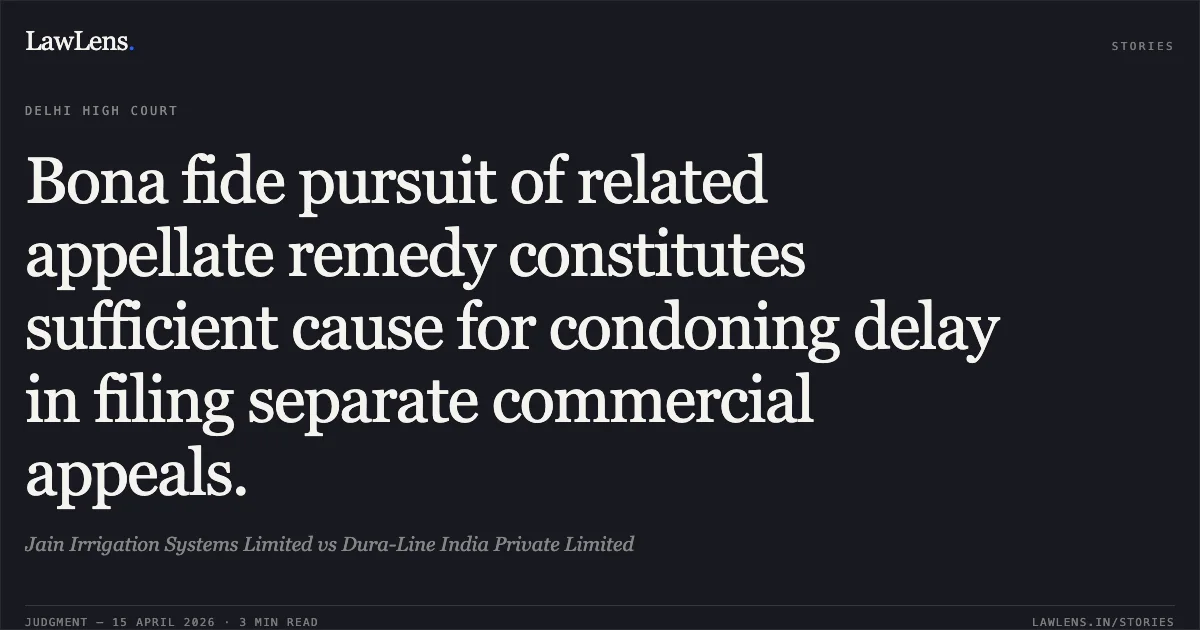
The Court condoned the 54-day delay in filing and the 111-day delay in re-filing the appeal
¶ 17It held that the Appellant had shown "sufficient cause" and that a refusal to condone the delay would cause substantive prejudice by foreclosing the Appellant's defenses in the related pending appeal on grounds of res judicata
¶ 15The condonation was granted subject to the Appellant paying costs of Rs. 50,000 to the Delhi High Court Advocates Welfare Trust and Rs. 50,000 to the Delhi High Court Bar Clerk’s Association
¶ 18The appeal was ordered to be listed alongside the related appeal on May 12, 2026
¶ 19Original Court PDF
Jain Irrigation Systems LimitedvsDura-Line India Private Limited
Click to open original judgment
Original judgment, available to read, download and summarize on LawLens.in