Facts
The respondent instituted a suit for defamation against the appellant concerning two social-media posts published on the appellant’s Facebook account, allegedly relating to the respondent and his deceased father.
Source reference: paras. 1–3The Trial Court granted an ex parte ad interim injunction restraining the appellant from publishing, circulating, posting or disseminating defamatory or disparaging statements concerning the respondent or his deceased father, and directed the appellant to freeze access to the impugned articles pending disposal of the temporary injunction application.
Source reference: para. 3The appellant challenged the order, contending that the Trial Court had failed to apply the Bonnard principle, that the defences of truth and fair comment were available, that the second post did not refer to the respondent, and that the order was inconsistent with Order XXXIX Rules 1, 2 and 3A of the Code of Civil Procedure, 1908.
Source reference: paras. 4–7The appellant also admitted that he was an employee of the Cricket Association of Bengal and worked in its media cell.
Source reference: para. 13Issues
Whether the impugned injunction was liable to be set aside because the appellant invoked truth, fair comment, public interest and the Bonnard principle protecting free speech.
Source reference: paras. 4–5, 16–19, 27–28Whether the first impugned Facebook post was prima facie defamatory, derogatory or disparaging so as to justify interim injunctive relief.
Source reference: paras. 14–15, 21–27, 31Whether the second impugned post could be restrained when it did not disclose any ex facie direct connection with the respondent.
Source reference: para. 29Whether the grant and continuation of the ex parte injunction violated Order XXXIX Rules 1, 2 and 3A of the Code of Civil Procedure, 1908.
Source reference: para. 7Law Applied
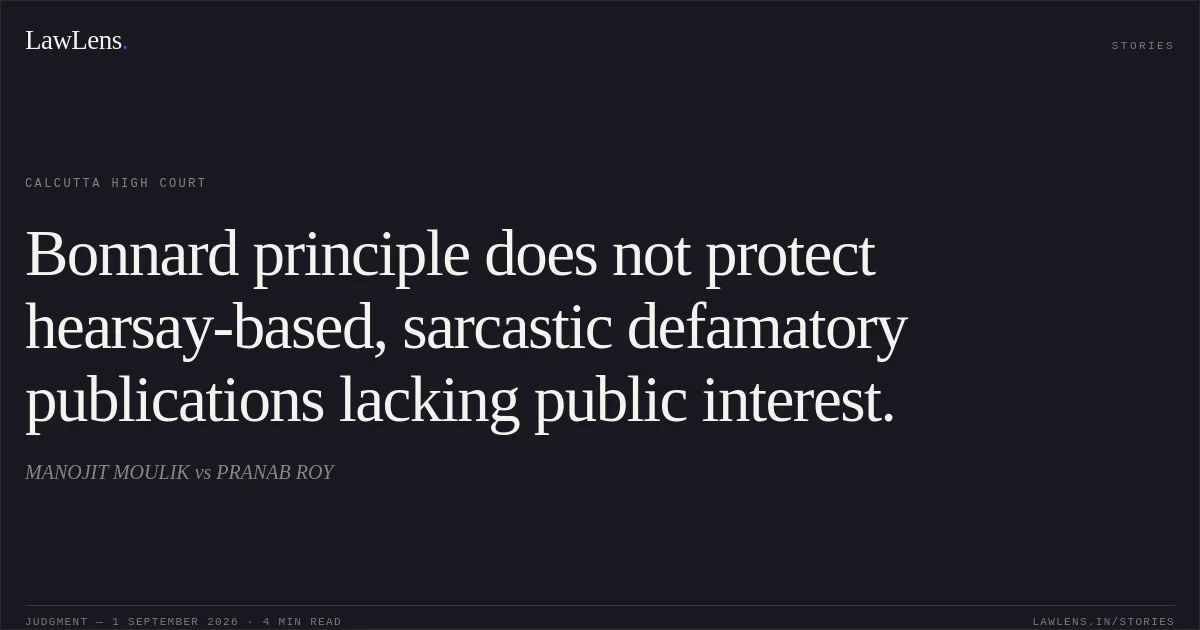
The Court applied the Bonnard principle, as reiterated in Bloomberg Television Production Services India Private Limited v. Zee Entertainment Enterprises Limited, (2025) 1 SCC 741, under which courts ordinarily should not restrain allegedly defamatory publication where the defendant intends to justify the publication or rely on fair comment concerning a matter of public interest.
Source reference: paras. 4, 18–19However, the protection is not absolute: a bare personal perception, sarcastic imputation or disparaging statement unsupported by personal knowledge does not necessarily constitute truth, fair comment or public-interest speech.
Source reference: paras. 20–27The Court also considered the requirements governing temporary and ex parte injunctions under Order XXXIX Rules 1, 2 and 3A of the Code of Civil Procedure, 1908.
Source reference: paras. 7, 28At the interlocutory stage, the court may grant relief on the basis of prima facie defamatory content, while leaving the ultimate truth, merits and defences to determination by the Trial Court.
Source reference: paras. 30, 36Reasoning
The Court found the first post to be plainly derogatory and designed to portray the respondent in a bad light.
Source reference: paras. 14–15, 22–23The language of the post itself indicated that the allegations were hearsay from the appellant’s perspective; consequently, the appellant could not prima facie rely on truth when he lacked personal knowledge of the alleged facts.
Source reference: paras. 16–17The Court further held that the post was judgmental, sarcastic and intended to demean the respondent, rather than being a fair comment on a matter of public interest.
Source reference: paras. 21–27The appellant’s employment in the CAB media cell and the post’s reference to an alleged communication with CAB also permitted an inference that the publication could have been intended to protect CAB’s interests by maligning the respondent.
Source reference: paras. 24–26Although the Court found no ex facie direct connection between the second post and the respondent, it declined to interfere with the injunction because the first post independently disclosed sufficient sarcasm and intended disparagement to support interim relief.
Source reference: paras. 29–31The Court clarified that its observations were preliminary and would not bind the Trial Court in deciding the temporary injunction application or the suit on merits.
Source reference: para. 36Holding
The appeal was dismissed on contest, and the Trial Court’s order dated 10 June 2026 granting the ex parte injunction in Money Suit No. 441 of 2026 was affirmed.
The Court held that the Bonnard principle was not applicable on the facts, since the first post was prima facie hearsay, sarcastic, judgmental and intended to disparage the respondent rather than constitute truth or fair comment on a matter of public interest.
Source reference: paras. 16–27The appellant was directed to file his written objection to the temporary injunction application by 7 September 2026 and serve an advance copy on the respondent; the Trial Court was directed to hear the application on 8 September 2026 and dispose of it by 15 September 2026.
Source reference: paras. 34–35CAN 1 of 2026 was disposed of, with no order as to costs.
Source reference: paras. 38–39Original Court PDF
MANOJIT MOULIKvsPRANAB ROY
Click to open original judgment
Original judgment, available to read, download and summarize on LawLens.in