Facts
The petitioner, S. Thilagar, Managing Director of Sevens Global Trading Pvt. Ltd., Thanjavur, availed various loan facilities totalling Rs. 95.03 lakhs from the respondent, Indian Overseas Bank, Thanjavur.
Source reference: para. 2, p.2To secure the said loan, a Memorandum of Deposit of Title Deeds was executed, and title deeds belonging to a third party, S. Alangaram, were offered as collateral security by way of an equitable mortgage over the subject property — residential land and building situated at Old Survey No. 261/3, New Survey Nos. 396/23 and 396/24, New Burma Colony, Navalpattu Village, Thiruverumbur Taluk, Tiruchirappalli District, under a supplementary MOD registered as Doc No. 1519/2019 dated 21.03.2019.
Source reference: para. 2, p.2–3; Prayer, p.1Upon enforcement, the respondent Bank issued a possession notice, which S. Alangaram challenged in S.A. No. 23 of 2024 before the Debt Recovery Tribunal, Chennai; the same remains pending.
Source reference: para. 4, p.3The subsequent sale notice was separately challenged before the DRT by the petitioner, his father, and S. Alangaram; all such applications were dismissed, and the connected proceedings are pending before the appropriate forum.
Source reference: para. 4, p.3–4The petitioner then approached the High Court under Article 226 seeking a Writ of Mandamus directing the Bank to release the third-party collateral security documents, contending that he is a bona fide borrower willing to pay Rs. 15,00,000/-.
Source reference: Prayer, p.1; para. 3, p.3The respondent Bank stated on record that S. Alangaram has never directly approached it seeking return of the original title deeds.
Source reference: para. 5, p.4Issues
1. Whether the petitioner, not being the owner/mortgagor of the property offered as third-party collateral security, possesses the locus standi to seek a direction for the return of the original title deeds.
Source reference: para. 3, p.32. Whether the High Court, in the exercise of writ jurisdiction under Article 226, ought to direct the Bank to release the title deeds when the borrower's liability remains undischarged and the Debt Recovery Tribunal is already seized of parallel proceedings arising from the same mortgage and recovery action.
Source reference: para. 4–5, p.3–4Law Applied
The Court applied the contractual principle governing mortgages, namely, that once a mortgage is created, the relationship between the parties is governed by the terms of the contract, and it is the mortgagor alone who is entitled to seek the return of the title deeds upon discharge of the liability.
Source reference: para. 3, p.3It further applied the doctrine of locus standi, under which a stranger to the mortgaged property cannot maintain a claim for the release of title deeds belonging to another.
Source reference: para. 3, p.3The Court also invoked the settled principle governing the scope of writ jurisdiction under Article 226, holding that disputed questions — such as the petitioner's bona fides and his offer of part-payment — are matters to be examined by the creditor Bank and cannot be adjudicated in a writ petition.
Source reference: para. 3, p.3Finally, the Court applied the doctrine of judicial restraint where a statutory alternative forum is seized of the matter, holding it neither proper nor prudent to issue interim directions when the Debt Recovery Tribunal is already in seisin of the dispute.
Source reference: para. 5, p.4Reasoning
Applying the law of mortgage to the facts, the Court reasoned that the equitable mortgage over the subject property was created by S. Alangaram, the owner of the title deeds, and consequently only he — as mortgagor — could seek their return upon discharge of the liability; the petitioner, who is not the owner of the mortgaged property, lacked locus standi to maintain the prayer.
Source reference: para. 3, p.3The petitioner's plea of being a bona fide borrower willing to deposit Rs. 15,00,000/- was held to be a matter exclusively for the respondent Bank's consideration, falling outside the scope of writ adjudication.
Source reference: para. 3, p.3The Court drew a significant inference from S. Alangaram's filing of S.A. No. 23 of 2024 before the DRT, Chennai, holding that it demonstrated his full awareness of the MOD, the mortgage over his property, and the possession proceedings initiated by the Bank.
Source reference: para. 4, p.3It further noted that the challenges to the sale notice — mounted by the petitioner, his father, and S. Alangaram — had already been dismissed by the DRT and that proceedings remained pending before the appropriate forum.
Source reference: para. 4, p.3–4Given that the DRT was already seized of the controversy, the Court held that issuing any interim direction would be improper and imprudent, and that absent discharge of the outstanding dues, no direction for release of title deeds could issue.
Source reference: para. 5, p.4Holding
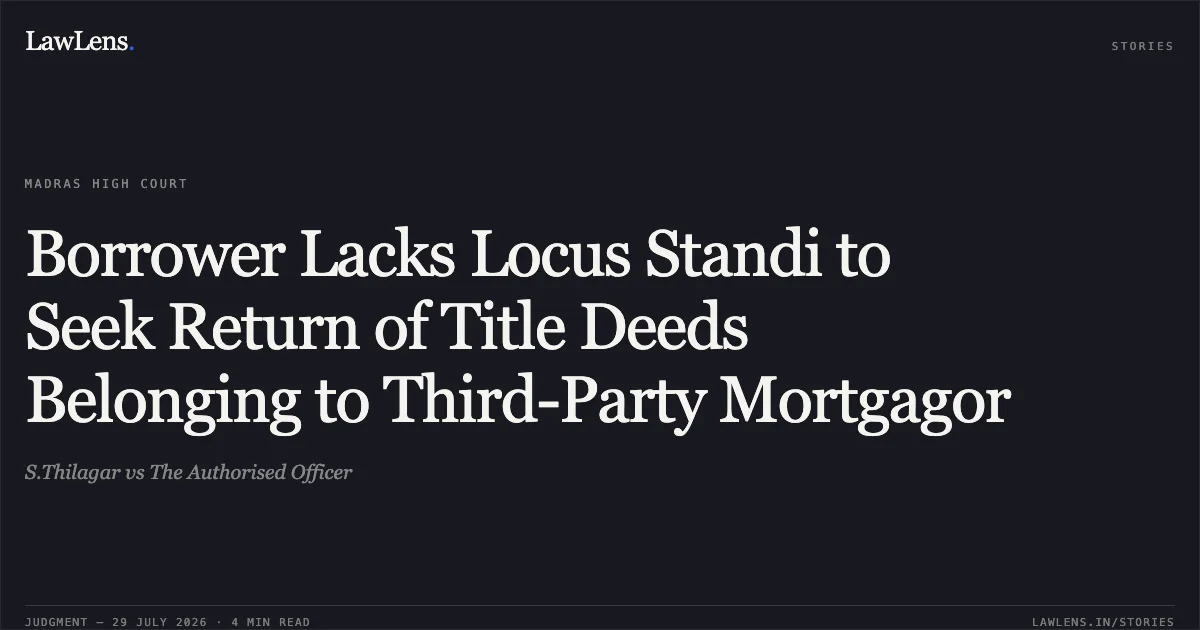
The Court answered both issues against the petitioner: a non-mortgagor borrower has no locus standi to seek release of third-party collateral title deeds, and no mandamus can lie to the Bank while dues remain undischarged and the DRT is seized of the matter.
The writ petition was accordingly dismissed with liberty to the petitioner to work out his remedy before the Debt Recovery Tribunal, if so advised.
Source reference: para. 5, p.4Original Court PDF
S.ThilagarvsThe Authorised Officer
Click to open original judgment
Original judgment, available to read, download and summarize on LawLens.in