Facts
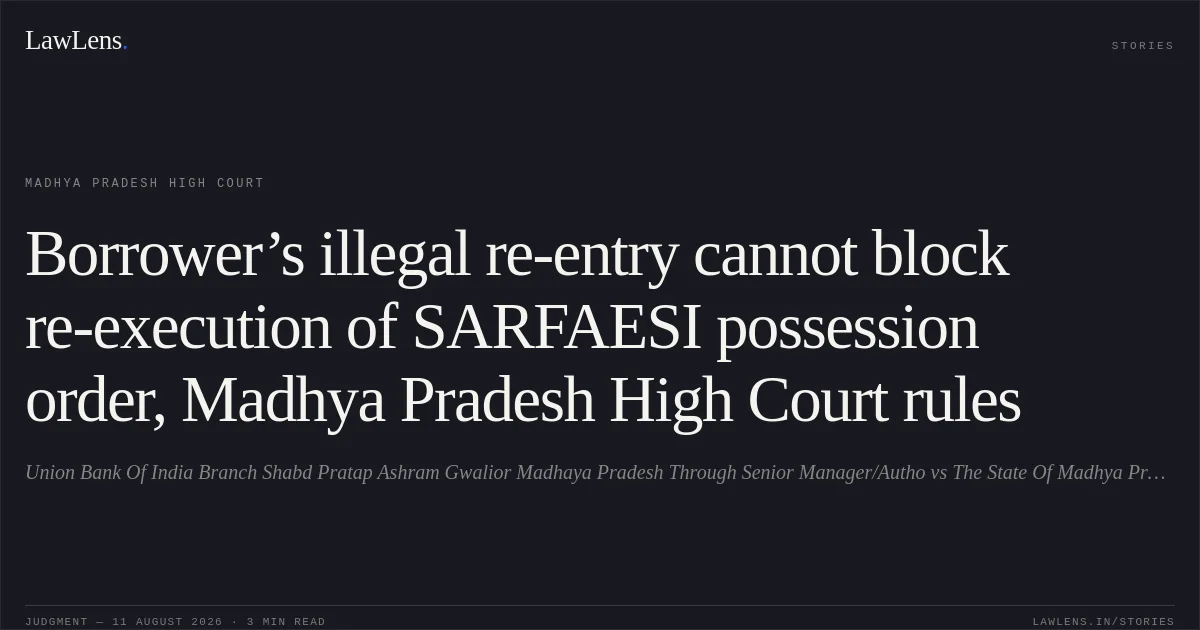
The petitioner-Bank obtained an order dated 26 September 2022 from the District Magistrate, Gwalior under Section 14 of the Securitisation and Reconstruction of Financial Assets and Enforcement of Security Interest Act, 2002 (“SARFAESI Act”) for taking possession of the secured asset, namely House No. 1/3265, Plot No. 121, Block-B, Ward No. 1, Girraj Park Ki Kisari, Anand Nagar, Bahodapur Awasiya Yojna, Gwalior.
Source reference: pp. 1–2, paras. 1–5Pursuant to that order, possession was handed over to the Bank. The borrower, Manoj Kumar Mahor, and his family members allegedly re-entered the property on 18 June 2026 on the pretext of removing household articles and thereafter retained possession. The Bank sought restoration of possession from the authorities by application dated 2 June 2026, but no action was taken.
Source reference: pp. 1–2, paras. 1–5The State opposed the petition, contending that the Section 14 order had already been executed and that the Bank was responsible for safeguarding the property after possession had been delivered.
Source reference: pp. 1–2, paras. 1–5Issues
Whether the authorities may re-execute or provide further assistance under an existing order passed under Section 14 of the SARFAESI Act when the borrower illegally re-enters the secured asset after possession has been delivered to the secured creditor.
Source reference: pp. 2–3, paras. 3–6Whether the secured creditor is entitled to a writ directing the State authorities to dispossess the borrower and restore possession of the secured asset to the Bank.
Source reference: pp. 1, 7–8, paras. 1, 7–9Law Applied
The Court applied Article 226 of the Constitution and Section 14 of the SARFAESI Act, under which the District Magistrate or Chief Metropolitan Magistrate is required to assist a secured creditor in taking possession of a secured asset and may authorise subordinate officers and use necessary force to secure compliance.
Source reference: pp. 4–6, para. 9The Court held that Section 14 contains no legal bar against re-executing a possession order or providing re-assistance where possession, once delivered, has been unlawfully interfered with.
Source reference: p. 6, paras. 10–12It relied principally on Cholamandalam Investment and Finance Company Ltd. v. District Magistrate, District Gwalior & Ors., W.P. No. 1681/2025, decided on 16 June 2025, which held that illegal re-entry by a borrower does not prevent restoration of possession under the existing Section 14 order.
Source reference: pp. 2–3, 6–7, paras. 3, 6, 18The Court also relied on the Full Bench decision in W.P. No. 11500/2020, which characterised action under Section 14 as ministerial and undertaken in aid of the secured creditor, and referred to analogous Bombay High Court decisions directing re-execution of possession orders.
Source reference: p. 6, paras. 14–17Reasoning
The Court treated the borrower’s re-entry after delivery of possession as an unlawful act that could not nullify the Bank’s statutory entitlement or render the District Magistrate functus officio.
Source reference: pp. 5–6, paras. 10–12Section 14 is intended to facilitate recovery by secured creditors and to prevent defaulting borrowers from frustrating enforcement proceedings.
Source reference: pp. 6–7, paras. 10–18Consequently, the State’s argument that the order had been exhausted upon its first execution was rejected.
Source reference: pp. 6–7, paras. 10–18The Court reasoned that permitting such a position would allow illegality to defeat the SARFAESI mechanism and undermine the rule of law.
Source reference: pp. 6–7, paras. 10–18Although the Bank had a duty to safeguard possession, that circumstance did not authorise the borrower to retain possession obtained through alleged illegal re-entry.
Source reference: pp. 6–7, paras. 10–18The authorities were therefore required to provide police and administrative assistance to dispossess the borrower and restore possession to the Bank.
Source reference: pp. 6–7, paras. 10–18Holding
The petition was allowed.
The Court directed the respondent authorities to provide necessary assistance and aid to dispossess the borrower from the secured property and restore possession to the petitioner-Bank in accordance with law.
Source reference: p. 7, paras. 7–8The petition was accordingly disposed of, with no order as to costs.
Source reference: p. 8, para. 9Acts & Sections Cited
3 provisions across 2 statutes referred to in this judgment. Each provision opens on LawLens.
Securitisation and Reconstruction of Financial Assets and Enforcement of Security Interest Act, 20022
MP Land Revenue Code 19591
Original Court PDF
Union Bank Of India Branch Shabd Pratap Ashram Gwalior Madhaya Pradesh Through Senior Manager/AuthovsThe State Of Madhya Pradesh
Click to open original judgment
Original judgment, available to read, download and summarize on LawLens.in