Facts
The petitioners agreed to sell property to the complainant under an agreement dated 16 September 2022 and received ₹20,00,000 in two instalments.
Source reference: para. 3–5, 9–10Before the stipulated period expired, they sold the property to accused No. 3 by a registered sale deed dated 21 November 2022.
Source reference: para. 3–5, 9–10The complainant alleged that the petitioners and accused No. 3 acted in concert to defeat his rights under the agreement.
Source reference: para. 3–5, 9–10The complainant had filed a civil suit for specific performance, which remained pending.
Source reference: para. 6, 17Bellandur Police registered Crime No. 554/2025 for offences under Sections 420, 477A, 425, 415 and 417 of the Indian Penal Code, 1860.
Source reference: para. 2, 7–8The petitioners sought quashing of the proceedings under Section 482 of the Code of Criminal Procedure, 1973 (Section 528 of the Bharatiya Nagarik Suraksha Sanhita, 2023).
Source reference: para. 2, 7–8Issues
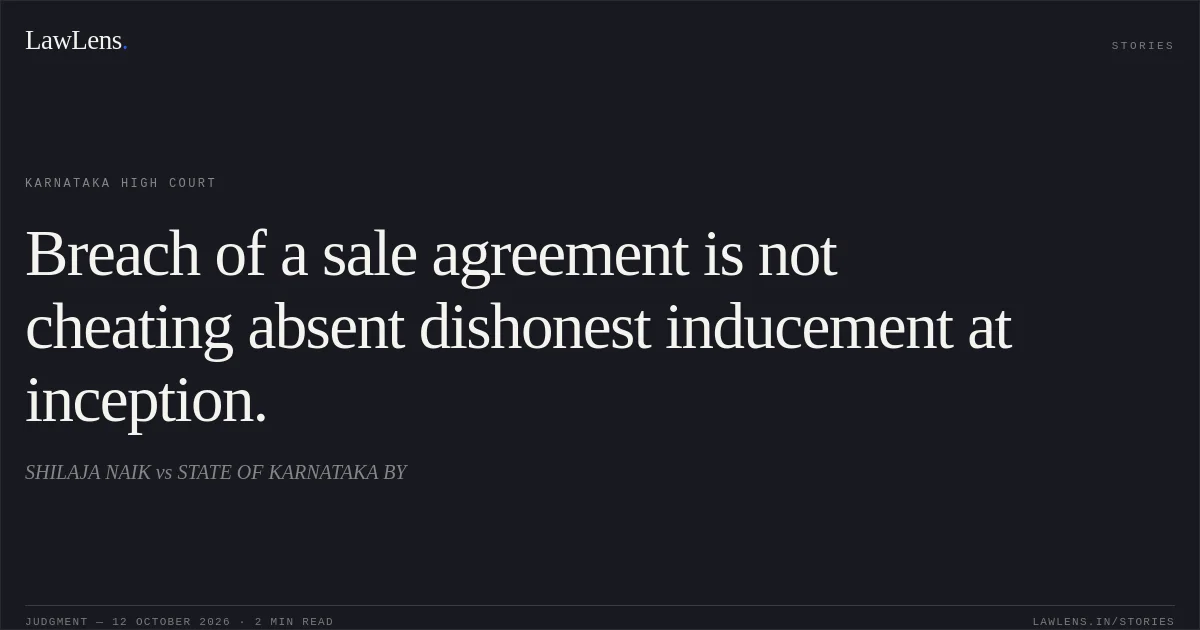
Whether the complaint alleged the inducement and dishonest intention necessary to constitute cheating under Sections 415 and 420 IPC.
Source reference: para. 7, 12–16Whether, in the circumstances—including the pending civil suit—the criminal proceedings should be quashed as untenable.
Source reference: para. 17–19Law Applied
Section 415 IPC defines cheating as deception that fraudulently or dishonestly induces a person to deliver property, or intentionally induces an act or omission likely to cause harm; dishonest concealment of facts is also deception.
Source reference: para. 12To attract cheating based on delivery of property, the complaint must disclose inducement and that the person parted with or delivered property because of it.
Source reference: para. 13, 16The petition invoked the High Court’s inherent jurisdiction under Section 482 CrPC, corresponding to Section 528 BNSS, to seek quashing of the criminal proceedings.
Source reference: case heading; para. 2The judgment cites no precedents.
Source reference: no citationReasoning
The Court examined the complaint, particularly paragraphs 14 and 15, and found that it alleged the subsequent sale of the property during the subsistence of the agreement, but did not allege that, when entering the agreement, the petitioners intended to cheat or induced the complainant to part with money.
Source reference: para. 14–16The complainant’s specific-performance suit was already pending, and he had issued notice to the petitioners before filing it.
Source reference: para. 17In the Court’s view, the dispute was therefore one for resolution through the civil proceedings, and the criminal complaint was wholly untenable on the allegations presented.
Source reference: para. 18–19Holding
The Court allowed the petition and quashed the proceedings in Crime No. 554/2025 registered by Bellandur Police.
It clarified that its observations did not express an opinion on the merits of the pending civil suit and directed that the suit be decided uninfluenced by those observations.
Source reference: para. 20(iii)–(iv)Acts & Sections Cited
6 provisions across 3 statutes referred to in this judgment. Each provision opens on LawLens.
Code of Criminal Procedure, 19731
Bharatiya Nagarik Suraksha Sanhita, 20231
Indian Penal Code, 18604
Original Court PDF
SHILAJA NAIKvsSTATE OF KARNATAKA BY
Click to open original judgment
Original judgment, available to read, download and summarize on LawLens.in