Facts
Opposite Party No. 2 alleged that an agreement for sale was executed on 22 March 1991 between him and the accused persons, including the petitioner’s late father, Gopeswar Prasad Chowdhury, concerning immovable property at Mouza Barapalasan, Purba Bardhaman. The complainant claimed to have paid ₹1,58,000/- but alleged that possession was not delivered, no registered conveyance deed was executed, and the property was subsequently transferred to third parties without notice
Source reference: para. 2On the basis of the complaint dated 26 December 2022, Memari Police Station Case No. 834 of 2022 was registered under Sections 420/406/34 IPC. During investigation, the police collected witness statements, land records, the agreement for sale, and money receipts dated between 1992 and 1995, and thereafter submitted Charge Sheet No. 776 of 2023 against the petitioner and two co-accused persons
Source reference: para. 3The Chief Judicial Magistrate took cognizance on 13 December 2023. The petitioner invoked Sections 401 and 482 CrPC seeking quashing of the entire proceeding, contending that the dispute was civil in nature and that no criminal intent or entrustment was attributable to him
Source reference: paras. 1, 4Issues
Whether the allegations in the FIR and the materials collected during investigation, taken at face value, disclosed the essential ingredients of offences under Sections 420 and 406 read with Section 34 IPC against the petitioner
Source reference: para. 6Whether the dispute was essentially civil in nature and whether continuation of the criminal proceeding constituted an abuse of the process of court warranting interference under Sections 401 and 482 CrPC
Source reference: para. 6Law Applied
The Court applied Sections 401 and 482 CrPC, recognising the High Court’s revisional and inherent jurisdiction to prevent abuse of process and secure the ends of justice
Source reference: paras. 1, 13Section 420 IPC, read with the definition of cheating under Section 415 IPC, requires deception and fraudulent or dishonest inducement at the inception of the transaction, resulting in delivery of property and wrongful gain or loss
Source reference: para. 10Section 406 IPC, read with Section 405 IPC, requires entrustment or dominion over property followed by dishonest misappropriation or conversion
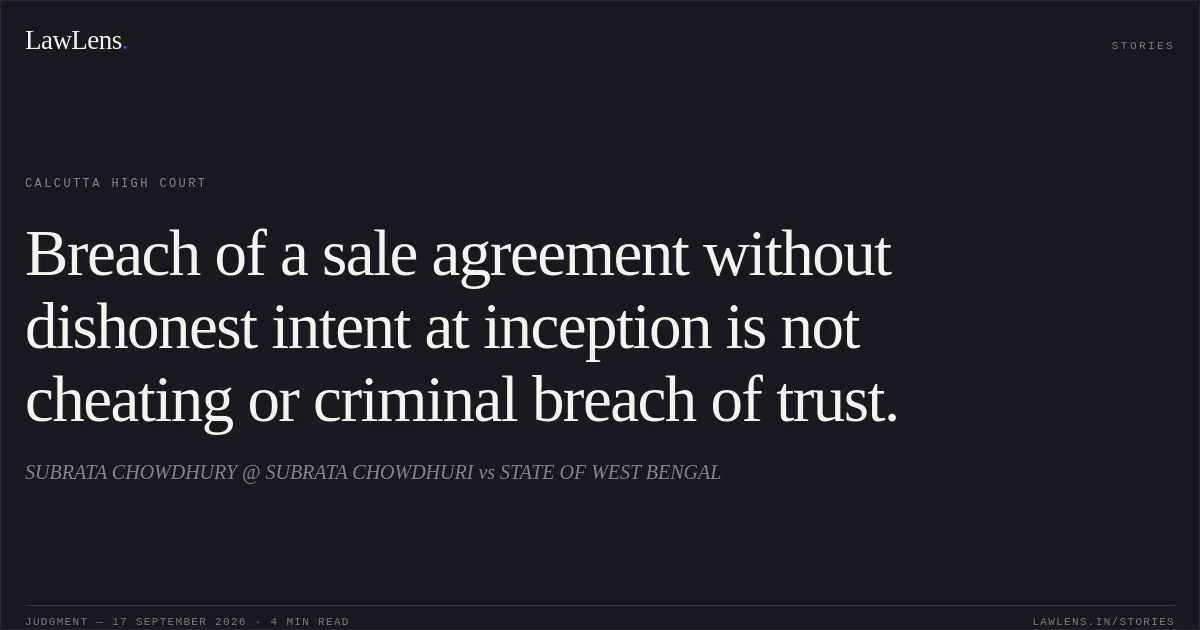
Source reference: para. 10The Court relied on Murari Lal Gupta v. Gopi Singh, (2005) 13 SCC 699, for the principle that mere failure to honour an agreement for sale does not, without dishonest intention from the beginning, constitute cheating or criminal breach of trust
Source reference: para. 11It also relied on Indian Oil Corpn. v. NEPC India Ltd., (2006) 6 SCC 736, and the related principle that essentially civil disputes should not be converted into criminal prosecutions to exert pressure or settle civil claims
Source reference: para. 14Reasoning
The Court found that the transaction arose from an agreement for sale executed in 1991 and was, in substance, a contractual dispute concerning immovable property
Source reference: paras. 8–9The principal contracting party was the petitioner’s deceased father, and the materials did not disclose that the petitioner possessed a dishonest or fraudulent intention at the inception of the transaction
Source reference: para. 9The alleged subsequent failure to execute a conveyance deed or deliver possession could amount, at most, to breach of contractual obligations; it could not by itself establish the initial deception or dishonest inducement required under Sections 415 and 420 IPC
Source reference: paras. 10–11Likewise, payment of advance consideration under an agreement for sale did not constitute entrustment sufficient to attract Sections 405/406 IPC
Source reference: para. 10The Court further noted the unexplained delay of more than 31 years in initiating the criminal case and held that the petitioner could not be subjected to criminal liability merely as a legal heir for an alleged contractual default of his deceased father
Source reference: para. 12In these circumstances, the criminal proceeding appeared to have been instituted to bypass civil remedies and limitations and therefore amounted to an abuse of process
Source reference: paras. 12–14Holding
The Court answered the first issue in the negative, holding that the materials did not disclose the essential ingredients of Sections 420 or 406 IPC against the petitioner
It answered the second issue in the affirmative, holding that the dispute was predominantly civil and that continuation of the criminal proceeding would constitute an abuse of the process of court
Source reference: para. 14Accordingly, CRR 2318 of 2024 was allowed, and G.R. Case No. 6653 of 2022 arising out of Memari Police Station Case No. 834 of 2022, together with the order of cognizance dated 13 December 2023, was quashed insofar as the petitioner, Subrata Chowdhury @ Subrata Chowdhuri, was concerned
Source reference: paras. 16–17The connected application, CRAN 1 of 2025, was disposed of, with no order as to costs
Source reference: paras. 19–20Acts & Sections Cited
10 provisions across 2 statutes referred to in this judgment. Each provision opens on LawLens.
Code of Criminal Procedure, 19735
Indian Penal Code, 18605
Original Court PDF
SUBRATA CHOWDHURY @ SUBRATA CHOWDHURIvsSTATE OF WEST BENGAL
Click to open original judgment
Original judgment, available to read, download and summarize on LawLens.in