Facts
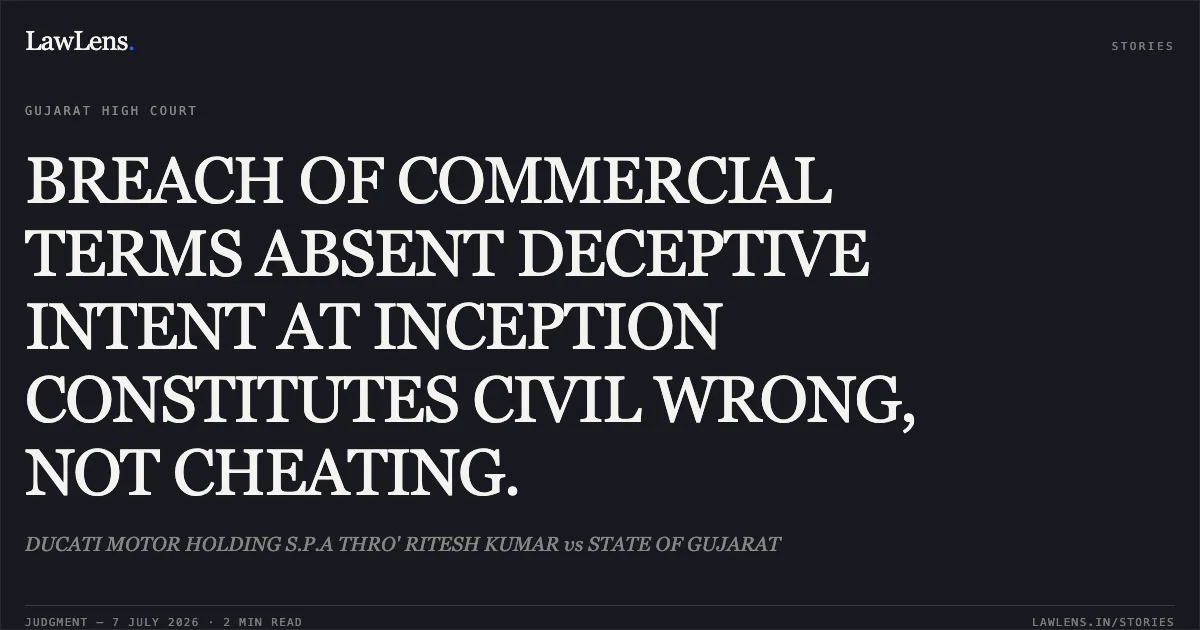
The petitioners (Accused Nos. 2 and 5) sought to quash a private complaint filed under Sections 406, 420, 120(b), 418, 504, and 114 of the IPC
Source reference: p. 1-2The complainant, General Manager of Cama Motors Pvt. Ltd., alleged that Accused No. 7 (Precision Motors), acting as a distributor for Petitioner No. 5 (Ducati), induced them into a dealership via a Letter of Intent (LOI) dated 24.06.2010
Source reference: p. 2The complainant claimed the accused misrepresented the marketability and supply of bikes, demanded 100% advance payments and bank guarantees despite contrary assurances, and delivered defective or incorrect models
Source reference: p. 3-4Petitioner No. 2 (CEO of Ducati) was alleged to have visited the showroom and given vague "wrong promises"
Source reference: p. 10A civil suit for the same grievance had been filed prior to the criminal complaint
Source reference: p. 6Issues
1. Whether the allegations in the complaint, taken at face value, satisfy the essential ingredients of cheating and dishonest inducement under Sections 415, 418, and 420 of the IPC against the petitioners
Source reference: para. 7-122. Whether the dispute is predominantly civil in nature, such that criminal proceedings constitute an abuse of the process of the court
Source reference: para. 13-14Law Applied
The court applied Section 415 IPC defining "cheating" and Section 420 IPC regarding "dishonest inducement," noting that a fraudulent intention must exist at the inception of the transaction
Source reference: para. 8-9, 14Relying on Vijay Kumar Ghai v. State of West Bengal [(2022) 7 SCC 124], the court held that mere breach of contract does not constitute cheating unless dishonest intention is shown right from the beginning
Source reference: para. 14It further applied the four-step analytical framework from Pradeep Kumar Kesarwani v. State of Uttar Pradesh [AIROnline 2025 SC 956] to determine if quashing under Section 482 Cr.P.C. is warranted to prevent the abuse of judicial process
Source reference: para. 10, 13Reasoning
The court found no specific allegations or evidence that Petitioner Nos. 2 or 5 made direct false promises or representations to the complainant. The LOI was exclusively between the complainant and Accused No. 7/Accused No. 1
Source reference: para. 11The "Exclusive Distribution Agreement" between Ducati and its distributor explicitly stated that the distributor's actions would not bind Ducati
Source reference: para. 4, 12The court noted that Petitioner No. 2’s emails and visits were efforts to resolve operational issues rather than evidence of a criminal conspiracy
Source reference: para. 13, 17Applying the Kesarwani test, the court determined that the documentary evidence (emails and agreements) refuted the factual assertions in the complaint. Since the dispute arose from a commercial dealership arrangement and the petitioners were not parties to the specific contracts alleged to have been breached, the criminal case lacked the requisite mens rea for cheating
Source reference: para. 13.1, 15Holding
The court answered both issues in the affirmative, holding that the complaint failed to disclose any cognizable criminal offence against Petitioner Nos. 2 and 5.
The High Court allowed the petition and quashed Inquiry Case No. 5 of 2012 and all consequential proceedings specifically against the petitioners, while allowing the Magistrate to proceed against other accused persons independently
Source reference: para. 21-22Acts & Sections Cited
14 provisions across 2 statutes referred to in this judgment. Each provision opens on LawLens.
Code of Criminal Procedure, 19735
Original Court PDF
DUCATI MOTOR HOLDING S.P.A THRO' RITESH KUMARvsSTATE OF GUJARAT
Click to open original judgment
Original judgment, available to read, download and summarize on LawLens.in