Facts
The Petitioner (a film producer from Madhya Pradesh) and Opposite Party No. 2 (the Complainant) entered into an agreement to co-produce a film titled "ARAAJAK" on a 50-50% investment and profit-sharing basis.
Source reference: para 3The Complainant alleged he invested ₹31,85,000, but the Petitioner failed to pay his share or return the investment, thereby committed fraud.
Source reference: para 3Prior to this complaint, the Complainant attempted to lodge an FIR in Jabalpur, M.P., where the police concluded the claim was premature as the film remains unreleased.
Source reference: para 6Subsequently, the Complainant filed a complaint in Patna, and the Judicial Magistrate took cognizance under Sections 406 and 420 of the IPC on 01.07.2023.
Source reference: para 2, 4The Petitioner moved the High Court to quash the order, arguing it was a civil breach of contract and lacked territorial jurisdiction in Bihar.
Source reference: para 7-8Issues
1. Whether the allegations in the complaint constitute criminal offences under Sections 406 and 420 of the IPC or are purely civil in nature regarding a breach of contract.
Source reference: para 152. Whether the criminal proceedings amount to an abuse of the process of law given the prior failed attempts to litigate the same facts in another state.
Source reference: para 7, 17Law Applied
The Court primarily applied Section 406 (criminal breach of trust) and Section 420 (cheating) of the Indian Penal Code.
Source reference: para 2It relied on the principle that a mere breach of contract does not attract criminal liability unless dishonest intention existed at the inception of the transaction.
Source reference: para 7, 15The Court specifically cited *Delhi Race Club (1940) Limited and Ors. vs State of Uttar Pradesh and Another* (2024 10 SCC 690), which held that offences under Sections 406 and 420 IPC generally cannot go side by side as they are based on distinct legal premises.
Source reference: para 16It also considered Section 73 of the Indian Contract Act, 1872 regarding damages for breach of contract.
Source reference: para 13Reasoning
The Court observed that the legal notice sent by the Complainant explicitly described the dispute as a "breach of contract" and sought damages under the Indian Contract Act.
Source reference: para 13-14The court found that the Complainant’s own admissions indicated the dispute arose from the non-performance of contractual terms regarding profit-sharing and investment.
Source reference: para 15Since the film had not yet been released, the police inquiry in Jabalpur had already deemed the claim premature.
Source reference: para 6The High Court reasoned that the essential ingredients of cheating (dishonest inducement at the start) and criminal breach of trust were absent; instead, the case represented a civil dispute dressed up as a criminal one.
Source reference: para 15-16Furthermore, the court noted that the agreement was executed in Mumbai and the petitioner resided in Jabalpur, raising significant territorial jurisdiction concerns for a case filed in Patna.
Source reference: para 8Holding
The High Court answered that the dispute is civil in nature and the application of Sections 406 and 420 IPC is legally untenable in this context.
The Court held that continuing the criminal proceedings would amount to an abuse of the process of the court.
Source reference: para 17Consequently, the application was allowed, and the order of cognizance dated 01.07.2023 passed by the Judicial Magistrate 1st Class, Patna, in Complaint Case No. 1965(c) of 2023 was set aside.
Source reference: para 17-18Acts & Sections Cited
5 provisions across 2 statutes referred to in this judgment. Each provision opens on LawLens.
Indian Penal Code, 18604
Indian Contract Act, 18721
Original Court PDF
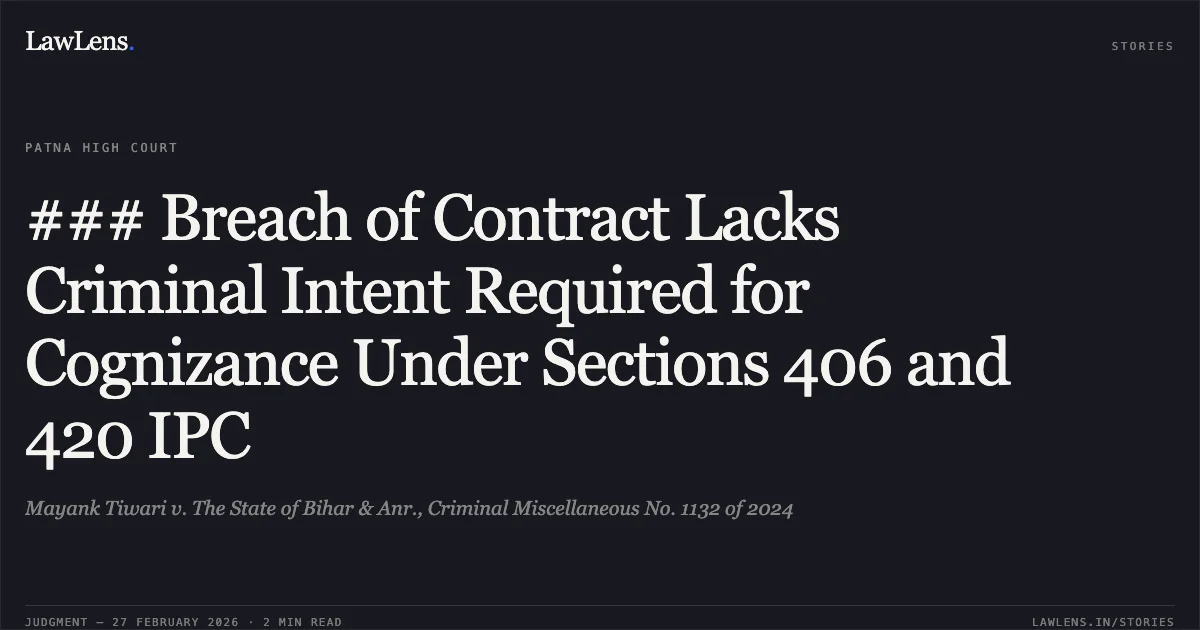
Mayank Tiwari v. The State of Bihar & Anr., Criminal Miscellaneous No. 1132 of 2024
Click to open original judgment
Original judgment, available to read, download and summarize on LawLens.in