Facts
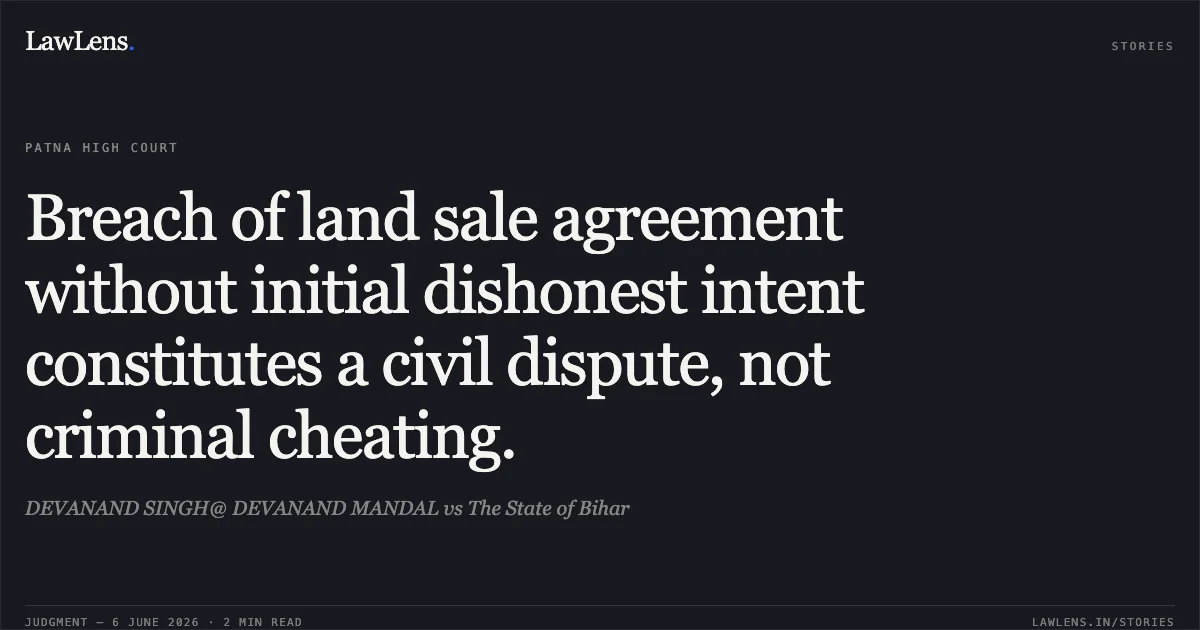
The petitioner sought to quash a cognizance order dated 29.06.2022.
Source reference: p. 1The complainant, a land broker, alleged that the petitioner induced him to enter into a land agreement for 73½ decimals of land for a consideration of over Rs. 2.35 Crores, of which the complainant paid approximately Rs. 2 Crores.
Source reference: p. 2The sale was not completed within the stipulated timeframe.
Source reference: p. 2The petitioner contended that the matter was a civil dispute arising from commercial transactions involving immovable property, noting that a title suit for registration and a cross-complaint by the landowner were already pending.
Source reference: p. 2Issues
1. Whether the allegations in the complaint, taken at face value, disclose a criminal offense of cheating under Section 420 IPC or merely a civil breach of contract.
Source reference: p. 32. Whether the criminal proceedings for offenses under Sections 323, 504, and 506 IPC are sustainable in the absence of specific factual particulars.
Source reference: p. 3Law Applied
The Court relied on the landmark precedent State of Haryana v. Bhajan Lal (1992 Supp (1) SCC 335), which establishes that inherent powers to quash should be exercised where a complaint does not disclose a cognizable offense or constitutes an abuse of process.
Source reference: p. 2It further applied the principle from Hridaya Ranjan Prasad Verma v. State of Bihar (2000 4 SCC 168), which distinguishes between a breach of contract and cheating based on the existence of fraudulent or dishonest intention at the time of the initial inducement.
Source reference: p. 3Sections 420 (cheating), 323 (voluntary hurt), 504 (intentional insult), and 506 (criminal intimidation) of the Indian Penal Code (IPC) were the primary statutes under review.
Source reference: p. 1Reasoning
Applying the Hridaya Ranjan test, the Court found that the complaint described a commercial arrangement that failed to reach completion, but lacked any material indicating the petitioner had a dishonest intention at the inception of the transaction.
Source reference: p. 3The Court reasoned that a subsequent failure to keep a promise does not automatically presume a culpable intention at the start.
Source reference: p. 3Regarding the charges under Sections 323, 504, and 506 IPC, the Court observed that the complaint was "bereft of any particulars" regarding specific acts of assault or intimidation, concluding these charges were added mechanically without factual foundation.
Source reference: p. 3Consequently, the Court determined the dispute was essentially contractual and the criminal process was being misused as a substitute for civil remedies like specific performance or recovery.
Source reference: p. 4Holding
The Court answered the issues in the affirmative, holding that the continuation of criminal proceedings would amount to an abuse of the process of the Court.
The Court allowed the quashing application and set aside the order taking cognizance dated 29.06.2022 in Complaint Case No. 152 of 2020 as it pertained to the petitioner.
Source reference: p. 4Acts & Sections Cited
5 provisions across 1 statute referred to in this judgment. Each provision opens on LawLens.
Indian Penal Code, 18605
Original Court PDF
DEVANAND SINGH@ DEVANAND MANDALvsThe State of Bihar
Click to open original judgment
Original judgment, available to read, download and summarize on LawLens.in