Facts
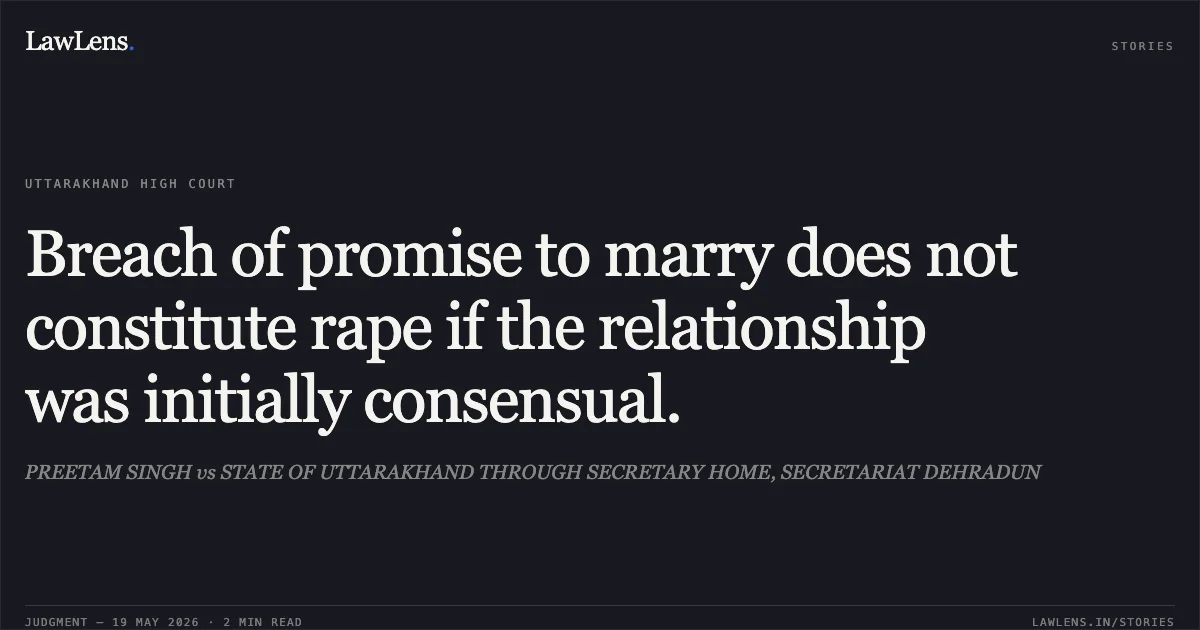
The applicant sought the quashing of a chargesheet and summoning order dated 19.09.2022 in Criminal Case No. 6496 of 2022, involving an offence under Section 376 of the Indian Penal Code (IPC).
Source reference: para. 3The respondent no. 2 (victim) alleged that the applicant established physical relations with her on a promise of marriage while they were in Dehradun for coaching classes.
Source reference: para. 4Matrimonial negotiations were actively ongoing between both families.
Source reference: para. 4, 11After the applicant informed the victim that his marriage had been fixed elsewhere, an F.I.R. was lodged.
Source reference: para. 4Subsequently, the parties moved a joint compounding application asserting the relationship was consensual and failed due to unavoidable circumstances.
Source reference: para. 7Issues
1. Whether the breach of a promise to marry, in the context of a long-term consensual relationship where matrimonial talks were ongoing, constitutes the offence of rape under Section 376 IPC.
Source reference: para. 122. Whether the continuation of criminal proceedings, in light of the victim’s admission of consensual relations, would amount to an abuse of the process of law.
Source reference: para. 14Law Applied
The court primarily applied Section 376 of the IPC regarding rape and assessed the validity of "consent" under Section 90 of the IPC, which negates consent given under a "misconception of fact".
Source reference: para. 3, 6The court relied on the established legal principle that every breach of promise to marry does not amount to rape unless it is proven that the promise was false and fraudulent from the very inception (i.e., a "lucid intervals" or "mere device" to obtain sex).
Source reference: para. 12Furthermore, the court exercised its inherent powers under Section 482 of the Cr.P.C. to prevent the abuse of the process of any court.
Source reference: para. 14, 15Reasoning
The Court observed that the physical relationship was not based on a fraudulent promise but emanated from a pre-existing matrimonial understanding involving both families.
Source reference: para. 11It noted that the allegations and material collected during investigation showed the relationship was consensual over a considerable period.
Source reference: para. 11The Court emphasized that there was no prima facie evidence that the applicant never intended to marry the victim from the beginning.
Source reference: para. 11It specifically highlighted the affidavit filed by respondent no. 2 in previous proceedings, which explicitly characterized the relationship as voluntary and lacking coercion.
Source reference: para. 7, 13Consequently, the Court reasoned that since the marriage failed due to subsequent family circumstances rather than initial deceit, the essential ingredient of "absence of free consent" for a Section 376 IPC charge was missing.
Source reference: para. 12, 13Holding
The Court answered the issues in the negative, holding that a breach of promise caused by subsequent circumstances in a consensual relationship does not attract Section 376 IPC.
The Court held that continuing the prosecution would be an abuse of process.
Source reference: para. 14Accordingly, the application was allowed, and the chargesheet, cognizance order dated 19.09.2022, and the entire proceedings of Criminal Case No. 6496 of 2022 were quashed.
Source reference: para. 15Acts & Sections Cited
3 provisions across 2 statutes referred to in this judgment. Each provision opens on LawLens.
Code of Criminal Procedure, 19731
Indian Penal Code, 18602
Original Court PDF
PREETAM SINGHvsSTATE OF UTTARAKHAND THROUGH SECRETARY HOME, SECRETARIAT DEHRADUN
Click to open original judgment
Original judgment, available to read, download and summarize on LawLens.in