Facts
The prosecution alleged that on December 28, 2007, the appellant raped the victim, then a Class X student, after gagging her mouth
Source reference: p. 2, para. 3Following the incident, the appellant allegedly promised to marry her, leading to a continued physical relationship on 2-3 occasions, resulting in the victim’s pregnancy
Source reference: p. 2, para. 3When the appellant eventually refused to marry her, a village panchayati was convened on May 27, 2008, which proved unsuccessful
Source reference: p. 3, para. 3A complaint was subsequently filed before the Magistrate and registered as an FIR on August 4, 2008
Source reference: p. 4, para. 5The Trial Court (Additional Sessions Judge, F.T.C.-I, Katihar) convicted the appellant under Section 376 of the IPC on September 7, 2011, sentencing him to 10 years of rigorous imprisonment
Source reference: p. 2, para. 2The appellant challenged this conviction on grounds of an unexplained 8-month delay in filing the FIR, the consensual nature of the relationship, and the lack of proof regarding the victim's minority
Source reference: p. 4, para. 5Issues
1. Whether the delay of eight months in lodging the FIR was fatal to the prosecution’s case
Source reference: p. 24, para. 222. Whether the physical relationship was consensual and if consent was vitiated by a "misconception of fact" under Section 90 IPC due to a promise of marriage
Source reference: p. 14-16, para. 15-183. Whether the prosecution established the victim’s minority beyond reasonable doubt at the time of the occurrence
Source reference: p. 26, para. 23Law Applied
The Court applied Section 375 of the IPC defining rape and Section 376 providing punishment
Source reference: p. 10-11, para. 14It relied on Section 90 IPC regarding consent given under a "misconception of fact"
Source reference: p. 12, para. 15The court cited Pramod Suryabhan Pawar v. State of Maharashtra (2019) and Deepak Gulati v. State of Haryana (2013) to distinguish between a "false promise of marriage" (made with mala fide intent at inception to satisfy lust) and a "breach of promise" (a promise made in good faith but not fulfilled due to subsequent circumstances)
Source reference: p. 12-18, para. 15-18It further referenced Mahesh Damu Khare v. State of Maharashtra (2024) regarding the emerging trend of criminalizing prolonged consensual relationships
Source reference: p. 23, para. 20Reasoning
The Court observed that the FIR was lodged nearly eight months after the initial incident, only after marriage negotiations via a panchayati had failed, suggesting the criminal machinery was used as a tool for settlement
Source reference: p. 24-25, para. 22On the issue of age, the prosecution failed to produce documentary evidence; however, the Medical Officer (PW-10) assessed the victim’s age as 18–19 years, leading the Court to treat her as an adult whose consent was relevant
Source reference: p. 26, para. 23The Court found the relationship was prolonged and consensual, evidenced by the victim’s "active and reasoned deliberation" in maintaining the relationship and her subsequent pregnancy without raising an alarm
Source reference: p. 26, para. 23Applying the Pramod Suryabhan Pawar ratio, the Court held that the prosecution failed to prove the appellant had no intention to marry from the very inception; rather, the refusal appeared to be a subsequent development
Source reference: p. 27, para. 24Consequently, the consent was not vitiated by a misconception of fact, and the ingredients of rape under Section 375 were not satisfied
Source reference: p. 27, para. 24Holding
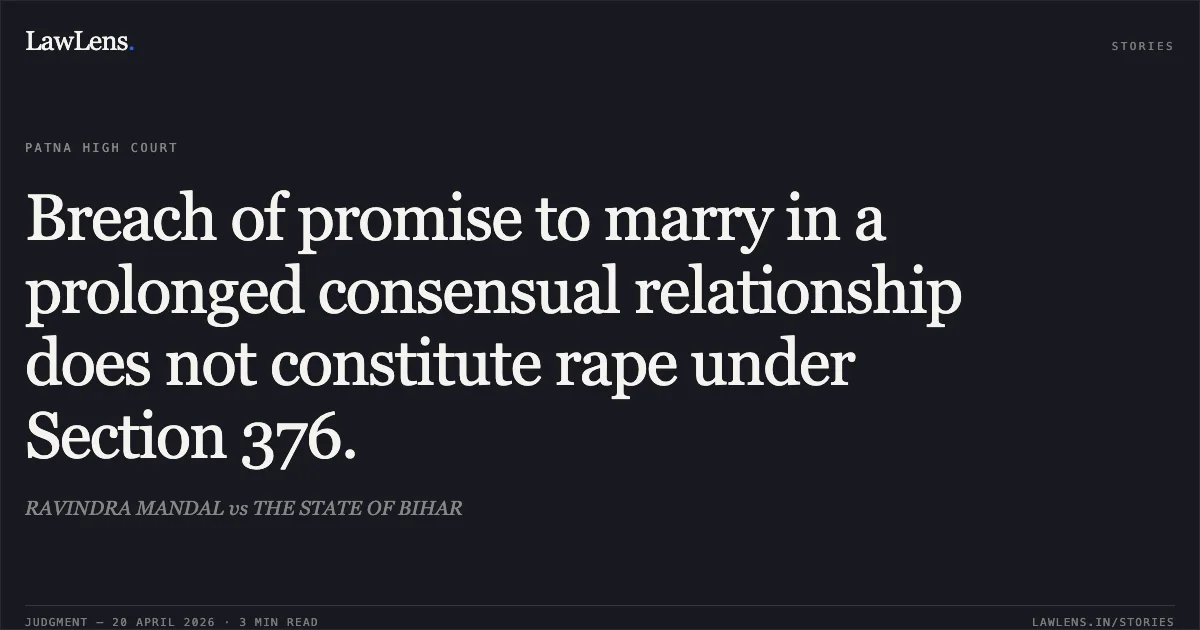
The Court concluded that the physical relationship was consensual and the prosecution failed to establish the essential ingredients of rape
The High Court allowed the appeal, setting aside the judgment of conviction dated September 7, 2011, and the order of sentence dated September 8, 2011. The appellant was acquitted of all charges and discharged from his bail bonds.
Source reference: p. 27-28, para. 25-26The Court also directed the payment of a fee to the Amicus Curiae for his services
Source reference: p. 28, para. 27Acts & Sections Cited
3 provisions across 1 statute referred to in this judgment. Each provision opens on LawLens.
Indian Penal Code, 18603
Original Court PDF
RAVINDRA MANDALvsTHE STATE OF BIHAR
Click to open original judgment
Original judgment, available to read, download and summarize on LawLens.in