Facts
The applicants are retired railway employees from the South Western and Central Railway divisions
Source reference: para 2Following the implementation of the 6th Central Pay Commission (CPC) recommendations, several pre-revised pay scales (Rs. 5000-8000, Rs. 5500-9000, and Rs. 6500-10500) were merged into common Grade Pays of Rs. 4200 and Rs. 4600
Source reference: para 2The applicants contended that their pay was incorrectly fixed using fitment tables applicable to normal replacements rather than following the bunching benefit provisions under Rule 7(1)(A) of the Railway Services (Revised Pay) Rules, 2008
Source reference: para 3They argued that under Illustration 4A/4B of the Rules, they were entitled to additional increments to avoid "bunching" (where seniors and juniors end up at the same pay stage)
Source reference: para 3, 7The respondents maintained that the pay fixation followed RBE No. 103/2008 and that bunching increments only apply if two or more consecutive stages in an existing scale result in the same revised pay, which did not occur in the applicants' cases
Source reference: para 4Issues
Whether the applicants are entitled to bunching benefits under Rule 7(1)(A)(i) and (ii) of the Railway Services (Revised Pay) Rules, 2008, read with Note 2A/2B and Illustrations 4A/4B appended thereto?
Source reference: para 6Law Applied
The court primarily applied Rule 7 of the Railway Services (Revised Pay) Rules, 2008 (RBE 103/2008), which stipulates that revised pay is determined by multiplying existing basic pay by a factor of 1.86
Source reference: para 13The "bunching" proviso therein mandates that if two or more consecutive stages in an existing scale get fixed at the same stage in the revised pay band, one additional increment (3% of pay in the pay band) shall be given for every two stages so bunched
Source reference: para 13The court also relied on Note 2A (Upgradation) and Note 2B (Merger) of the Rules, read with OM dated 13.10.2008 and RBE No. 172/2008, which clarify that in cases of upgradation, the fitment table of the pre-revised scale must be used to determine the pay in the pay band, to which the upgraded Grade Pay is then added
Source reference: para 13, 16Reasoning
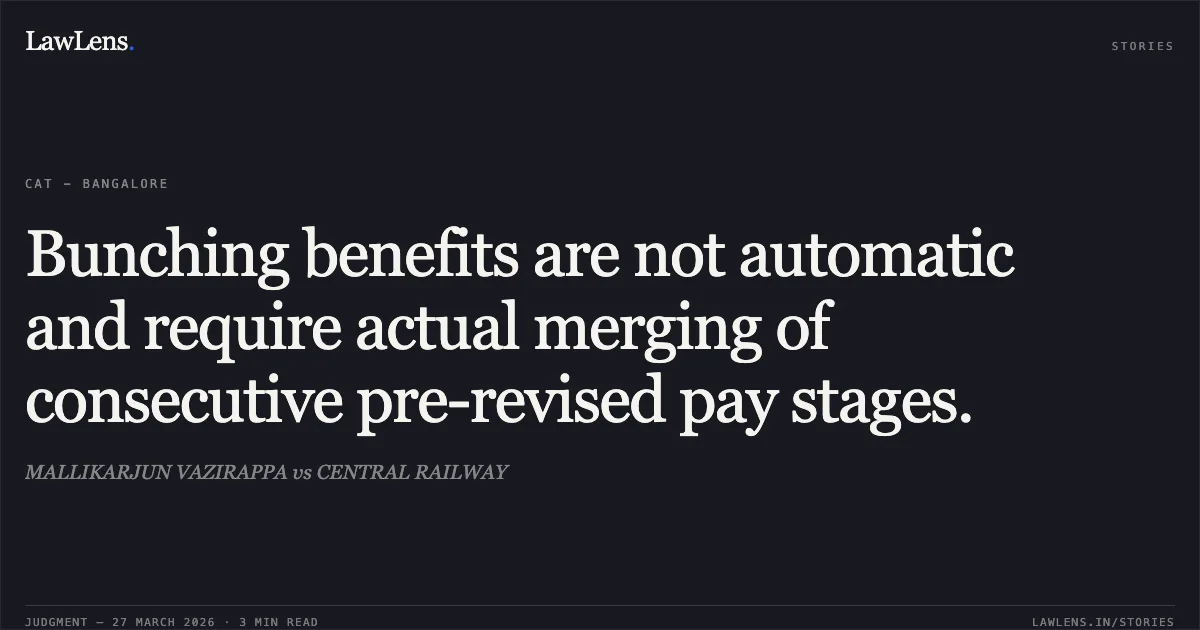
The Tribunal clarified that "bunching" is an exceptional measure to alleviate instances where pay progression is unfairly neutralized by revision; it is not an automatic entitlement for every merged or upgraded scale
Source reference: para 11-12The court analyzed Illustration 4A and 4B of the Explanatory Memorandum, noting that Illustration 4A (which the applicants relied upon) was specifically applicable only when the pre-revised pay of Rs. 3125 bunched with the lower stage of Rs. 3050 after multiplication by 1.86
Source reference: para 16-17The Tribunal found that the applicants' calculations were misplaced because they sought to apply Illustration 4A as a universal rule rather than a specific example of admissibility
Source reference: para 24-25Regarding the precedent S.C. Sharma v. UOI, the Tribunal distinguished it, noting that the Jaipur Bench in that case was not informed of specific Government clarifications (RBE No. 172/2008) which mandated the use of fitment tables even for upgraded posts
Source reference: para 22The Tribunal concluded that since the applicants’ revised pay stages did not result in identical figures for consecutive pre-revised stages, no "bunching" occurred
Source reference: para 25Holding
The Tribunal held that the applicants were not entitled to bunching benefits as they failed to demonstrate that their pay stages were bunched according to the criteria defined in Rule 7
The court ruled that the term "if admissible" in the Illustrations is pivotal and requires a factual overlap of pay stages, which was absent here
Source reference: para 25Consequently, the Original Applications were dismissed for lack of merit
Source reference: para 26Original Court PDF
MALLIKARJUN VAZIRAPPAvsCENTRAL RAILWAY
Click to open original judgment
Original judgment, available to read, download and summarize on LawLens.in