Facts
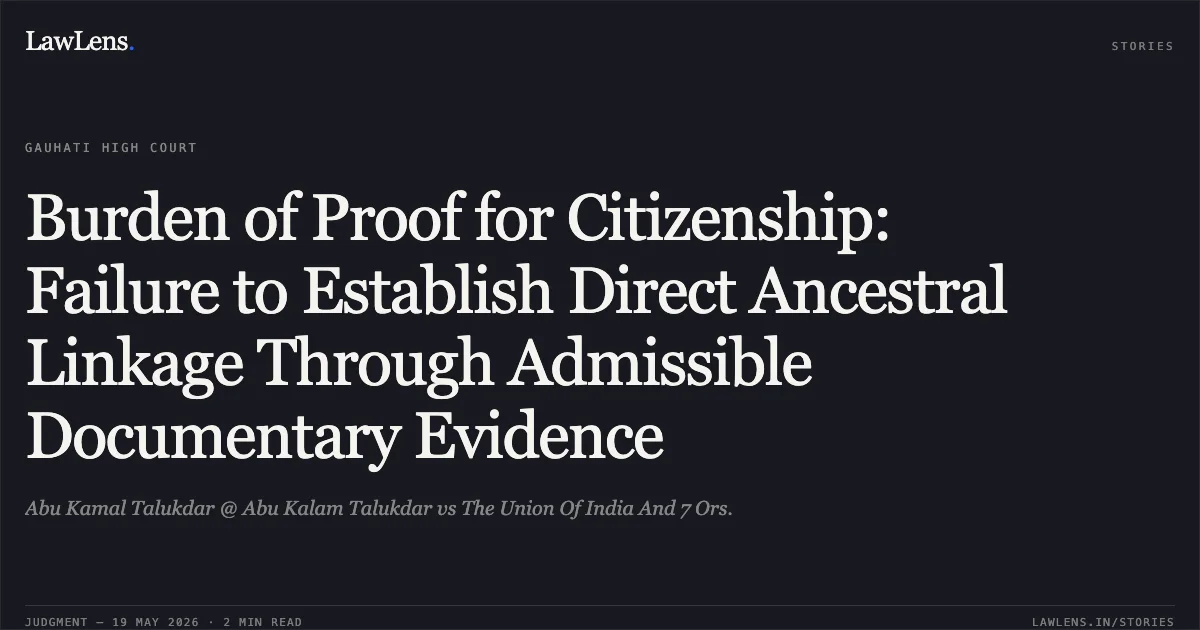
The petitioner was referred to the Foreigners’ Tribunal, Kamrup (M) 2nd, Guwahati (FT Case No. 87 of 2018), on suspicion of being a post-1971 illegal immigrant.
Source reference: p.3The petitioner claimed Indian citizenship by descent, asserting his grandfather, Dil Mohammad, lived in Village Balikuri Nonke and appeared in the 1951 NRC and 1966/1970 voters' lists.
Source reference: p.4He claimed his family shifted to Village Bhograndha in 1992 due to river erosion.
Source reference: p.4The petitioner submitted several voters' lists (1966–2015), a Gaonburah certificate, and land revenue receipts to establish his lineage.
Source reference: p.7-8On 04.04.2019, the Tribunal declared him a foreigner, citing a lack of linkage between the petitioner, his father, and the projected grandfather.
Source reference: p.8Issues
1. Whether the petitioner established a valid legal linkage to an Indian ancestor residing in Assam prior to the cut-off date of 25.03.1971.
Source reference: p.8, 132. Whether documents such as NRC 1951 extracts, Gaonburah certificates, and Voter ID cards are admissible as substantive evidence to prove citizenship.
Source reference: p.11, 13, 14Law Applied
The court applied Section 9 of the Foreigners Act, 1946, which places the burden of proof on the proceedee to establish citizenship.
Source reference: p.13Regarding the admissibility of NRC 1951, the court relied on Mazam Ali v. Union of India [2024 (4) GLT 274] and Bhanbhasa Sheikh v. Union of India [1970 Assam LR 206], which held that NRC extracts are inadmissible under Section 15 of the Census Act, 1948.
Source reference: p.11The court further applied the principle that a Gaonburah certificate must be proved by its author’s personal knowledge, and Voter ID cards serve only for identification, not as proof of citizenship.
Source reference: p.14Reasoning
The court found the petitioner failed to bridge the "linkage" gap between himself and his projected grandfather.
Source reference: p.13While Dil Mohammad appeared in 1966/1970 lists, the petitioner's father (Abdul Rezzak) only appeared in 1989 at age 34; he should have been listed with his father in the 1985 rolls, but was not, leaving the bloodline unverified.
Source reference: p.12, 13Discrepancies in the mother's identity (Nabiran Nessa vs. Nabiya Begum) and age (a 2-year increase over an 8-year span) further weakened the claim.
Source reference: p.12, 15The Gaonburah certificate (Ext-M) was deemed unreliable because the witness (DW-3) admitted he only knew the petitioner from 1992 and issued the certificate based on the petitioner's own documents rather than personal knowledge.
Source reference: p.14Lastly, the court reiterated its limited supervisory jurisdiction under Article 226, refusing to overturn the Tribunal's factual findings unless perverse.
Source reference: p.15Holding
The court answered the issues in the negative, holding that the petitioner failed to prove a direct bloodline to an Indian ancestor prior to 25.03.1971.
The Writ Petition was dismissed, and the Tribunal's opinion dated 04.04.2019 declaring the petitioner a foreigner was upheld, with the court ordering the immediate return of the case records for consequential action in accordance with the law.
Source reference: p.15-16Acts & Sections Cited
1 provisions across 1 statute referred to in this judgment. Each provision opens on LawLens.
Census Act, 19481
Original Court PDF
Abu Kamal Talukdar @ Abu Kalam TalukdarvsThe Union Of India And 7 Ors.
Click to open original judgment
Original judgment, available to read, download and summarize on LawLens.in