Facts
The Superintendent of Police (Border), Kamrup, made a reference against the petitioner, suspecting her to be a foreigner.
Source reference: p.2The case was transferred to the Foreigners Tribunal following the Supreme Court’s ruling in Sarbananda Sonowal v. Union of India.
Source reference: p.2The petitioner filed a written statement claiming Indian citizenship by birth, asserting she was the daughter of Bachu Mia.
Source reference: p.4-5She produced various documents, including voters lists from 1966 to 2018, land revenue receipts, a marriage certificate, and a Gaonburha certificate.
Source reference: p.4The Foreigners Tribunal No. 1, Kamrup (R), in G.F.T. Case No. 991/2017, declared her a foreigner post-25.03.1971, finding she failed to discharge her burden of proof.
Source reference: p.2-3The petitioner challenged this opinion via a writ of certiorari.
Source reference: p.2Issues
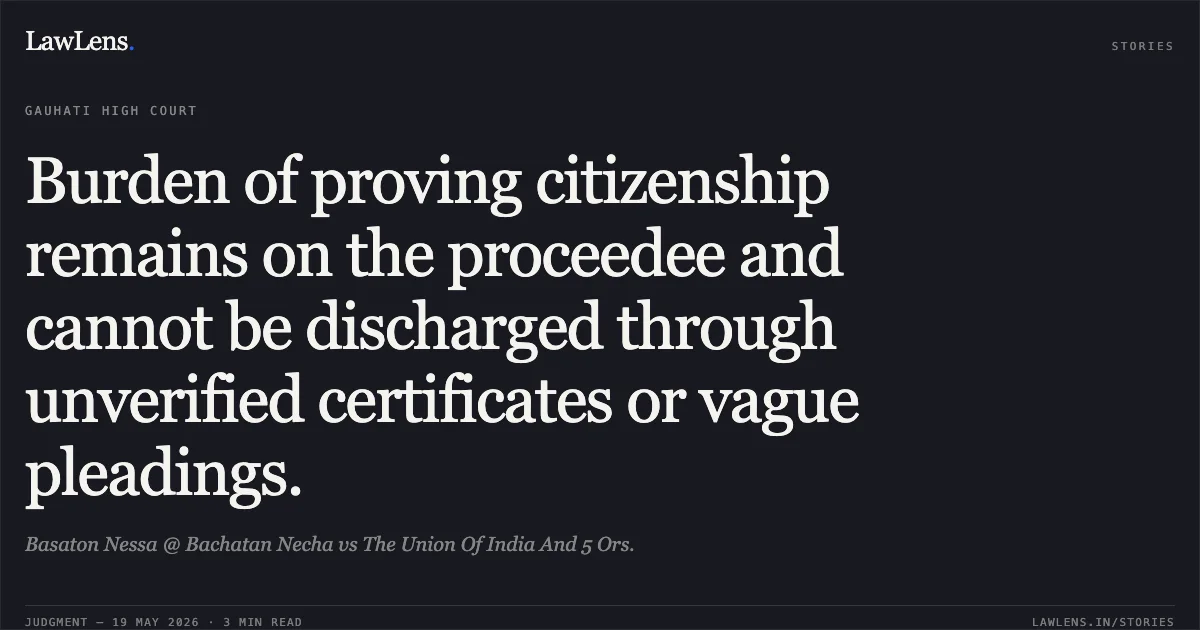
1. Whether the petitioner discharged the burden of proof to establish her Indian citizenship under Section 9 of the Foreigners Act, 1946.
Source reference: p.3, para 2(iii)2. Whether the findings of the Foreigners Tribunal suffered from any perversity or procedural impropriety warranting interference under Article 226.
Source reference: p.8, para 15; p.11, para 24Law Applied
The court applied Section 9 of the Foreigners Act, 1946, which mandates that the burden of proving a person is not a foreigner lies strictly upon that person, notwithstanding the Indian Evidence Act.
Source reference: p.10, para 21It relied on Sarbananda Sonowal v. Union of India (2005), which established that a proceedee must specifically disclose their date of birth, place of birth, and parental details to discharge this burden.
Source reference: p.6, para 11Under Rupjan Begum v. Union of India (2018) and Romila Khatun v. Union of India (2018), certificates (like those from a Gaonburha) must be proved by the issuing authority using contemporaneous records to establish the truthfulness of their contents.
Source reference: p.8, para 14, 16The court applied the principles of certiorari jurisdiction as defined in Central Council for Research in Ayurvedic Sciences v. Bikartan Das (2023), stating a High Court does not act as an appellate court and cannot re-weigh evidence unless the lower order is palpably erroneous.
Source reference: p.11-12, para 24Reasoning
The Court found the petitioner’s written statement "absolutely vague" as it lacked essential biographical details required by the Sonowal precedent.
Source reference: p.12, para 25Regarding documentary evidence, the Court noted that the 1971 voters list was a photocopy and the application for a certified copy was legally defective as it wasn't filed by the elector herself.
Source reference: p.13-14Furthermore, the 1966 and 1970 voters lists failed to provide a "linkage" between the petitioner and the projected ancestors.
Source reference: p.13, para 26The marriage certificate was rejected because the Kazi (DW2) failed to appear for cross-examination, rendering his testimony inadmissible.
Source reference: p.15, para 29The Gaonburha's (DW3) certificate was deemed unreliable because he was appointed in 2006 (long after the alleged events), lacked personal knowledge, and failed to produce a Certificate Issue Register.
Source reference: p.16, para 30Consequently, the petitioner failed to establish the mandatory "linkage" to any Indian predecessor prior to the 1971 cutoff.
Source reference: p.16, para 31Holding
The Court answered both issues in the negative, holding that the petitioner failed to discharge her statutory burden under Section 9 of the Foreigners Act.
The Court affirmed that it would not interfere with the Tribunal’s findings of fact in its supervisory jurisdiction.
Source reference: p.11, para 23-24The writ petition was dismissed, the interim protection was vacated, and the Tribunal’s opinion declaring the petitioner a foreigner post-25.03.1971 was upheld.
Source reference: p.17, para 33-34Acts & Sections Cited
1 provisions across 1 statute referred to in this judgment. Each provision opens on LawLens.
Right to Information Act, 20051
Original Court PDF
Basaton Nessa @ Bachatan NechavsThe Union Of India And 5 Ors.
Click to open original judgment
Original judgment, available to read, download and summarize on LawLens.in