Facts
The petitioner, Rabia Khatun, challenged the opinion of the Foreigners’ Tribunal No. 7, Barpeta, dated 13.03.2019, which declared her a foreigner post-25.03.1971.
Source reference: p. 3A reference was made against her by the Superintendent of Police (B), Barpeta.
Source reference: p. 3The petitioner filed a written statement claiming Indian citizenship by lineage, relying on 1966 and 1970 Voter Lists (projected father and stepmother) and 1997/2016 Voter Lists.
Source reference: p. 4She also produced Gaonburah (village headman) certificates and oral testimony from her projected brother (DW3).
Source reference: p. 4-5The Tribunal found she failed to discharge her burden of proof under Section 9 of the Foreigners Act, 1946.
Source reference: p. 3Issues
1. Whether the petitioner discharged the burden of proof to establish her citizenship through cogent and admissible evidence as required under Section 9 of the Foreigners Act, 1946?
Source reference: p. 9 / para. 162. Whether the findings of the Foreigners’ Tribunal suffered from any jurisdictional error or procedural impropriety warranting interference under Article 226?
Source reference: p. 10 / para. 18-19Law Applied
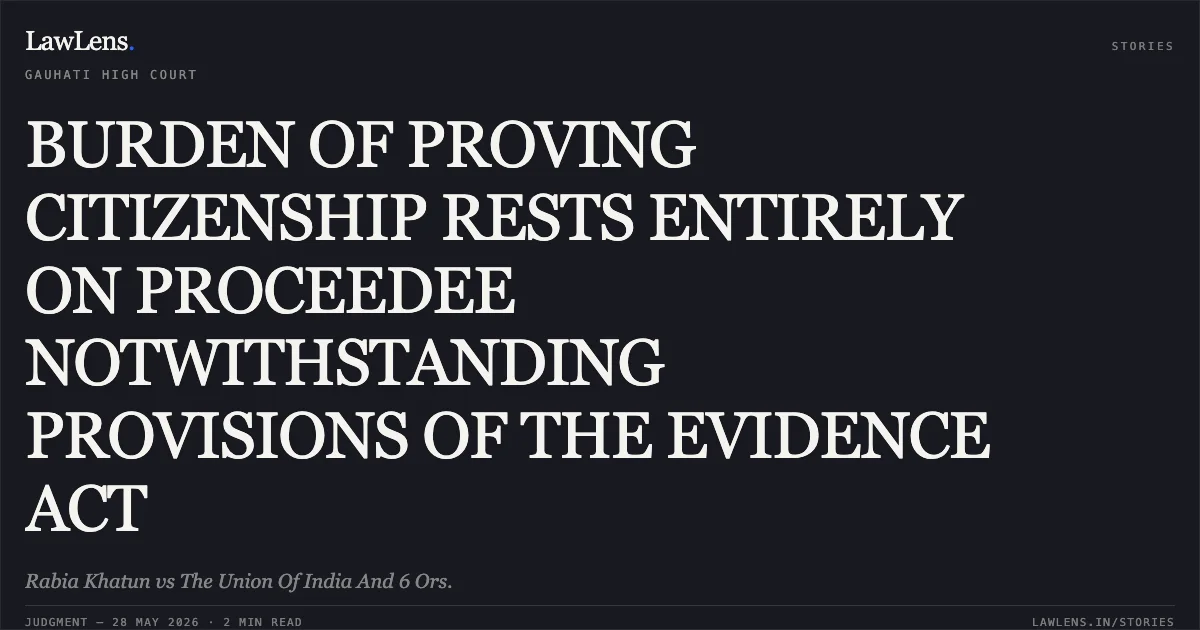
Section 9 of the Foreigners Act, 1946, which mandates that the burden of proving that a person is not a foreigner lies squarely on that person, notwithstanding the Indian Evidence Act.
Source reference: p. 9Supreme Court’s ruling in Sarbananda Sonowal v. UOI (2005), which necessitates specific disclosure of birth dates, places, and parental details.
Source reference: p. 6, 12Romila Khatun v. UOI (2018) (distinction between proof of document and proof of contents).
Source reference: p. 7Rupajan Begum v. UOI (2018) regarding the validation of Gaonburah certificates.
Source reference: p. 8Certiorari jurisdiction under Article 226 as defined in Central Council for Research in Ayurvedic Sciences v. Bikartan Das (2023).
Source reference: p. 11Reasoning
The court found the petitioner’s written statement "absolutely vague," failing to provide essential biographical details required by the Sonowal precedent.
Source reference: p. 12Although the 1966 and 1970 Voter Lists contained names similar to her projected father, there was an "inexplicable gap of 27 years" before the next appearance in 1997 in a different district.
Source reference: p. 12The court noted a discrepancy in her projected mother's age (60 years in 1997) and the lack of explanation for her absence from previous lists.
Source reference: p. 12-13The Gaonburah certificates (Ext-I/J) were deemed legally insufficient as the Gaonburah (DW2) admitted during cross-examination that he had no personal knowledge of the petitioner’s ancestry, did not maintain official records for such certifications, and used the State Emblem without authority.
Source reference: p. 13-14The court concluded there was no documentary evidence linking the petitioner to her projected ancestors.
Source reference: p. 13Holding
The High Court held that the petitioner failed to discharge the burden of proof under Section 9 of the Act and that the Tribunal's findings of fact were based on a valid appreciation of evidence.
The writ petition was dismissed, the interim stay on deportation was vacated, and the Tribunal's opinion declaring the petitioner a foreigner was upheld.
Source reference: p. 14Acts & Sections Cited
4 provisions across 3 statutes referred to in this judgment. Linked provisions open on LawLens.
Foreigners Act, 19462
Foreigners (Tribunals) Order, 19641
Citizenship Act, 19551
Original Court PDF
Rabia KhatunvsThe Union Of India And 6 Ors.
Click to open original judgment
Original judgment, available to read, download and summarize on LawLens.in