Facts
The petitioner, Sukuron Nesa, challenged an opinion dated 09.08.2019 passed by the Foreigners Tribunal No. 2nd, Dhubri, which declared her a foreigner post-25.03.1971.
Source reference: p. 3A reference was originally made against her by the Superintendent of Police (B), Dhubri.
Source reference: p. 3The petitioner submitted a written statement along with several documents, including a marriage Kabinnama (1993), land records (Draft Chitha and Final Khatian), and various Electoral Rolls ranging from 1966 to 2018, seeking to establish linkage to her projected father, Habez Uddin.
Source reference: p. 4Three witnesses, including the petitioner and her projected father, testified before the Tribunal.
Source reference: p. 5Issues
1. Whether the petitioner discharged the burden of proof under Section 9 of the Foreigners Act, 1946, to establish her Indian citizenship by proving linkage to her projected ancestors.
Source reference: p. 6 / para. 92. Whether the findings of the Foreigners Tribunal suffered from any jurisdictional or procedural error warranting interference under the High Court's certiorari jurisdiction.
Source reference: p. 8 / para. 13Law Applied
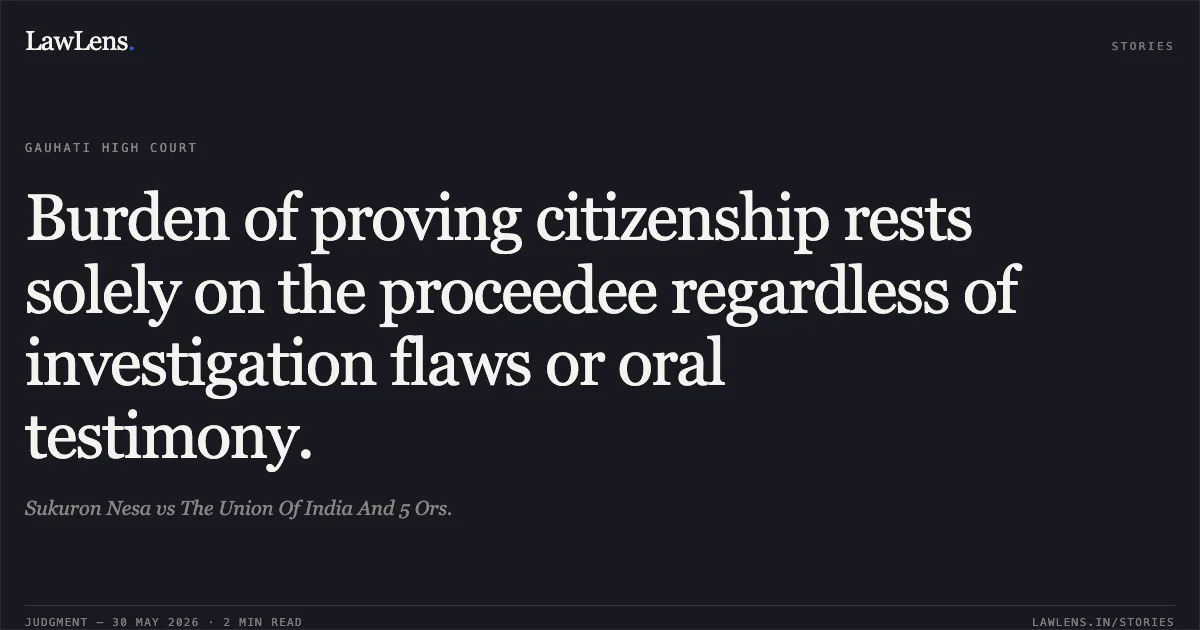
The court primarily applied Section 9 of the Foreigners Act, 1946, which mandates that the burden of proving citizenship lies solely on the proceedee, notwithstanding the Indian Evidence Act.
Source reference: p. 11The court relied on Sarbananda Sonowal v. Union of India (2005) to emphasize that facts regarding birth and parentage are within the personal knowledge of the proceedee per Section 106 of the Evidence Act.
Source reference: p. 6-7The court applied the principle from Romila Khatun v. Union of India (2018) that documents must be proved by contemporaneous records and their contents verified.
Source reference: p. 8Regarding certiorari jurisdiction, the court followed Central Council for Research in Ayurvedic Sciences v. Bikartan Das (2023), holding that a Writ Court does not act as an Appellate Tribunal and cannot re-weigh evidence.
Source reference: p. 12-13Reasoning
The Court found that the petitioner's written statement was "absolutely vague" and failed to provide essential details such as date or place of birth as required by the Sonowal precedent.
Source reference: p. 14The documentary evidence was deemed insufficient: the 1993 Kabinnama was not proved by a Kazi, and the 1997 Voters List (prefixing "D" to her name) was an uncertified copy.
Source reference: p. 15The court highlighted significant discrepancies in the land records (Ext. 2 and 3); specifically, the Draft Chitha showed the petitioner's name being inserted in 2015 while leaving out her brothers, and the land descriptions in the Chitha and the Khatian did not match.
Source reference: p. 15Following Sayam Uddin v. Union of India, the court rejected the argument that a faulty investigation report (LVO) could benefit the proceedee, as she still had the opportunity to prove her case before the Tribunal.
Source reference: p. 14-15The oral testimony of the projected father (DW2) was insufficient without corroborating, consistent documentary evidence.
Source reference: p. 18Holding
The court answered both issues against the petitioner, holding that she failed to discharge her burden of proof under Section 9 of the Foreigners Act.
The Court affirmed that the Tribunal’s findings were based on a proper appreciation of facts and evidence, and no error was apparent on the face of the record; Consequently, the High Court dismissed the writ petition, vacated the interim stay, and ordered the return of records to the Tribunal for necessary action.
Source reference: p. 19Acts & Sections Cited
5 provisions across 3 statutes referred to in this judgment. Linked provisions open on LawLens.
Foreigners Act, 19462
Indian Evidence Act, 18722
Citizenship Act, 19551
Original Court PDF
Sukuron NesavsThe Union Of India And 5 Ors.
Click to open original judgment
Original judgment, available to read, download and summarize on LawLens.in