Facts
The Petitioner challenged an order dated 24.06.2019 passed by the Foreigners Tribunal No. 3rd, Morigaon in F.T. Case No. 10/2015, which declared him a foreigner post-25.03.1971
Source reference: p. 2A reference was made against the Petitioner by the Superintendent of Police (B), Morigaon
Source reference: p. 2-3The Petitioner submitted various documents, including land records of a projected grandfather (Selamot SK) and voter lists of a projected father (Nantu/A. Rahim)
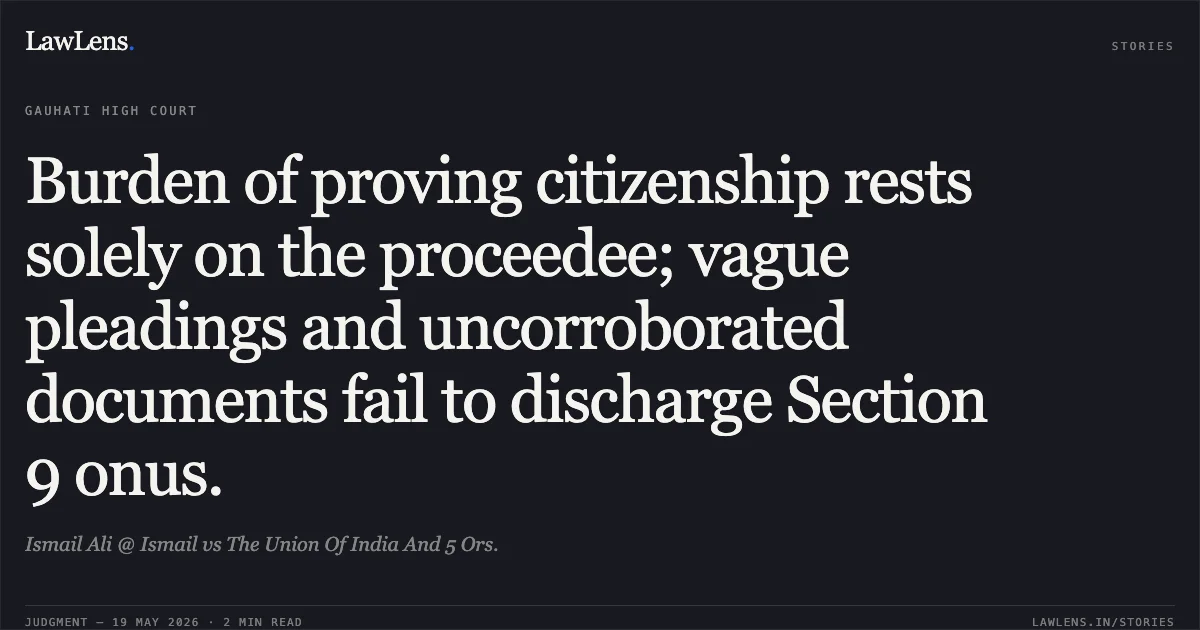
Source reference: p. 3-4the Tribunal found the Petitioner failed to discharge his burden of proof under Section 9 of the Foreigners Act, 1946
Source reference: p. 3The Petitioner then invoked the extra-ordinary jurisdiction of the High Court under Article 226
Source reference: p. 2Issues
1. Whether the Petitioner successfully discharged the burden of proof to establish his Indian citizenship under Section 9 of the Foreigners Act, 1946
Source reference: p. 5/82. Whether the findings of fact recorded by the Foreigners Tribunal are liable to be interfered with under the High Court’s certiorari jurisdiction
Source reference: p. 9/10Law Applied
Section 9 of the Foreigners Act, 1946, which mandates that the burden of proving a person is not a foreigner lies squarely upon that person
Source reference: p. 8Sarbananda Sonowal v. Union of India, which established that facts regarding birth and parentage are within the personal knowledge of the proceedee
Source reference: p. 5Romila Khatun v. Union of India that contents of documents must be proved by contemporaneous records
Source reference: p. 6Rupjan Begum v. Union of India regarding the proof required for certificates
Source reference: p. 7Central Council for Research in Ayurvedic Sciences v. Bikartan Das to define the limited scope of certiorari jurisdiction under Article 226
Source reference: p. 10Reasoning
The Court observed that the Petitioner’s written statement was vague and lacked essential details like date/place of birth or family history as required by the Sonowal precedent
Source reference: p. 11There were major inconsistencies in the evidence: the projected father’s name shifted from "Nantu" (1966/1970 voter lists) to "A. Rahim" (1993 list) without adequate explanation
Source reference: p. 11The Petitioner’s name first appeared in the 1993 voter list at age 37, leaving a gap from when he became eligible in 1977
Source reference: p. 12The Gaon Burah certificate (Ext. G) was rejected because the author was not examined and it contained an unauthorized National Emblem
Source reference: p. 12The court also dismissed the Petitioner’s self-serving affidavit (Ext. I) intended to explain name discrepancies, holding that such affidavits are not "proof in the eye of law" per Abdul Sheikh v. UOI
Source reference: p. 13Holding
The Court answered the issues in the negative, holding that the Petitioner failed to establish a link between himself and his projected ancestors
The Court held that in its supervisory capacity, it cannot re-weigh evidence or act as an appellate body. Consequently, the Writ Petition was dismissed, the Tribunal's opinion declaring the Petitioner a foreigner was upheld, and the records were ordered to be returned to the Foreigners Tribunal for further action
Source reference: p. 10, 13Acts & Sections Cited
5 provisions across 3 statutes referred to in this judgment. Linked provisions open on LawLens.
Foreigners Act, 19463
Foreigners (Tribunals) Order, 19641
Citizenship Act, 19551
Original Court PDF
Ismail Ali @ IsmailvsThe Union Of India And 5 Ors.
Click to open original judgment
Original judgment, available to read, download and summarize on LawLens.in