Facts
The Appellant married the deceased in 1988.
Source reference: p.9On 29.04.1992, a village chaukidar (Informant) learned that the deceased had died after allegedly consuming poison.
Source reference: p.2The Informant alleged the matrimonial family cremated the body hurriedly to destroy evidence before police arrival.
Source reference: p.3The prosecution alleged the deceased was harassed for a color television.
Source reference: p.9The trial court convicted the Appellant under Sections 304B (dowry death) and 201 (disappearing evidence) of the IPC, sentencing him to life imprisonment.
Source reference: p.1-2The Appellant challenged this, citing a lack of medical evidence, non-examination of the Investigating Officer (IO), and the absence of proof of cruelty "soon before death".
Source reference: p.6Issues
1. Whether the prosecution established that the death occurred otherwise than under normal circumstances and was connected to dowry harassment "soon before death" to satisfy Section 304B IPC?
Source reference: p.14 / para. 67-682. Whether the statutory presumption under Section 113B of the Evidence Act can be invoked in the absence of medical evidence and specific proximity of cruelty?
Source reference: p.14 / para. 673. Whether the non-examination of the Investigating Officer caused material prejudice to the Appellant’s defense?
Source reference: p.6, p.15Law Applied
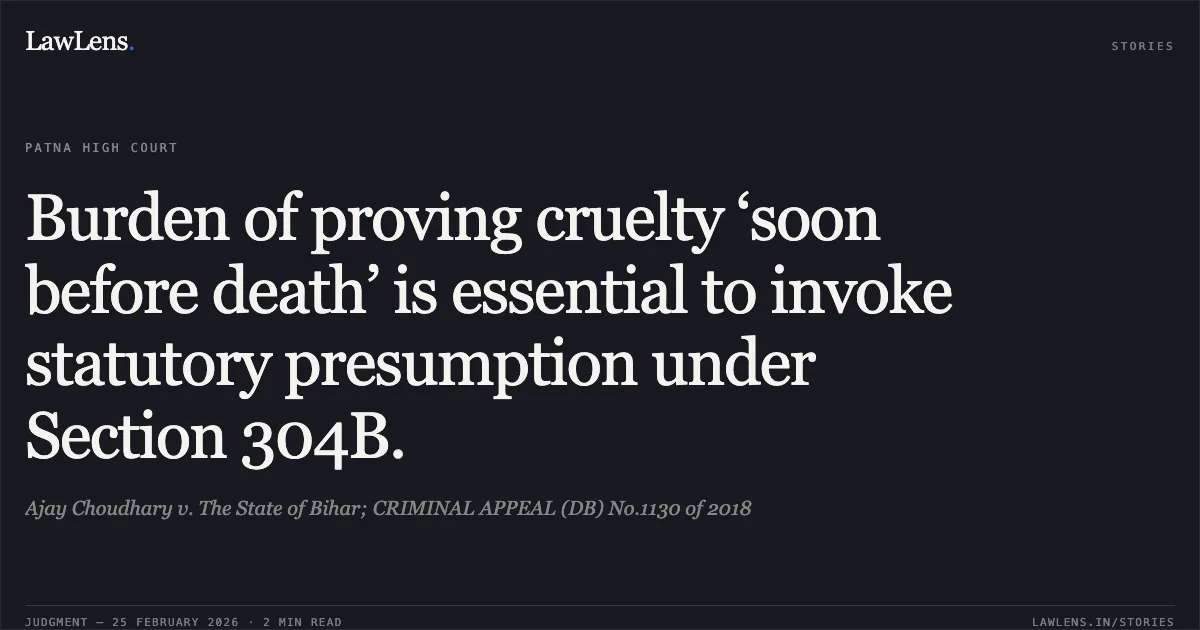
The court applied Section 304B of the IPC, which defines dowry death as a death occurring within seven years of marriage under abnormal circumstances following cruelty "soon before death" in connection with dowry.
Source reference: p.14It relied on Section 113B of the Indian Evidence Act, which mandates a presumption of dowry death only after the prosecution proves the "foundational facts".
Source reference: p.14, p.18The court further cited the precedent *Karan Singh v. State of Haryana (2025)*, which clarifies that vague, general allegations without specific proximity or a "live link" to the death are insufficient for conviction.
Source reference: p.16-18Reasoning
The High Court found the prosecution failed to prove the foundational facts requisite for Section 304B.
Source reference: no citationFirst, there was no medical evidence or post-mortem report to establish the cause of death as "unnatural".
Source reference: p.15Second, the testimonies of the parental witnesses (P.W.1, P.W.7) contained only general allegations of a demand for a television and failed to show specific instances of cruelty "soon before death".
Source reference: p.15-16The court noted that independent witnesses from the matrimonial village did not support the harassment claims.
Source reference: p.12-13Furthermore, the non-examination of the IO was held to be fatal, as it prevented the defense from proving contradictions in witness statements.
Source reference: p.15-16Consequently, since the "live link" between the alleged demand and death was missing, the trial court erred in invoking the Section 113B presumption based on mere suspicion.
Source reference: p.18-19Holding
The Court answered the issues in the negative, holding that suspicion, no matter how strong, cannot replace legal proof.
The High Court set aside the conviction and life sentence under Section 304B IPC and the conviction under Section 201 IPC.
Source reference: p.20The Appellant was acquitted of all charges and ordered to be released forthwith.
Source reference: p.20Acts & Sections Cited
7 provisions across 2 statutes referred to in this judgment. Each provision opens on LawLens.
Indian Penal Code, 18606
Code of Criminal Procedure, 19731
Original Court PDF
Ajay Choudhary v. The State of Bihar; CRIMINAL APPEAL (DB) No.1130 of 2018
Click to open original judgment
Original judgment, available to read, download and summarize on LawLens.in