Facts
The respondent-workman, Sh. Abdul Hafeez Khan, alleged his services as a Technician at a CNG station were illegally terminated by the Petitioner (IGL) on 20.08.2002
Source reference: p. 1-2IGL contested the claim, asserting no employer-employee relationship existed as the respondent was engaged through an independent contractor, M/s Mahajan Enterprises
Source reference: p. 2-4The Labour Court, vide Award dated 19.02.2011, directed reinstatement with compensation, finding an employer-employee relationship established despite the workman failing to produce direct documentary evidence of employment
Source reference: p. 3, 9IGL challenged this Award via a writ petition, arguing the burden of proof was erroneously shifted
Source reference: p. 3-4Issues
1. Whether the reference was without jurisdiction on the ground that the Central Government, and not the State Government, was the "appropriate Government"
Source reference: p. 6, 112. Whether an employer-employee relationship existed between IGL and the respondent-workman
Source reference: p. 3, 113. Whether the respondent-workman had completed 240 days of continuous service to entitle him to protection under the Industrial Disputes Act, 1947
Source reference: p. 5, 21Law Applied
The Court applied Section 2(a) of the Industrial Disputes Act regarding the "appropriate government" and Sections 25-B and 25-F regarding continuous service and conditions for retrenchment
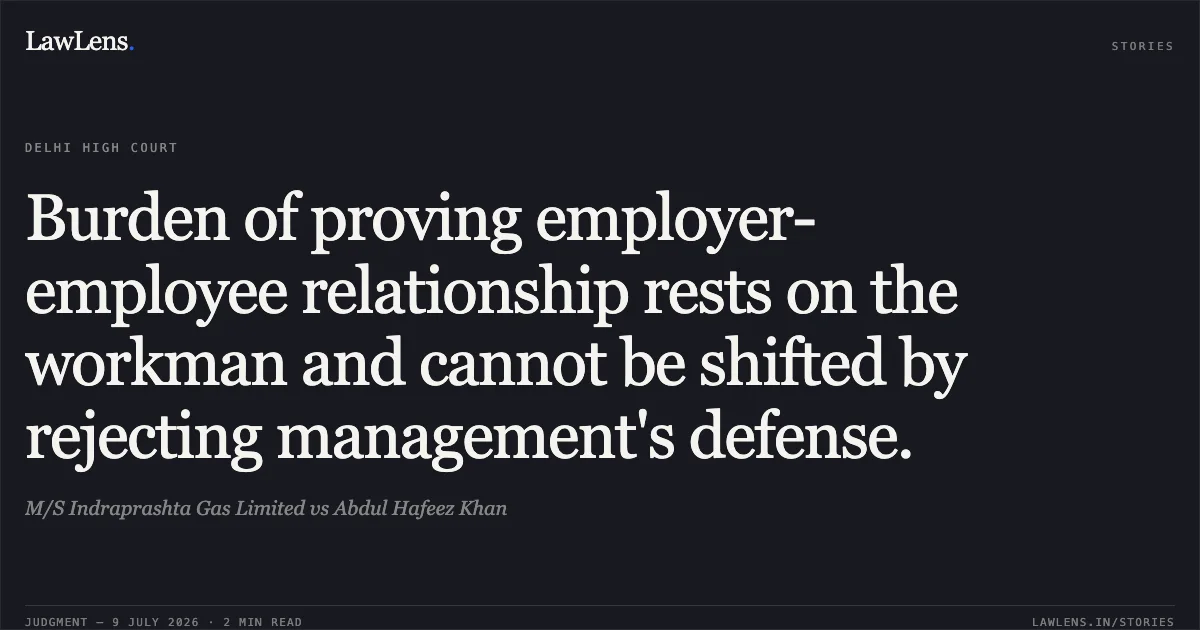
Source reference: p. 10, 21It relied on Workmen of Nilgiri Coop. Mkt. Society Ltd. v. State of Tamil Nadu, which establishes that the burden of proving an employer-employee relationship lies on the person asserting it
Source reference: p. 11The Court followed Range Forest Officer v. S.T. Hadimani, mandating that the workman must produce cogent evidence to prove 240 days of continuous service
Source reference: p. 21the indicia of employment (appointment power, wage payment, disciplinary control) as defined in Balwant Rai Saluja v. Air India Ltd.
Source reference: p. 5, 12Reasoning
The Court found the Labour Court's reasoning flawed as it inverted the burden of proof. While the Labour Court rightly rejected IGL's contractor defense due to the post-dated operating agreement, it erroneously inferred direct employment merely from the failure of that defense and the respondent's physical presence at the CNG station
Source reference: p. 16, 18-19The High Court noted that the workman admitted to having no appointment letter, pay slips, or PF records from IGL
Source reference: p. 14Per Nilgiri Coop., the management's failure to produce records does not automatically prove the workman's case; the workman must first discharge the initial burden of proof
Source reference: p. 12-13the Labour Court failed to independently evaluate the evidence for "240 days of service," instead treating it as a consequence of the employment finding, which violates the standards set in S.T. Hadimani
Source reference: p. 21-22Holding
the respondent failed to establish a direct employer-employee relationship with IGL through cogent evidence
The High Court allowed the writ petition and set aside the Labour Court’s Award dated 19.02.2011
Source reference: p. 23Acts & Sections Cited
5 provisions across 1 statute referred to in this judgment. Linked provisions open on LawLens.
Industrial Disputes Act, 19475
Original Court PDF
M/S Indraprashta Gas LimitedvsAbdul Hafeez Khan
Click to open original judgment
Original judgment, available to read, download and summarize on LawLens.in