Facts
The appellant was convicted by the Trial Court on 30.09.2008 under Section 376 of the IPC and sentenced to 7 years R.I.
Source reference: p. 2The prosecution alleged that the appellant subjected the prosecutrix (aged approximately 15 years at the time) to continuous sexual abuse for 1.5 years with the tacit support of her relatives.
Source reference: p. 2The FIR was lodged on 18.08.2006, roughly 1.5 years after the alleged commencement of the abuse.
Source reference: p. 6The Trial Court acquitted co-accused relatives but convicted the appellant, finding that while the prosecutrix may have been a consenting party, she was below 16 years of age at the time of the incident, rendering consent immaterial.
Source reference: p. 6The appellant challenged this on grounds of unreliable evidence regarding age and lack of medical corroboration.
Source reference: p. 4Issues
1. Whether the prosecution proved beyond reasonable doubt that the prosecutrix was below 16 years of age at the time of the incident.
Source reference: p. 6 / para. 82. Whether the sole testimony of the prosecutrix was credible and inspired sufficient confidence to sustain a conviction under Section 376 IPC in the absence of medical corroboration.
Source reference: p. 20 / para. 20Law Applied
Section 376 of the IPC regarding rape.
Source reference: p. 2Section 35 of the Indian Evidence Act, 1872, and Section 94 of the Juvenile Justice Act, 2015, emphasizing that school records lack evidentiary value without the underlying material used for the entry.
Source reference: para. 21-24Principles established in Ravinder Singh Gorkhi v. State of UP and P. Yuvaprakash v. State to establish the hierarchy of age-proof documents.
Source reference: para. 21-24Doctrine from Manak Chand @ Mani v. State of Haryana (AIR 2023 SC 5600), which holds that if the prosecutrix’s version is improbable or unsupported by medical evidence, the court should not act on solitary testimony.
Source reference: para. 20Reasoning
The High Court found the Trial Court's finding on age perverse, noting that the prosecution failed to produce the Class I admission register and the birth register entry was vague (naming only "Soni"), failing to meet the standards for proving minority beyond reasonable doubt.
Source reference: p. 17 / para. 14The Court observed that the prosecutrix admitted to a love affair with another man (Rajendra Sahu) and acknowledged writing "I Love You" in a register.
Source reference: p. 18-19The medical examiner (PW-4) found no injuries and noted the prosecutrix was "habituated" to intercourse, providing no evidence of recent force.
Source reference: p. 19 / para. 18The Court highlighted the unexplained 1.5-year delay in filing the FIR and the prosecutrix's own admission that she refused to live with her parents, casting deep suspicion on the motive for the allegations.
Source reference: p. 18, 27Holding
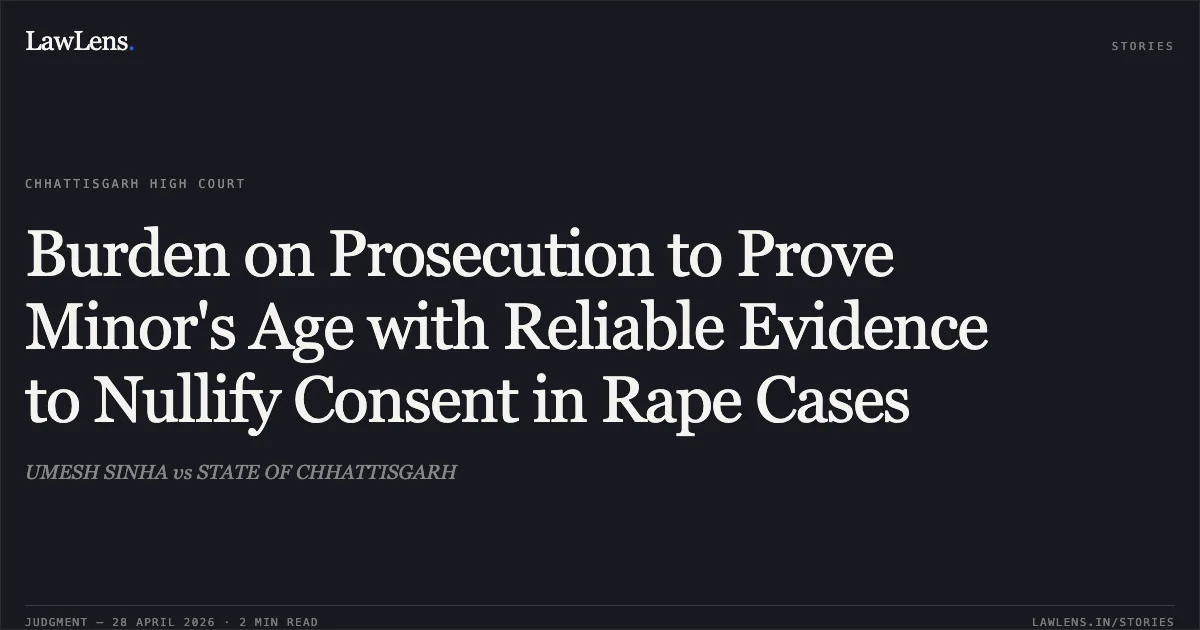
The Court answered both issues in the negative, holding that the prosecution failed to conclusively prove the prosecutrix was a minor and that her testimony was riddled with contradictions that failed to inspire confidence.
The High Court allowed the appeal, set aside the judgment dated 30.09.2008, and acquitted the appellant of all charges, directing release from bail bonds subject to Section 437-A CrPC.
Source reference: p. 27 / para. 25; p. 28Acts & Sections Cited
5 provisions across 3 statutes referred to in this judgment. Each provision opens on LawLens.
Indian Penal Code, 18602
Juvenile Justice (Care and Protection of Children) Act, 2015.2
Bharatiya Nagarik Suraksha Sanhita, 20231
Original Court PDF
UMESH SINHAvsSTATE OF CHHATTISGARH
Click to open original judgment
Original judgment, available to read, download and summarize on LawLens.in