01Facts
The Revenue challenged the orders of the Commissioner of Income Tax (Appeals) and the Income Tax Appellate Tribunal concerning the respondent-assessee’s assessment for Assessment Year 2018–19.
pp. 1–4 · ¶ 1, 5–6The Assessing Officer had disallowed ₹51,48,28,498 claimed as expenditure towards the Employee Stock Option Scheme (ESOP) and had made an addition of ₹62,72,719 under Section 56(2)(viib) of the Income Tax Act, 1961.
pp. 1–4 · ¶ 1, 5–6The latter addition was based on the Assessing Officer’s rejection of a valuation report prepared by a Chartered Accountant, on the ground that the valuation ought to have been performed by a Merchant Banker pursuant to CBDT Notification No. 23/2018 dated 24 May 2018.
pp. 1–4 · ¶ 1, 5–6The appeal was admitted on two substantial questions of law.
p. 1 · ¶ 102Issues
i.Whether, in the facts and circumstances of the case, the ITAT was correct in deleting the disallowance of ₹51,48,28,498 claimed as expenditure on account of ESOP?
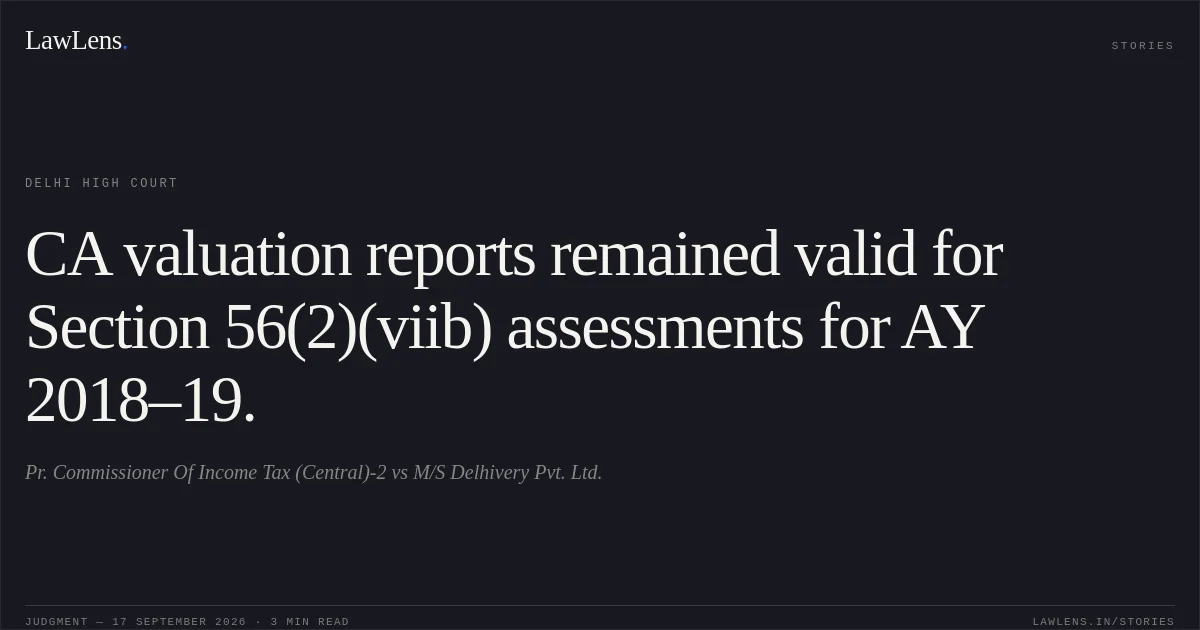
p. 1 · ¶ 1(i)ii.Whether the addition of ₹62,72,719 was required to be made as undisclosed income under Section 56(2)(viib) of the Income Tax Act, 1961, on the ground that the valuation was performed by a Chartered Accountant rather than a Merchant Banker?
p. 1 · ¶ 1(ii) · p. 3 · ¶ 503Law Applied
The Court applied the principle that ESOP costs may be debited to the profit and loss account as allowable expenditure, following CIT v. Lemon Tree Hotels Ltd., ITA No. 107/2015 (Delhi High Court, decided 18 August 2015), which relied on CIT-III, Chennai v. PVP Ventures Ltd. and treated the cost of ESOP as a permissible business expenditure.
pp. 2–3 · ¶ 2–3The Court also referred to the principle in CIT v. Oswal Agro Mills Ltd. that expenditure connected with the issue of debentures or obtaining a loan may constitute revenue expenditure.
p. 3 · ¶ 3In relation to Section 56(2)(viib), the Court held that the valuation requirement introduced by CBDT Notification No. 23/2018, under which valuation was to be undertaken by a Merchant Banker rather than a Chartered Accountant, could not be applied retrospectively to Financial Year 2017–18, since the change operated from the subsequent financial year.
p. 3 · ¶ 6Provisions in the judgment · 1
Income Tax Act, 1961 Section 56
04Reasoning
On the ESOP issue, the Court followed its binding decision in Lemon Tree Hotels Ltd., which had affirmed the deletion of a similar disallowance and held that ESOP expenditure could be debited to the profit and loss account.
pp. 2–3 · ¶ 2–4The Revenue did not dispute the applicability of that precedent; accordingly, the ITAT’s deletion of the disallowance was upheld.
pp. 2–3 · ¶ 2–4On the valuation issue, the relevant assessment year was 2018–19, corresponding to Financial Year 2017–18.
p. 3 · ¶ 6Since CBDT Notification No. 23/2018 dispensing with Chartered Accountant certification and requiring Merchant Banker valuation applied from the subsequent financial year, the Assessing Officer was not justified in rejecting the assessee’s Chartered Accountant valuation report for the year under consideration.
p. 3 · ¶ 6The CIT(A) and ITAT therefore correctly deleted the addition under Section 56(2)(viib).
p. 4 · ¶ 705Holding
The Court answered the first issue in the affirmative and in favour of the assessee, thereby sustaining the deletion of the ESOP disallowance of ₹51,48,28,498.
p. 3 · ¶ 4It answered the second issue against the Revenue and in favour of the assessee, holding that the Chartered Accountant’s valuation could not be rejected on the basis of a requirement introduced for a subsequent financial year.
pp. 3–4 · ¶ 6–8Finding no infirmity in the appellate orders, the Court dismissed the Revenue’s appeal in toto.
p. 4 · ¶ 9Original Court PDF
Pr. Commissioner Of Income Tax (Central)-2vsM/S Delhivery Pvt. Ltd.
Click to open original judgment
Original judgment, available to read, download and summarize on LawLens.in