01Facts
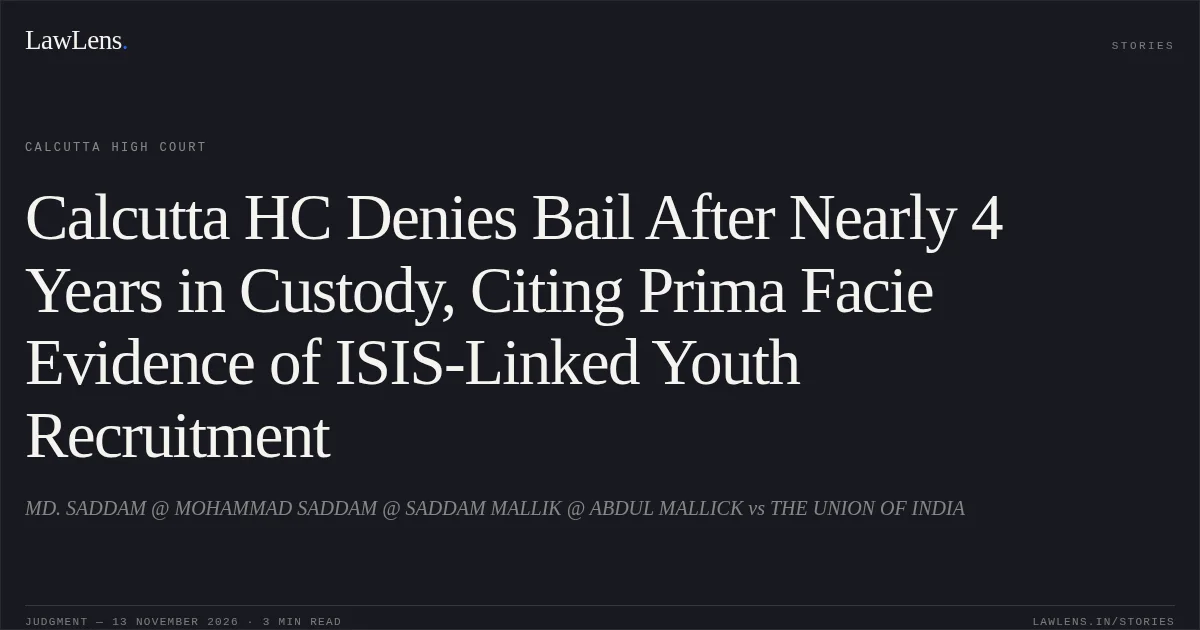
The appellant, arrested on 6 January 2023 in a UAPA case, sought bail after more than three years and ten months in custody.
pp. 1–8He argued that only three of 52 charge-sheet witnesses had been examined, that the electronic material allegedly recovered from his devices did not establish an offence, and that the grounds of arrest had not been communicated to him.
pp. 1–8The NIA alleged that the appellant used Telegram and virtual numbers to communicate with persons abroad, circulate ISIS propaganda, recruit and radicalise youths, and discuss extremist violence; it relied on forensic extraction reports and the statement of witness Farhan Javed.
pp. 8–10The Court considered the evidence of trial progress, including that charges had been framed, that the appellant had sought discharge, and that cross-examination of witnesses had been deferred.
¶ 17, 2002Issues
i.1. Whether the materials on record gave reasonable grounds to believe that the accusations against the appellant were prima facie true, engaging the bar on bail under Section 43D(5) of the UAPA.
¶ 13–15, 20ii.2. Whether the appellant’s period of custody and the progress of the trial warranted bail on the ground of delay, notwithstanding Section 43D(5).
¶ 16–17, 20iii.3. Whether the alleged failure to communicate the grounds of arrest affected the bail decision in this case.
¶ 1803Law Applied
Section 43D(5) of the UAPA restricts bail where, on perusal of the case diary or police report, the Court finds reasonable grounds for believing that the accusation is prima facie true.
¶ 13Under National Investigation Agency v. Zahoor Ahmad Shah Watali, the bail court does not conduct a threadbare evaluation of evidence or a mini-trial; Union of India v. K.A. Najeeb establishes that the statutory restriction does not exclude constitutional bail where prolonged incarceration and the absence of a reasonable prospect of timely trial imperil fundamental rights, though the statutory policy remains relevant.
¶ 16, 20Under Thwaha Fasal v. Union of India, association with or support for a terrorist organisation must be accompanied by an intention to further its activities, which may be inferred from overt acts or active participation; Vernon v. State of Maharashtra holds that mere possession of literature, without more, does not by itself establish the relevant terrorist activity.
¶ 14The Court also referred to Gulfisha Fatima and Tasleem Ahmed for the proposition that trial delay is not automatically attributable to the prosecution.
¶ 17Provisions in the judgment · 8 · Linked ones open on LawLens
Unlawful Activities (Prevention) Act, 1967 Section 15Section 38Section 39
Code of Criminal Procedure, 1973 Section 164Section 173Section 231
Prevention of Money-Laundering Act, 2002 Section 45
Narcotic Drugs and Psychotropic Substances Act, 1985 Section 37
04Reasoning
The Court found that the extracted Telegram communications allegedly showed exchanges with persons abroad about recruiting Indian youths for militant activity, as well as discussions of attacks and killings.
¶ 14–15, 19–20It treated these communications, together with the alleged circulation of videos and the evidence concerning Farhan, as indicating active involvement rather than mere possession of literature; it therefore distinguished Vernon and considered the alleged conduct consistent with the overt-act principle in Thwaha Fasal.
¶ 14–15, 19–20On delay, the Court found no intentional prosecution laches: charges had been framed, the appellant’s discharge proceedings and deferral of cross-examination had affected trial progress, and the number of witnesses was not unreasonable given the case’s nature.
¶ 17, 20It concluded that the case had not reached the “melting point” contemplated in Najeeb.
¶ 20The Court treated the grounds-of-arrest contention as academic in light of the timing of the arrest and the subsequent decisions relied on by the appellant.
¶ 1805Holding
The Court held that the accusation was prima facie true for the purposes of Section 43D(5), and that neither the period of custody nor the progress of the trial justified bail at that stage.
¶ 20It rejected the bail prayer and dismissed CRA (DB) 324 of 2025.
¶ 21Original Court PDF
MD. SADDAM @ MOHAMMAD SADDAM @ SADDAM MALLIK @ ABDUL MALLICKvsTHE UNION OF INDIA
Click to open original judgment
Original judgment, available to read, download and summarize on LawLens.in