01Facts
The petitioners challenged notices concerning their occupation of 15 decimals of land recorded in the name of Habra State General Hospital.
¶ 4–5In WPA 21480 of 2019, they challenged a notice forwarding minutes that identified them as encroachers and called on them to produce documents supporting their occupation.
¶ 4, 6In WPA 19815 of 2021, they challenged a notice issued under Section 3(1) of the West Bengal Public Land (Eviction of Unauthorised Occupants) Act, 1962 (“the Act”), requiring them to show cause why eviction proceedings should not follow.
¶ 5The petitioners argued that they had produced documents establishing their rights and that the notices showed the Sub-Divisional Officer’s (SDO’s) closed mind; the State contended that the Section 3 notice was preliminary and that the petitioners should respond to it.
¶ 6–1002Issues
i.1. Whether the SDO’s notice under Section 3(1) of the Act was unlawful because it demonstrated a closed mind or otherwise contained legal or procedural error.
¶ 14–17ii.2. Whether the High Court should determine the petitioners’ asserted right, title, and interest in the land in writ proceedings, rather than require them to present their case to the Collector under the Act.
¶ 18–1903Law Applied
The Court applied the West Bengal Public Land (Eviction of Unauthorised Occupants) Act, 1962. Under Section 2(1), an SDO may fall within the definition of “Collector”; Sections 2(7) and 2(8) define “public land” and “unauthorised occupation” respectively.
¶ 12–13Section 3(1) requires the Collector, upon forming the relevant opinion, to issue notice calling on persons concerned to show cause why an eviction order should not be made. Under Section 4(1), an eviction order may be made only after considering the response and evidence and giving the person a reasonable opportunity to be heard; Section 5 provides for enforcement of that order.
¶ 12, 14The Court also held that it would not adjudicate the petitioners’ disputed right, title, and interest in the land in writ jurisdiction, as that question was for the statutory authority to consider.
¶ 1804Reasoning
The Court treated the Section 3(1) notice as a preliminary step, not a final determination of unauthorised occupation.
¶ 14–17It reasoned that the SDO’s opinion was tentative because the notice invited the petitioners to show cause before any eviction order could be made.
¶ 14–17The petitioners’ claim to lawful occupation and supporting documents therefore had to be considered by the Collector through the statutory process, including a hearing, rather than adjudicated by the High Court in writ proceedings.
¶ 18–19The Court found no legal infirmity or procedural error in issuing the notice.
¶ 1705Holding
The Court dismissed both writ petitions and vacated any interim order.
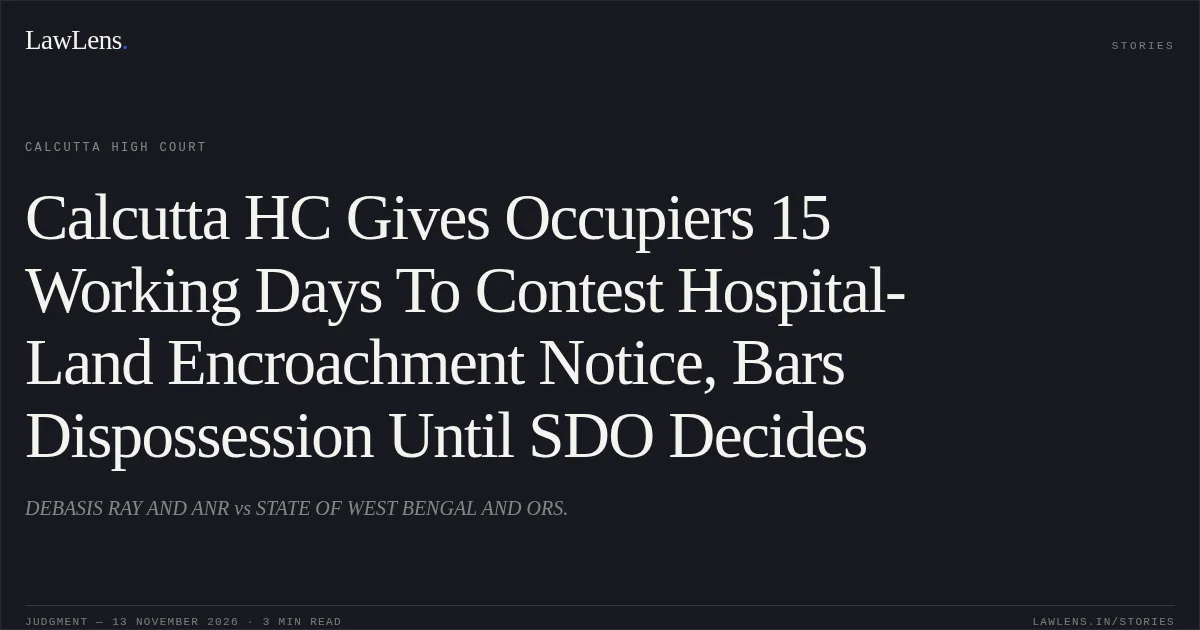
¶ 20–22It granted the petitioners liberty to submit a reply with supporting evidence to the Section 3(1) notice within 15 working days.
¶ 23–26The respondent authority was directed to hear the petitioners and pass and communicate a reasoned order within 30 working days of receiving the reply; if it rejected the show-cause, it was to take consequential action under Section 4.
¶ 23–26The State and its instrumentalities were directed not to disturb the petitioners’ possession until the reasoned order was passed.
¶ 28No order as to costs was made.
¶ 30Original Court PDF
DEBASIS RAY AND ANRvsSTATE OF WEST BENGAL AND ORS.
Click to open original judgment
Original judgment, available to read, download and summarize on LawLens.in