Facts
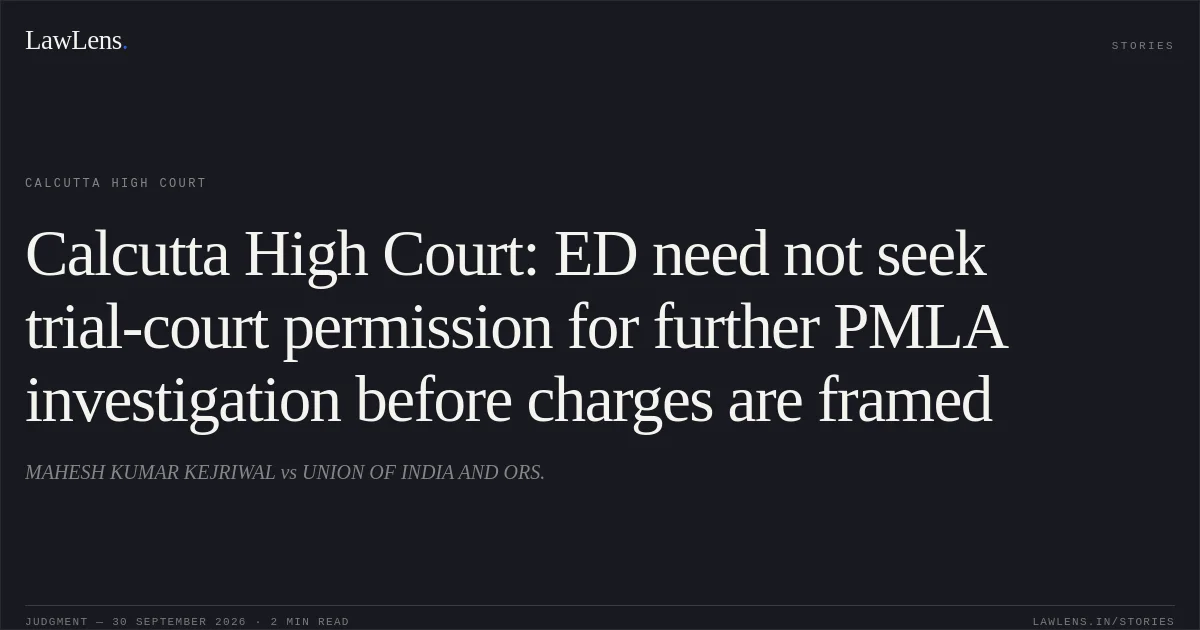
The Enforcement Directorate (ED) registered an ECIR against the petitioner and his family in 2020, treating a CBI charge-sheet as the scheduled offence.
Source reference: no citationAfter filing a prosecution complaint under the PMLA, the ED issued notices under Section 50 of the PMLA to the petitioner and his wife in August and September 2026, seeking their appearance to give evidence and produce documents
Source reference: para. 23, 25The petitioner had sought discharge before the Special Court; the application was rejected, but charges had not yet been framed
Source reference: para. 24He sought a writ restraining further investigation, arguing that the ED required the trial court’s permission. The ED contended that no such permission was required under the PMLA
Source reference: paras. 9–11, 17Issues
1. Whether the ED could continue or undertake further investigation and issue Section 50 notices after filing its prosecution complaint, without obtaining permission from the Special Court
Source reference: para. 212. Whether the statutory requirement of court permission for further investigation during trial applied when charges had not yet been framed
Source reference: paras. 22, 28Law Applied
Section 193 of the Bharatiya Nagarik Suraksha Sanhita, 2023 (BNSS) permits further investigation during trial with the permission of the court trying the case.
Source reference: para. 22Section 44 of the PMLA, which operates notwithstanding the CrPC, provides for trial of money-laundering offences by Special Courts; its Explanation (ii) permits further evidence to be brought on record in respect of an offence for which a complaint has already been filed.
Source reference: para. 26In Vijay Madanlal Choudhary v. Union of India, the Supreme Court explained that the ED may seek the Special Court’s permission to bring further evidence on record during trial.
Source reference: para. 33The Court also relied on authorities recognising further investigation as a continuing investigative power after filing a report, including State of Andhra Pradesh v. A.S. Peter, Vinay Tyagi v. Irshad Ali, State of Tamil Nadu v. Hemendhra Reddy and Vinubhai Haribhai Malaviya v. State of Gujarat.
Source reference: paras. 28–30It noted Debabrata Halder v. Enforcement Directorate, which held that permission is not required for further investigation, and distinguished Pramod Kumar v. State of Uttar Pradesh because it concerned Section 173(8) of the CrPC, not Section 44 of the PMLA.
Source reference: paras. 31–32Reasoning
The Court held that the statutory permission requirement for further investigation during trial did not bar the notices in this case because the Special Court had not framed charges and, in the Court’s view, trial had not commenced.
Source reference: paras. 24, 28It considered Section 44 of the PMLA and the authorities recognising the ED’s power to conduct further investigation after filing its complaint.
Source reference: no citationThe Court understood Vijay Madanlal Choudhary and Bhupesh Kumar Baghel v. Union of India to address obtaining permission to bring further evidence on record during trial, rather than to prohibit investigation before trial had commenced.
Source reference: paras. 27, 33It therefore found no basis to interfere with the ED’s investigation or its issuance of Section 50 notices.
Source reference: para. 34Holding
The Court rejected the petitioner’s challenge, holding that the further investigation initiated by the ED through the Section 50 notices did not warrant interference.
The writ petition was dismissed
Source reference: paras. 34–35Acts & Sections Cited
16 provisions across 5 statutes referred to in this judgment. Each provision opens on LawLens.
Prevention of Money-Laundering Act, 20028
Indian Penal Code, 18602
Prevention of Corruption Act, 19881
Bharatiya Nagarik Suraksha Sanhita, 20231
Code of Criminal Procedure, 19734
Original Court PDF
MAHESH KUMAR KEJRIWALvsUNION OF INDIA AND ORS.
Click to open original judgment
Original judgment, available to read, download and summarize on LawLens.in