Facts
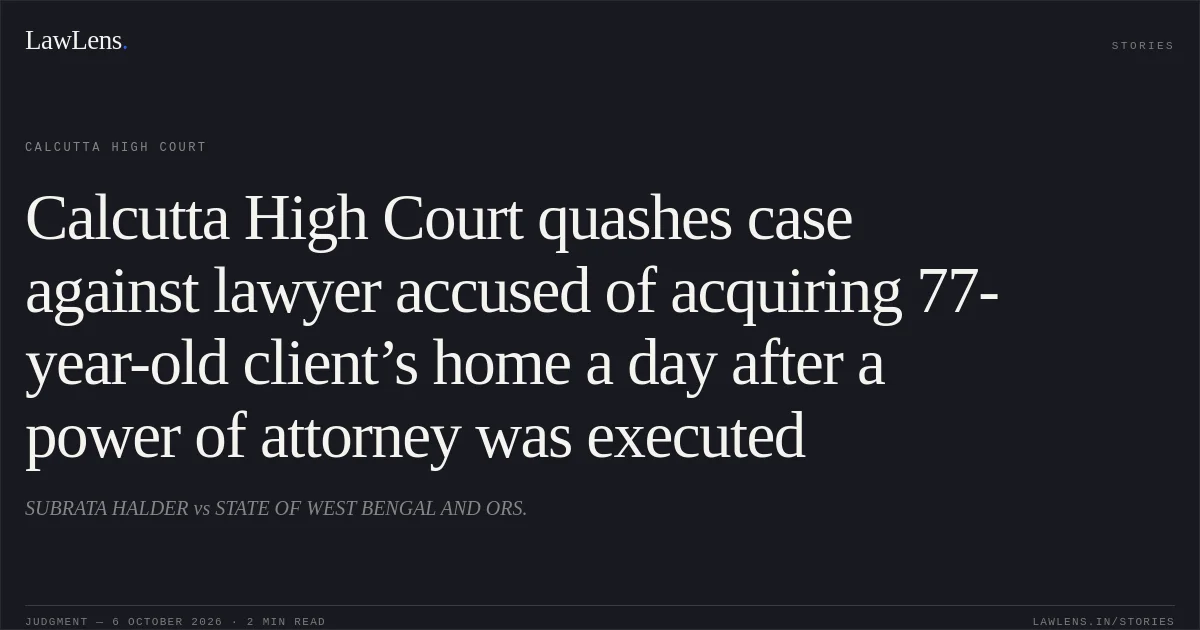
The complainant, a 77-year-old property owner, alleged that after being restored to possession of his home, he executed a registered General Power of Attorney in favour of Rahul Biswas, an office assistant of the petitioner, advocate Subrata Halder. The following day, Biswas executed a registered sale deed transferring the property to Halder. The complainant later alleged that Halder broke the locks, demolished rental rooms and took possession while he was away
Source reference: para. 2–4A police case was registered under Sections 420, 406, 448, 427, 506 and 120B IPC, and a charge-sheet followed. Halder sought quashing under Section 482 read with Sections 397 and 401 CrPC.
Source reference: para. 1, 4In a related civil suit, the Civil Court declined to find a prima facie case of fraud at the injunction stage and protected Halder’s possession
Source reference: para. 1, 4Issues
1. Whether a dispute concerning registered property-transfer instruments, financial transactions and issues pending before a Civil Court could lawfully sustain the criminal prosecution under the charged IPC provisions
Source reference: para. 102. Whether continuation of the criminal proceedings in the circumstances amounted to an abuse of process warranting quashing under Section 482 CrPC
Source reference: para. 10Law Applied
The Court proceeded under Section 482 read with Sections 397 and 401 CrPC and considered the offences alleged under Sections 420, 406, 448, 427, 506 and 120B IPC
Source reference: para. 1, 19It applied the principle that civil and criminal remedies may coexist, but criminal proceedings should not be used to exert pressure in disputes that do not disclose a criminal offence
Source reference: para. 11Relying on Indian Oil Corpn. v. NEPC India Ltd., (2006) 6 SCC 736, the Court noted that purely civil disputes should not be converted into criminal cases as a pressure tactic
Source reference: para. 7, 12It also relied on Nageswar Prasad Singh v. Narayan Singh, (1998) 5 SCC 694, concerning the proper civil-forum determination of disputes over property deeds.
Source reference: para. 7, 13For cheating under Section 420 IPC, the Court treated dishonest inducement from the inception of the transaction as an essential ingredient
Source reference: para. 6, 13, 15Reasoning
The Court viewed the dispute as turning principally on the validity and effect of registered instruments, agency, consideration and property rights, matters already before the Civil Court
Source reference: para. 14–15It considered the payment records and receipts, together with the Civil Court’s interlocutory finding that fraud had not been established prima facie, and concluded that the materials did not disclose the necessary dishonest inducement at the inception of the transaction to sustain the cheating allegation
Source reference: para. 14–15On that basis, it held that continuing the criminal case would amount to an abuse of process, notwithstanding the allegations of breach of trust and forcible possession
Source reference: para. 9, 15–16Holding
The Court answered both issues in favour of Halder, allowed the revision and quashed the FIR, consequential charge-sheet and entire criminal proceeding against him
Connected applications were disposed of, interim orders vacated, and no order as to costs was made
Source reference: para. 20–22Acts & Sections Cited
12 provisions across 2 statutes referred to in this judgment. Each provision opens on LawLens.
Code of Criminal Procedure, 19736
Indian Penal Code, 18606
Original Court PDF
SUBRATA HALDERvsSTATE OF WEST BENGAL AND ORS.
Click to open original judgment
Original judgment, available to read, download and summarize on LawLens.in