Facts
The Lakshadweep Administration issued an employment notification on 29.01.2018 for seven vacancies of Information Assistant-cum-Photographer.
Source reference: para. 2The recruitment process, involving a written test and a proficiency test conducted by CUSAT, Kochi, was substantially completed by 21.09.2020 when the Recruitment Committee approved the final merit list.
Source reference: para. 2The Lakshadweep Staff Selection Board (LSSB) was subsequently constituted on 23.01.2021.
Source reference: para. 3Despite legal opinions from the Administration’s Legal Cell stating that the prior recruitment process was valid, the Board intervened, citing inconsistencies in the scheme of examination.
Source reference: para. 3This led to the eventual cancellation of the recruitment process via an order dated 04.12.2025 (Annexure A-19).
Source reference: para. 13The applicants, who were top-ranked in the merit list, challenged this cancellation as arbitrary and illegal.
Source reference: para. 4Issues
1. Whether the applicants acquired an indefeasible right to appointment by virtue of being included in a finalized merit list that had not been officially published.
Source reference: para. 7, 112. Whether the Lakshadweep Administration acted bona fide and within its legal authority to cancel the recruitment process after its completion but before external publication.
Source reference: para. 11, 133. Whether the subsequent constitution of the LSSB provided a valid legal basis for intervening in a recruitment process initiated and concluded prior to its existence.
Source reference: para. 8, 12Law Applied
The court applied the established principle that successful candidates in a selection process do not acquire an indefeasible right to be appointed, as held in Shankarsan Dash v. Union of India.
Source reference: para. 11It further relied on State of Haryana v. Subash Chander Marwaha, stating that a notification is merely an invitation to apply and does not compel the authority to appoint.
Source reference: para. 11Doctrine from Jitendra Kumar v. State of Haryana and State of Assam v. Arabinda Rabha, which mandates that any decision to abandon a recruitment process mid-way must be taken bona fide for appropriate reasons and must not be arbitrary or whimsical.
Source reference: para. 10, 11Reasoning
The Tribunal noted that the recruitment process was conducted by a reputed independent body (CUSAT) and that no allegations of fraud or malpractice existed regarding the selection itself.
Source reference: para. 5, 13It found that the LSSB was constituted after all candidate-participation stages were finished, rendering its intervention questionable.
Source reference: para. 12The court observed that the Administration's justifications for cancellation appeared to be post-facto rationalizations rather than original causes for the decision.
Source reference: para. 12While acknowledging that the lack of formal Government approval of the select list prevented the creation of a "vested right" for the applicants, the Tribunal concluded that the total cancellation of the process lacked legal justification and was arbitrary, especially since vacancies continued to exist and previous legal challenges to the notification had already been dismissed by the High Court.
Source reference: para. 8, 13Holding
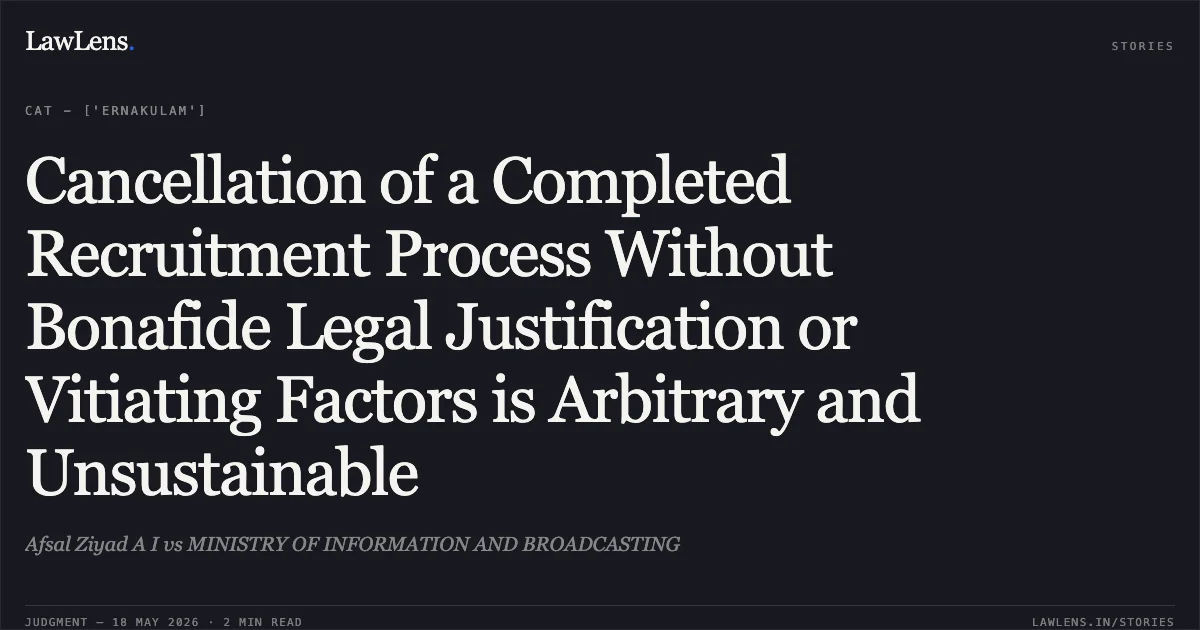
The Tribunal held that while the applicants did not have an absolute right to appointment, the Administration's decision to cancel the process was devoid of legal justification and lacked bona fides.
The Tribunal set aside the cancellation order (Annexure A-19) and directed the respondents to logically conclude the selection process and issue appropriate orders within three months; the O.As were disposed of with no order as to costs.
Source reference: para. 13Acts & Sections Cited
1 provisions across 1 statute referred to in this judgment. Each provision opens on LawLens.
Right to Information Act, 20051
Original Court PDF
Afsal Ziyad A IvsMINISTRY OF INFORMATION AND BROADCASTING
Click to open original judgment
Original judgment, available to read, download and summarize on LawLens.in