Facts
The respondents published a tender on the GeM Portal on 8 July 2026 for hiring consultancy services relating to the establishment of Aadhaar Enrolment Centres, project management, e-governance and selection of service providers.
Source reference: para. 4Of approximately seven participating entities, three, including the petitioner, qualified in the technical evaluation. Following technical presentations and evaluation by the competent committee, the petitioner was declared H-1, and the result was uploaded on the GeM Portal on 5 August 2026.
Source reference: para. 4The respondent authority subsequently uploaded the contract for execution on 11 August 2026.
Source reference: para. 5However, the tender was cancelled on 22 August 2026, initially citing only “unavoidable circumstances”.
Source reference: paras. 5–6During the proceedings, the respondents disclosed that the actual reason for cancellation was the inadvertent specification of an ePBG of 0.75% in the bid document, instead of the prescribed 3%–5% range applicable under GeM rules.
Source reference: para. 7The petitioner undertook to deposit the additional amount necessary to raise the ePBG to 5% of the contract value.
Source reference: para. 8Issues
Whether the respondents’ cancellation of the tender, after the petitioner had been declared H-1 and the contract had been uploaded, was arbitrary and legally sustainable on the ground of “unavoidable circumstances” and the incorrect specification of the ePBG percentage?
Source reference: paras. 5–7, 16Whether the ePBG requirement was an essential condition of the tender, such that its correction from 0.75% to 5% would impermissibly alter the tender or prejudice other bidders?
Source reference: paras. 11–14Whether the petitioner could be directed to deposit the deficit ePBG and the tender revived without resorting to re-tendering?
Source reference: paras. 8, 16–18Law Applied
The Court applied the distinction between essential and ancillary tender conditions recognised in Poddar Steel Corporation v. Ganesh Engineering Works, (1991) 3 SCC 273, G.J. Fernandez v. State of Karnataka, (1990) 2 SCC 488, and B.S.N. Joshi & Sons Ltd. v. Nair Coal Services Ltd., (2006) 11 SCC 548: non-compliance with an ancillary condition may be waived or corrected where the relaxation is non-discriminatory and causes no prejudice.
Source reference: para. 11It applied the principle that a public authority cannot take advantage of its own wrong—nullus commodum capere potest de injuria sua propria—as recognised in Kusheshwar Prasad Singh v. State of Bihar, (2007) 13 SCC 433.
Source reference: para. 12The Court also relied on the principles of legitimate expectation under Food Corporation of India v. Kamdhenu Cattle Feed Industries, (1993) 1 SCC 71, and National Buildings Construction Corporation v. S. Raghunathan, (1998) 7 SCC 66, and recognised that State action in contractual matters remains subject to Article 14 of the Constitution.
Source reference: para. 15While acknowledging the authority’s role in interpreting its tender document under Central Coalfields Ltd. v. SLL-SML (Joint Venture Consortium), (2016) 8 SCC 622, and Afcons Infrastructure Ltd. v. Nagpur Metro Rail Corporation Ltd., (2016) 16 SCC 818, the Court held that such interpretive deference is not absolute.
Source reference: para. 13Reasoning
The Court held that the ePBG was a financial safeguard for performance and did not affect the bidders’ eligibility, technical competence, comparative merit or H-1 ranking.
Source reference: para. 12Since the incorrect 0.75% figure resulted from the respondents’ own inadvertence, correction of the ePBG to 5%, particularly after the petitioner voluntarily undertook to bear the additional burden, did not alter the substantive competitive evaluation or the essential structure of the tender.
Source reference: paras. 10–12Clause 2.3 of the RFP prescribed a procedure for amendment but did not prohibit correction or render the financial terms immutable.
Source reference: para. 13The Court found no actual prejudice to the other bidders: increasing the successful bidder’s performance security neither changed their rankings nor conferred any comparative advantage on the petitioner.
Source reference: para. 14Cancellation at the final stage, after declaration of the petitioner as H-1 and upload of the contract, therefore defeated the petitioner’s legitimate expectation and was disproportionate, arbitrary and unsupported by any overriding public interest, financial impossibility or other substantive impediment.
Source reference: paras. 15–16Holding
The Court allowed the writ petition and quashed the order dated 22 August 2026 cancelling the tender.
The petitioner was directed to deposit, within one week, the deficit amount required to raise the ePBG to 5% of the contract value.
Source reference: para. 17Upon such deposit, the tender was to stand revived and the parties restored to the position prevailing immediately before cancellation, subject to any other legal impediment.
Source reference: para. 17The respondents were directed to provide the contract document and complete the allied formalities within two weeks of deposit of the enhanced ePBG.
Source reference: para. 18The judgment was confined to the legality of cancellation on the ground of inadequate ePBG and expressed no opinion on any other aspect of the tender process.
Source reference: para. 19No order as to costs was made.
Source reference: para. 20Original Court PDF
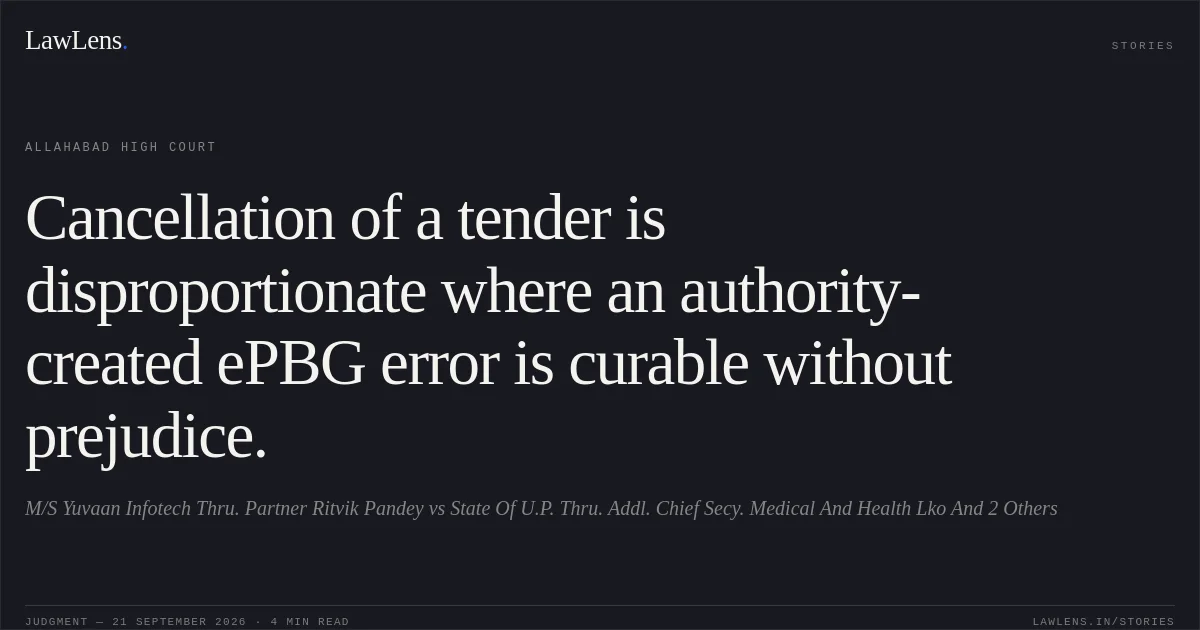
M/S Yuvaan Infotech Thru. Partner Ritvik PandeyvsState Of U.P. Thru. Addl. Chief Secy. Medical And Health Lko And 2 Others
Click to open original judgment
Original judgment, available to read, download and summarize on LawLens.in