Facts
The petitioners challenged a Refusal Check Slip dated 8 September 2026, by which the second respondent refused to register a settlement deed in favour of Isral Inbaraj, the first petitioner’s son and the second petitioner’s brother.
Source reference: para. 3The petitioners had purchased the properties under registered sale deeds and later created the “Meetpar Yesu Trust” by a registered deed dated 10 July 2006; that trust deed was subsequently revoked by a registered document dated 10 July 2012.
Source reference: paras. 4–5, 8The Registrar refused registration on the grounds that the properties belonged to the Trust, the petitioners had not established their authority to settle them personally, and an encumbrance certificate had not been furnished.
Source reference: para. 6The petitioners sought certiorari to quash the refusal and a direction to register the settlement deed.
Source reference: prayer; para. 3Issues
Whether the petitioners could settle the properties in their individual capacities when the Court treated those properties as trust property.
Source reference: paras. 7, 10–13Whether cancellation of the Trust Deed, without further steps to dissolve the Trust and deal with its assets according to law, permitted registration of the proposed settlement deed.
Source reference: paras. 17–19Law Applied
The Court relied on Sections 5 and 6 of the Indian Trusts Act, 1882: a trust concerning immovable property must be validly declared in writing and registered, and its creation requires certainty as to the author’s intention, purpose, beneficiary and trust property.
Source reference: paras. 11–12It also relied on Section 34, under which a trustee may seek the principal Civil Court’s opinion, advice or directions on certain questions concerning trust administration.
Source reference: para. 14The Court further stated that a trustee who has accepted a trust cannot renounce it except in circumstances recognised by law.
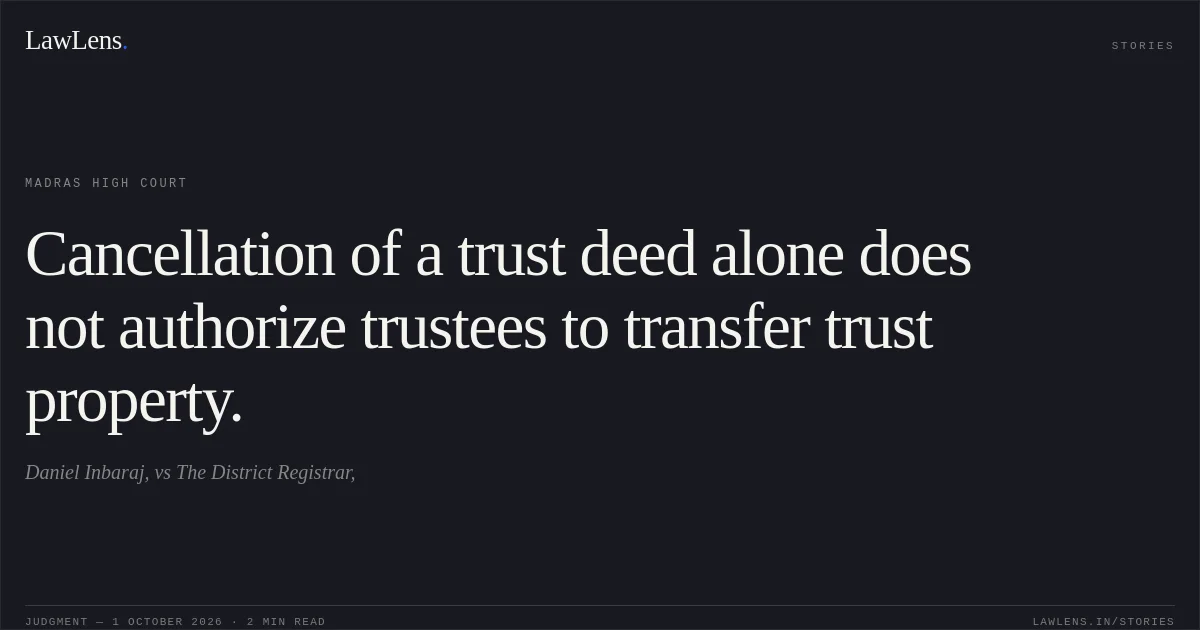
Source reference: para. 15Referring to Sections 77 and 78, the Court held that the stated grounds for extinguishment or revocation did not make mere cancellation of the Trust Deed sufficient to transfer the trust property to the petitioners’ family member.
Source reference: paras. 17–18Reasoning
The Court treated the sale deeds as having declared the properties to be trust property and regarded the petitioners as trustees bound to protect those assets.
Source reference: paras. 9–10On that basis, it concluded that the petitioners could not use a family arrangement to transfer the properties to Isral Inbaraj in their individual capacities without obtaining the necessary authority or otherwise dealing with the Trust in accordance with law.
Source reference: paras. 13–16It further held that registration of the Trust’s revocation did not, by itself, establish that the trust assets could be settled as proposed.
Source reference: paras. 17–18The Court therefore declined to interfere with the Registrar’s refusal.
Source reference: no citationHolding
The writ petition was dismissed, and the connected miscellaneous petition was closed, with no order as to costs.
The petitioners were given liberty to pursue the remedy available under law for dissolving the Trust and liquidating its assets.
Source reference: para. 19Acts & Sections Cited
5 provisions across 1 statute referred to in this judgment. Each provision opens on LawLens.
Indian Trust Act, 18825
Original Court PDF
Daniel Inbaraj,vsThe District Registrar,
Click to open original judgment
Original judgment, available to read, download and summarize on LawLens.in