Facts
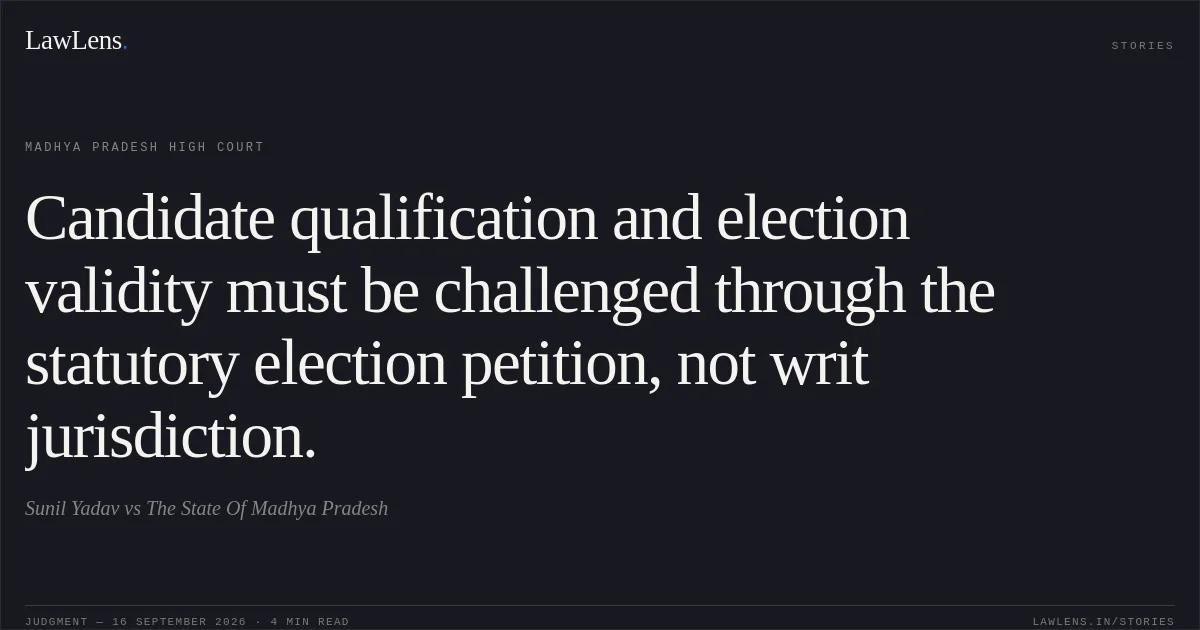
The petitioner and respondent No. 9 contested the election for Councillor from Ward No. 65 of the Municipal Corporation, a seat reserved for an OBC candidate. Respondent No. 9 declared himself to be of the “Lohar” OBC caste and relied upon a caste certificate dated 9 November 2009. The petitioner alleged that respondent No. 9 belonged to the Sindhi/Kalra community, which was not included in the OBC category, and that the caste certificate was forged or invalid.
Source reference: para. 3; pp. 1–2The petitioner initially approached the High Court in 2022 and 2024 seeking consideration of his complaint. Pursuant to directions issued in those proceedings, the Backward Class High Level Scrutiny Committee examined the matter and, by order dated 4 April 2025, rejected the complaint. The Committee relied, inter alia, upon verification obtained from the Sub-Divisional Officer, Juni, Indore, confirming that the certificate had been issued in accordance with the prescribed procedure.
Source reference: paras. 3–4, 6; pp. 1–7The petitioner challenged the Committee’s order under Article 226 of the Constitution and sought cancellation of the caste certificate, cancellation of respondent No. 9’s election, a declaration that the petitioner was the duly elected Councillor, and initiation of disciplinary or criminal proceedings. Respondent No. 9 opposed the petition on the ground that an election could be challenged only by an election petition under Sections 441 and 441-B of the Madhya Pradesh Municipal Corporation Act, 1956, read with Article 243ZG(b) of the Constitution.
Source reference: paras. 2, 5; pp. 1, 4–5Issues
1. Whether the writ petition under Article 226 was maintainable when the petitioner substantially sought cancellation of the election of respondent No. 9 and declaration of himself as the elected Councillor, despite the statutory remedy of an election petition under Sections 441 and 441-B of the Madhya Pradesh Municipal Corporation Act, 1956, and the bar under Article 243ZG(b)?
Source reference: paras. 5, 8, 11–13; pp. 4–5, 11–182. Whether the High Level Scrutiny Committee’s order dated 4 April 2025 rejecting the challenge to respondent No. 9’s 2009 caste certificate was arbitrary, perverse, procedurally unlawful, or violative of natural justice so as to warrant interference under Article 226?
Source reference: paras. 4, 6, 9–10, 13; pp. 2–7, 12–183. Whether the petitioner established that respondent No. 9’s caste certificate was forged or fraudulently obtained merely because the original 2009 record was unavailable and the petitioner disputed respondent No. 9’s caste status?
Source reference: paras. 4, 6, 13; pp. 2–9, 18Law Applied
Article 226 of the Constitution confers wide but discretionary judicial-review jurisdiction, which is ordinarily exercised only where the impugned decision suffers from illegality, arbitrariness, perversity, procedural impropriety, violation of natural justice, or mala fide exercise of power.
Source reference: paras. 7, 13; pp. 10, 18Article 243ZG(b), read with Sections 441(2) and 441-B of the Madhya Pradesh Municipal Corporation Act, 1956, requires an election or the eligibility of a returned candidate to be challenged through an election petition before the prescribed court; improper qualification or disqualification of a returned candidate is a statutory ground for declaring the election void.
Source reference: para. 8; pp. 11–12In Prem Narayan Yadav v. State of M.P., the Court held that the statutory election remedy is a self-contained code and that writ jurisdiction cannot be used to bypass it.
Source reference: para. 11; pp. 16–17The same principle was reiterated in Shrigopal Gupta v. State of M.P., particularly in view of Article 243ZG.
Source reference: para. 12; pp. 17–18The Court also applied the principle that allegations of fraud or forgery must be specifically pleaded and established by clear and convincing material; mere non-availability of old official records does not, by itself, invalidate a certificate.
Source reference: para. 13; p. 18Judicial review is not an appellate jurisdiction permitting re-appreciation of evidence considered by a competent scrutiny committee.
Source reference: paras. 5–6, 13; pp. 4–9, 18Reasoning
The Court held that the petitioner’s prayer to cancel respondent No. 9’s election and declare the petitioner elected was, in substance, an election challenge. Section 441-B expressly provides for an election petition where the returned candidate was not qualified or was disqualified. Accordingly, the petitioner could not use Article 226 to circumvent the statutory mechanism, particularly in view of Article 243ZG(b) and the authorities in Prem Narayan Yadav and Shrigopal Gupta.
Source reference: paras. 11–13; pp. 16–18On the challenge to the caste certificate, the Court found that the Committee had followed the prescribed procedure, obtained verification from the competent Sub-Divisional Officer, considered the available material, and afforded the parties an opportunity of hearing.
Source reference: paras. 6, 13; pp. 6–7, 18The petitioner failed to make a specific and substantiated allegation of fraud and did not produce clear evidence demonstrating that the certificate had been fabricated or obtained by misrepresentation. The mere absence of the original 2009 record, approximately thirteen years after its issuance and after the certificate had been acted upon, was insufficient to establish invalidity.
Source reference: para. 13; p. 18Since no violation of natural justice, jurisdictional error, perversity, or manifest illegality was demonstrated, the Court declined to re-appreciate the factual findings of the Scrutiny Committee under Article 226.
Source reference: paras. 5–6, 13; pp. 4–9, 18Holding
The High Court dismissed the writ petition for want of merit. It held that the challenge to respondent No. 9’s election was barred by the availability of the statutory election-petition remedy under Sections 441 and 441-B of the Madhya Pradesh Municipal Corporation Act, 1956, read with Article 243ZG(b) of the Constitution.
It further held that the petitioner failed to establish fraud, forgery, procedural illegality, perversity, or violation of natural justice in the Scrutiny Committee’s order dated 4 April 2025. No relief was granted, and the petition was accordingly dismissed.
Source reference: paras. 13–14; p. 18Acts & Sections Cited
5 provisions across 2 statutes referred to in this judgment. Each provision opens on LawLens.
Indian Penal Code, 18604
Code of Criminal Procedure, 19731
Original Court PDF
Sunil YadavvsThe State Of Madhya Pradesh
Click to open original judgment
Original judgment, available to read, download and summarize on LawLens.in