Facts
The respondents applied for Urdu Translator posts under Advertisement No. 01/2019.
Source reference: no citationThey contended that the advertisement and online portal’s use of “MBC,” rather than “EBC,” led some EBC candidates to apply under the BC category.
Source reference: no citationAfter the selection process concluded, the Single Judge directed the Commission to determine whether the petitioners belonged to the EBC category and had secured the cut-off marks, and to appoint successful candidates according to merit.
Source reference: p. 5–7The Commission appealed, arguing, among other things, that the advertisement identified the category in Hindi as “अत्यंत पिछड़ा वर्ग,” that only 15 of the 53 petitioners were EBC candidates, and that the writ petition was brought after publication of the merit list without joining successful candidates.
Source reference: p. 7–10, 14–15Issues
Whether the advertisement’s use of “MBC” and its category descriptions created ambiguity that caused EBC candidates to apply under the BC category.
Source reference: p. 13–16Whether the respondents could seek reclassification after participating in the selection process and after publication of the final merit list.
Source reference: p. 15–19Whether the writ petition was defective because it combined candidates with distinct claims and omitted successful candidates who could be affected by the relief.
Source reference: p. 7–8, 18–19Law Applied
The Court applied the principle in Bedanga Talukdar v. Saifudaullah Khan, (2011) 12 SCC 85, that public selection must follow the advertised procedure and that relaxation of advertised conditions is impermissible unless duly authorised and publicised.
Source reference: p. 17–18It also relied on Dhanyalakshmi Rice Mills v. Commissioner of Civil Supplies, (1976) 4 SCC 723, Prabodh Verma v. State of U.P., (1984) 4 SCC 251, and Samrendra Kumar Choudhary v. State of Bihar, concerning the need to address distinct causes of action separately and to implead persons whose existing rights may be affected by relief.
Source reference: p. 7–8, 18–19Under Clause 4 of the advertisement, a candidate claiming an incorrect reserved category was treated as a General-category candidate.
Source reference: p. 16Reasoning
The Court found that the advertisement repeatedly used the Hindi expression “अत्यंत पिछड़ा वर्ग” and identified the corresponding English category as “MBC”; it therefore did not accept that the omission of the abbreviation “EBC” in one clause created the asserted confusion.
Source reference: p. 14–16The fact that 31,344 candidates applied under the EBC category, while only 15 petitioners were EBC candidates who applied under BC, further undermined the claim of general ambiguity.
Source reference: p. 14–15The respondents had not sought clarification before the selection concluded, and their challenge followed publication of the merit list and recommendations.
Source reference: p. 15–16, 19The Court also found that the petitioners’ categories and individual claims differed, while successful candidates whose positions could be affected had not been joined.
Source reference: p. 7–8, 18–19Reopening the concluded selection would therefore be inconsistent with the advertised procedure and could unsettle the merit list.
Source reference: p. 17–19Holding
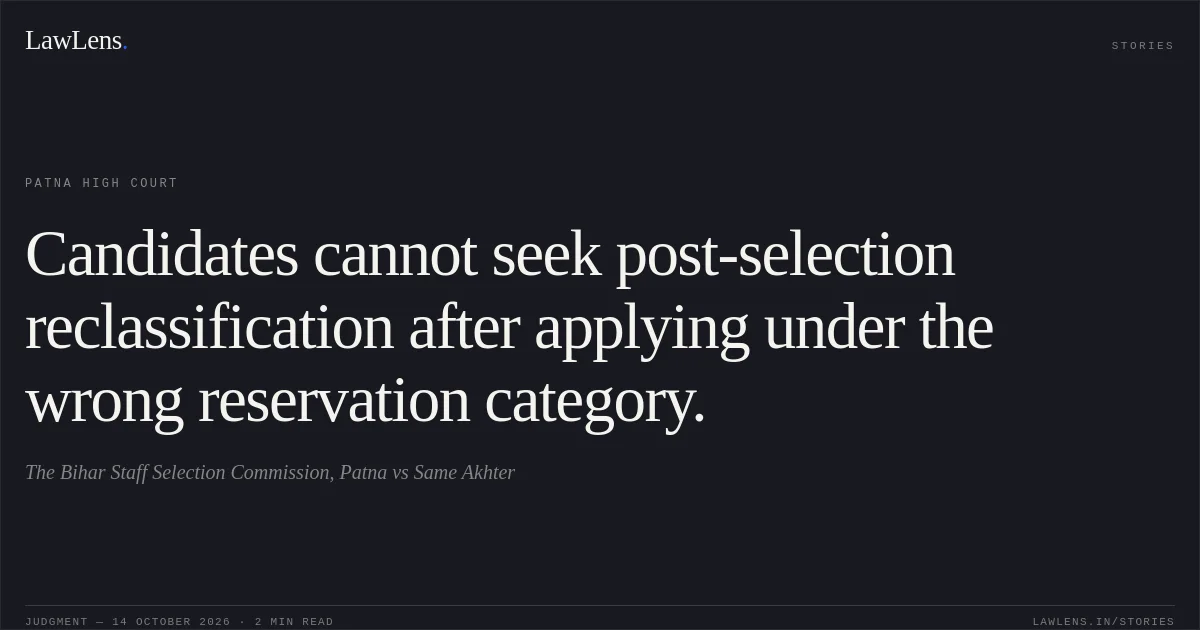
The Court held that the advertisement did not create the alleged ambiguity and that the respondents could not obtain post-selection reclassification.
It allowed the Letters Patent Appeal, set aside the Single Judge’s order dated 7 January 2026, and dismissed CWJC No. 12606 of 2025.
Source reference: p. 20Acts & Sections Cited
1 provisions across 1 statute referred to in this judgment. Each provision opens on LawLens.
Prohibition of Electronic Cigarettes (Production, Manufacture, Import, Export, Transport, Sale, Distribution, Storage and Advertisement) Act, 20191
Original Court PDF
The Bihar Staff Selection Commission, PatnavsSame Akhter
Click to open original judgment
Original judgment, available to read, download and summarize on LawLens.in