Facts
The Government of Jammu and Kashmir launched the Rehbar-e-Taleem (ReT) Scheme in 2000 to address teaching staff shortages
Source reference: para. 7On 16.11.2018, the Government issued Order No. 919-Edu of 2018 (Closure Order), formally closing the scheme and cancelling all pending advertisement notices and select panels where engagement orders had not yet been issued
Source reference: para. 4, 8Various candidates who were in select panels but hadn't received formal orders—often due to pending litigation or administrative delays—challenged the order
Source reference: para. 4The High Court upheld the Closure Order but carved out four exceptions, preserving rights for candidates where select panels were approved or litigation was pending
Source reference: para. 5The State appealed against these exceptions, and candidates appealed against the scheme's closure
Source reference: para. 6Issues
1. Whether the withdrawal of select panels and advertisements ab initio under the Closure Order via executive action violates Article 14 of the Constitution
Source reference: para. 182. Whether minimum qualifications under Section 23 of the Right of Children to Free and Compulsory Education Act, 2009 (RTE Act) must be mandatorily met by candidates seeking appointment under a defunct state scheme
Source reference: para. 19-20Law Applied
The Court applied the twin-test of "reasonable classification" under Article 14 of the Constitution, requiring an intelligible differentia and a rational nexus to the object sought
Source reference: para. 18It relied on Section 23 of the RTE Act and National Council for Teacher Education (NCTE) regulations, which mandate minimum qualifications (including the Teachers’ Eligibility Test or TET) for teacher appointments
Source reference: para. 19-20Precedent from Anjuman Ishaat-E-Taleem Trust v. State of Maharashtra (2025) was applied to establish TET as a constitutional necessity under Article 21-A
Source reference: para. 20the Court invoked its plenary powers under Article 142 to balance administrative closure with individual equity
Source reference: para. 23Reasoning
The Court found the State's classification—distinguishing between those with engagement orders and those whose orders were stalled solely due to pending litigation—to be arbitrary. Such a differentia had no rational nexus to the State's goal of curbing "forged documents," as litigation pendency is an extraneous circumstance
Source reference: para. 18However, the Court acknowledged that since the RTE Act now governs, no appointment can be absolute without meeting NCTE standards
Source reference: para. 19Rather than simply quashing or upholding the High Court's exceptions, the Court adopted a "harmonized approach"
Source reference: para. 19It reasoned that while merit-holders must not be penalized for litigation delays, they must also satisfy the modern statutory requirement of TET to ensure "quality education" under Article 21-A
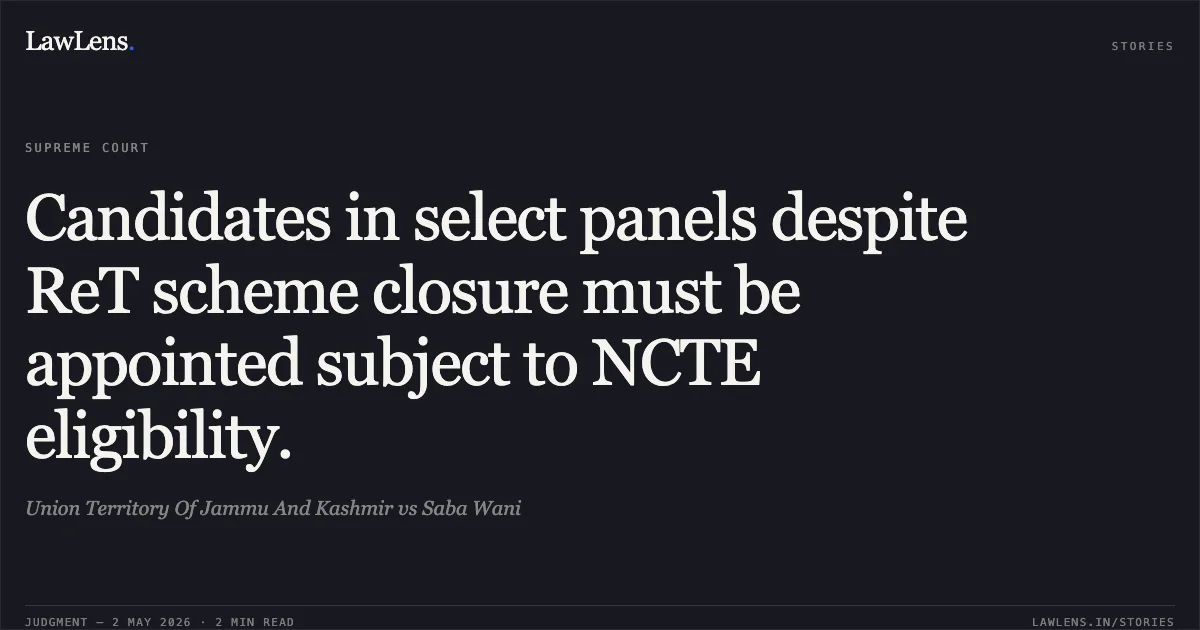
Source reference: para. 23, 25(f)Holding
The Closure Order cannot retrospectively impair the rights of candidates already in prepared select panels; they must be issued engagement orders within eight weeks
Such appointees must acquire NCTE qualifications and pass TET within 3 years and 3 attempts to secure regularization
Source reference: para. 25(c)Seniority for these candidates shall be redrawn based on their original panel position once they qualify TET
Source reference: para. 25(e)Failure to qualify within the period results in automatic termination
Source reference: para. 25(f)These directions are in rem for all candidates currently litigating before this judgment but do not revive the scheme for fresh claims
Source reference: para. 25(g)-(i)The Court modified the High Court's judgment and issued directions under Article 142
Source reference: para. 25, 26Acts & Sections Cited
2 provisions across 1 statute referred to in this judgment. Each provision opens on LawLens.
Right of Children to Free and Compulsory Education Act, 20092
Original Court PDF
Union Territory Of Jammu And KashmirvsSaba Wani
Click to open original judgment
Original judgment, available to read, download and summarize on LawLens.in