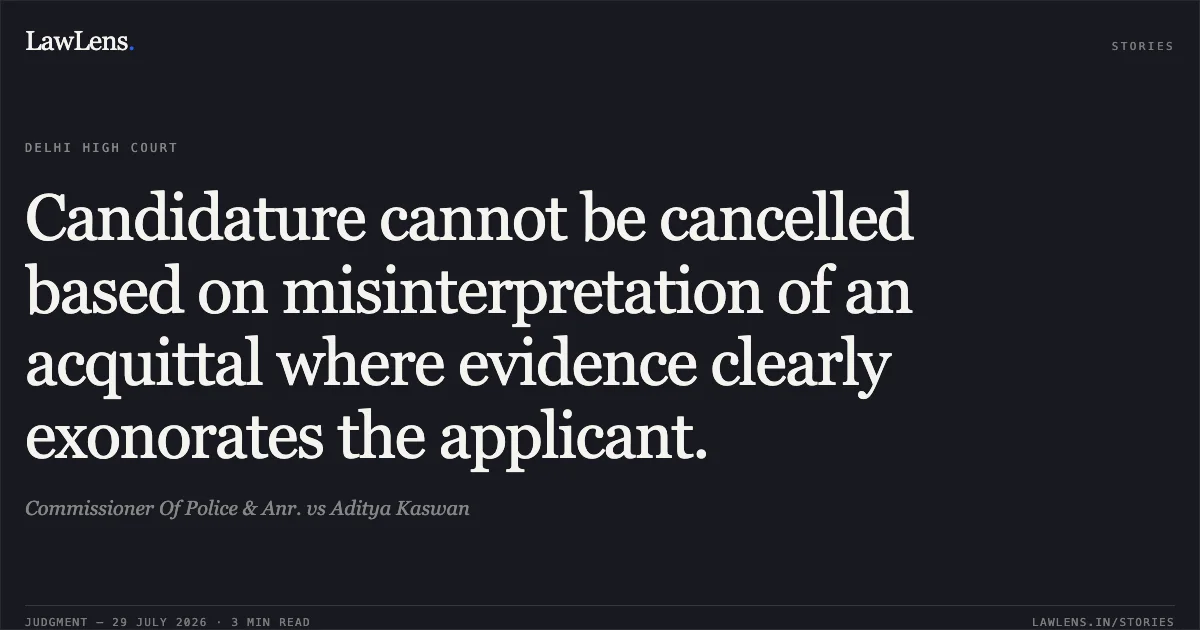
Facts
The respondent, a Constable in the Delhi Police, applied for the post of Head Constable (AWO/TPO) in 2022.
Source reference: no citationDuring the recruitment process, he disclosed in his attestation form his prior involvement in FIR No. 265/2015 under Sections 143/323/341/504 IPC.
Source reference: p. 2Despite clearing the selection rounds, he was issued a show-cause notice regarding this disclosure.
Source reference: p. 1-2Consequently, the Screening Committee cancelled his candidature on December 10, 2024, asserting that his acquittal by the Judicial Magistrate, Kota, was not "honourable" but based on a "benefit of doubt" since witnesses had turned hostile.
Source reference: p. 4The respondent challenged this before the Central Administrative Tribunal (CAT), which allowed his plea on November 13, 2025, finding that the respondent was actually exonerated on merits rather than a mere compromise.
Source reference: p. 4, 7The Commissioner of Police subsequently filed this writ petition challenging the CAT's order.
Source reference: p. 1Issues
1. Whether the Screening Committee misread the criminal court's judgment to incorrectly classify the respondent's acquittal as a "technical acquittal" rather than an "honourable" one.
Source reference: p. 7 / para. 92. Whether the respondent’s prior involvement in a criminal case, where he was found to have no active role, justified the cancellation of his candidature for a disciplined force.
Source reference: p. 8 / para. 12Law Applied
The Court primarily applied the principles governing the suitability of candidates with criminal antecedents for disciplined forces as established by the Supreme Court in Avtar Singh v. Union of India (2016).
Source reference: p. 10-12 / para. 14These principles dictate that if a candidate truthfully declares a concluded criminal case, the employer must objectively consider the nature of the offence, the extent of involvement, and the propensity for future misconduct.
Source reference: p. 13The Court further relied on Union of India v. Methu Meda (2022) and its own precedent in Sandeep K.L. v. Union of India (2025), which emphasizes that a Screening Committee cannot sit in appeal over a criminal court's findings or mechanically disqualify a candidate without assessing the specific grounds of acquittal.
Source reference: p. 4, 10, 8, 12Reasoning
The Court observed that the Screening Committee failed to holistically read the Judicial Magistrate’s judgment. While two co-accused (Mukesh and Sunil) were acquitted based on a compromise, the respondent (Accused 5) was acquitted because the prosecution witnesses specifically testified that only Mukesh and Sunil had assaulted them, and that the other accused were not involved.
Source reference: p. 7 / para. 10Consequently, the charge under Section 143 IPC (unlawful assembly) failed as the legal requirement of five or more persons was not met.
Source reference: p. 6The Court reasoned that the respondent’s acquittal was "clean and honourable" because no evidence linked him to the assault.
Source reference: p. 7 / para. 11Following the logic in Sandeep K.L., the Court found that the respondent had truthfully disclosed the FIR and that his involvement was non-existent. The Screening Committee's decision was deemed arbitrary as it ignored the specific findings of the criminal court and failed to evaluate the respondent's "propensity" for future violence.
Source reference: p. 13-14Holding
The Court held that the respondent’s acquittal was on merits and not a technicality, as the trial court explicitly ruled out his participation in the alleged acts.
The High Court dismissed the writ petition and affirmed the Tribunal's judgment. The Delhi Police was directed to proceed with the respondent’s appointment as he was otherwise successful in the selection process. No orders as to costs were made.
Source reference: p. 14 / para. 18, p. 6 / para. 7, p. 15Acts & Sections Cited
13 provisions across 2 statutes referred to in this judgment. Each provision opens on LawLens.
Indian Penal Code, 1860
Code of Criminal Procedure, 19733
Original Court PDF
Commissioner Of Police & Anr.vsAditya Kaswan
Click to open original judgment
Original judgment, available to read, download and summarize on LawLens.in


