Facts
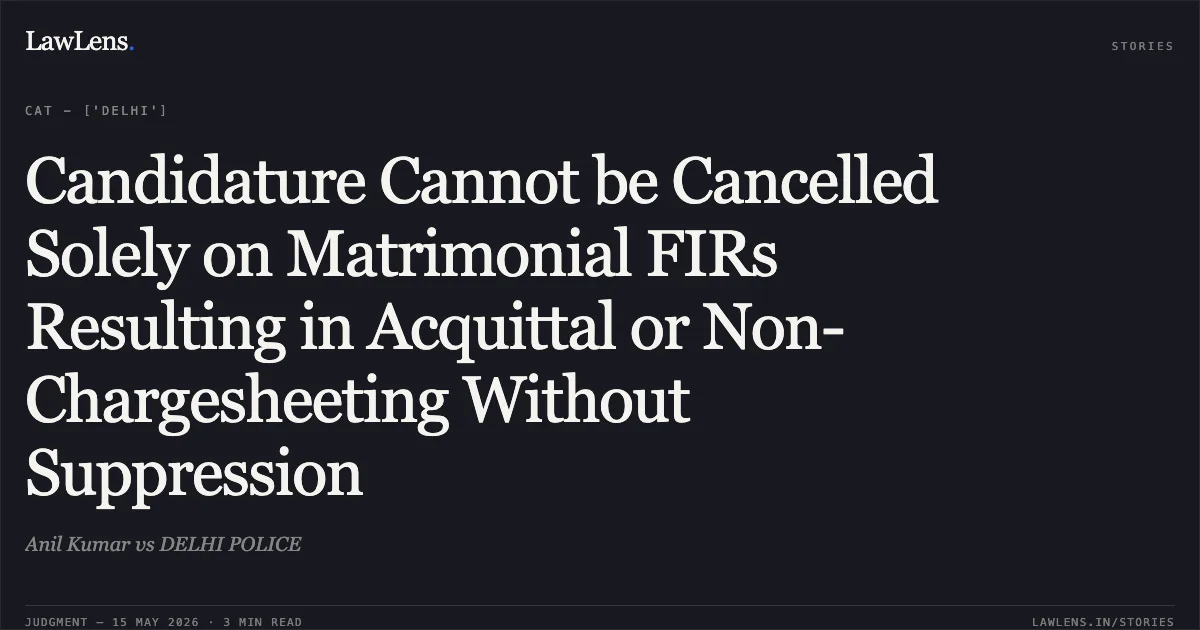
The applicant, a candidate for the post of Constable (Driver) in the Delhi Police, challenged the cancellation of his candidature via an order dated 06.12.2024 and a show cause notice dated 21.03.2024.
Source reference: p.2Despite successfully clearing the recruitment process, the respondents deemed him unsuitable due to his involvement in two criminal cases arising from matrimonial discord with his estranged wife.
Source reference: para. 2.1The first case (FIR No. 264/2020) resulted in acquittal on 26.04.2022 after the complainant and witnesses turned hostile, stating the injuries were accidental.
Source reference: para. 2.3In the second case (FIR No. 114/2023), the applicant was not chargesheeted.
Source reference: para. 2.1The applicant had truthfully disclosed these matters in his attestation form.
Source reference: para. 4The Delhi Police Screening Committee categorized the offences as involving moral turpitude and gender violence under Standing Order No. HRD 12/2022 and rejected his suitability.
Source reference: para. 6.4-6.5Issues
1. Whether the mere registration of FIRs in matrimonial disputes, despite acquittal or non-filing of a chargesheet, constitutes a valid ground for the cancellation of candidature in a disciplined force.
Source reference: p.10-11 / para. 6.1-6.22. Whether the Screening Committee acted arbitrarily by failing to distinguish between "main accused" and "collateral accused" and by ignoring the nature of the acquittal in matrimonial cases.
Source reference: p.15-16 / para. 6.7-6.10Law Applied
The court primarily applied Delhi Police Standing Order No. HRD 12/2022, which governs suitability assessments for candidates with criminal antecedents, specifically exempting collateral accused in matrimonial cases under Section 498A IPC.
Source reference: p.11-14It relied on the landmark principle from Avtar Singh v. Union of India, emphasizing that even if a candidate is acquitted, the employer must assess suitability fairly without being mechanical.
Source reference: p.12It further applied Pramod Singh Kirar v. State of Madhya Pradesh, which held that acquittals in matrimonial disputes ending in settlement should not bar appointment.
Source reference: p.9-10The court applied Vikram Ruhal v. Delhi Police, which established that being named in an FIR (especially where the candidate is placed in Column 12/not summoned) is not an automatic impediment to public employment.
Source reference: p.7-8Reasoning
The Tribunal reasoned that while the respondents have the discretion to scrub antecedents, such discretion must be exercised judiciously and not pedantically.
Source reference: para. 6.2The court noted that the applicant had made full disclosure, negating any charge of suppression.
Source reference: para. 6.5Regarding FIR No. 264/2020, the Tribunal found that the "hostile" nature of the witnesses did not diminish the acquittal because the substratum of the prosecution's case—that injuries were caused by assault—was directly contradicted by the victim’s testimony of an accidental fall.
Source reference: para. 6.7Regarding FIR No. 114/2023, the Tribunal highlighted that the applicant was not even chargesheeted, yet the respondents treated the mere FIR as proof of bad character.
Source reference: para. 6.10The Tribunal concluded that the Screening Committee failed to consider the "growing tendency" to rope in relatives in matrimonial discords, as cautioned in Vikram Ruhal, and instead focused disproportionately on the gravity of the penal sections rather than the factual outcome of the investigations.
Source reference: para. 6.12Holding
The Tribunal allowed the O.A., quashing the impugned order of cancellation and the show cause notice.
It held that the respondents' decision suffered from non-application of mind and was contrary to established precedents regarding matrimonial disputes.
Source reference: para. 6.12The respondents were directed to consider the applicant for appointment to the post of Constable (Driver) within eight weeks.
Source reference: para. 7.2The applicant was granted consequential benefits, including notional seniority from the date his juniors were appointed, though back wages were denied on the principle of "no work, no pay".
Source reference: para. 7.3Acts & Sections Cited
87 provisions across 1 statute referred to in this judgment. Each provision opens on LawLens.
Indian Penal Code, 1860
Original Court PDF
Anil KumarvsDELHI POLICE
Click to open original judgment
Original judgment, available to read, download and summarize on LawLens.in